French baguettes
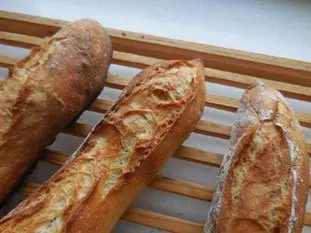
This classic of French baking is rather different from the recipe for leavened bread, it's a question of making a good crust and light crumb along the whole length. To succeed, you should know that there are two secrets: water first of all (much more than for normal bread), and the working of the dough, which is also very different.
Last modified on: October 24th 2017
Keywords for this recipe:For 6 baguettes, you will need:
- 1
 1 kg plain white flour (French Type 65)
 - 2
 550 ml water
 - 3
 18 g salt
 - 4
 250 g leaven
 - 5
 7 g yeast
 - Total weight: 1,825 grams


How long does it take?
Time required for this recipe:
| Preparation | Resting | Cooking | Start to finish |
|---|---|---|---|
| 41 min. | 4 hours 5 min. | 20 min. | 5 hours 6 min. |
At what time:
- When will I finish if I start the recipe at ... ?
When should I start for the recipe to be ready at ... ? - Work this out...
Step by step recipe
Stage 1
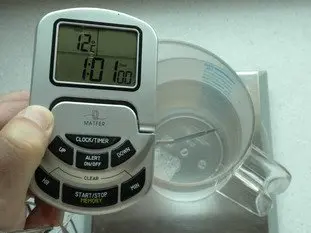
In bread-making, the water temperature is always important. It's not a fixed value, but related to 3 other temperatures: 1) the temperature of your flour, 2) the room temperature in your kitchen, and 3) the basic temperature of this recipe, which is 56-60°C.
You can calculate the temperature of the water for this recipe in one click, using this small calculator.
You can calculate the temperature of the water for this recipe in one click, using this small calculator.
Stage 2 - 7 min.
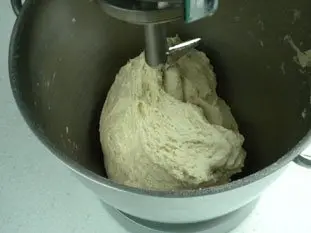
Put in the mixer bowl 1 kg plain white flour (French Type 65) and 550 ml water.
Knead for 5 minutes at minimum speed, to well mix water and flour.
Note: For the best way to knead, see: A few tips for effective kneading at home.
Knead for 5 minutes at minimum speed, to well mix water and flour.
Note: For the best way to knead, see: A few tips for effective kneading at home.
Stage 3 - 1 hour
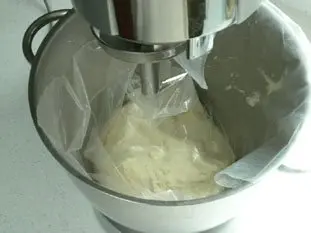
Cover with a plastic sheet and let stay for 1 hour.
Stage 4 - 10 min.
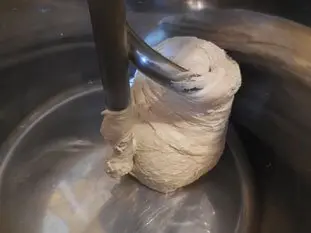
After this time, add 18 g salt, 250 g leaven and 7 g yeast.
Knead for about 10 minutes, ideally dough should be at the end of kneading at 73°F (23°C), or better try the window-pane test.
Knead for about 10 minutes, ideally dough should be at the end of kneading at 73°F (23°C), or better try the window-pane test.
Stage 5 - 1 hour 30 min.
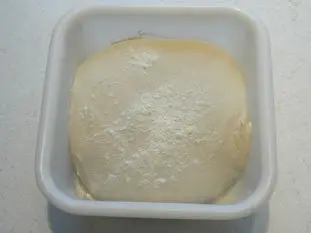
Put the dough, roughly shape in ball, in a plastic container, covered with a plastic sheet, and let stay for 1h30.
Stage 6 - 3 min.
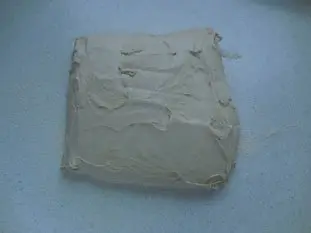
After this time, pour the dough on your working surface...
Stage 7 - 10 min.
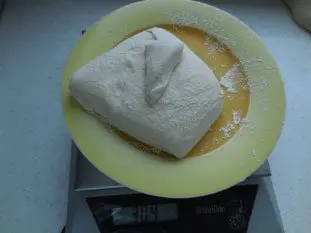
...and scale pieces of 300 grams.
Note: if you plan to make half-size baguettes, you should scale 150g pieces instead.
Note: if you plan to make half-size baguettes, you should scale 150g pieces instead.
Stage 8 - 15 min.
Shape pieces of dough in balls, like in this short video on the right.
Stage 9 - 15 min.
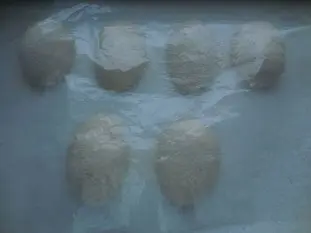
Let stay dough lumps on your working surface for 15 minutes, covered with a plastic sheet.
Stage 10 - 15 min.
From lumps, shape baguettes as shown in this video.
Stage 11
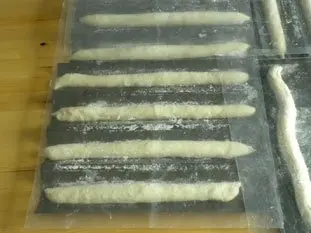
If you use baguettes moulds, put lumps directly in, cover with plastic sheets and let stay for 1 hour.
Stage 12 - 1 hour
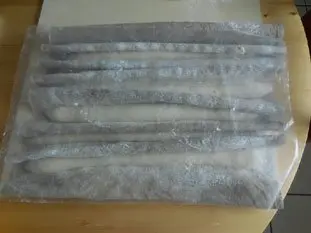
If you don't have moulds, put lumps on floured linen, then cover with plastic sheets and let stay for 1 hour.
Stage 13 - 1 min.
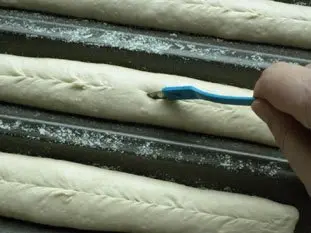
Preheat your oven at 460°F (240°C), slash top of lumps...
Stage 14 - 20 min.
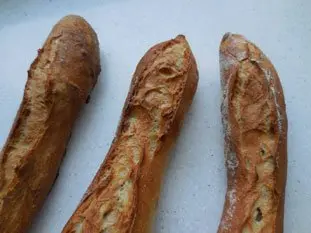
...and put in the oven for about 20 minutes.
Note: As when baking any bread, you should ensure that the oven is filled with steam for the first 15 minutes of baking. This page shows you how; it really is the secret of golden-brown, crusty loaves..
Note: As when baking any bread, you should ensure that the oven is filled with steam for the first 15 minutes of baking. This page shows you how; it really is the secret of golden-brown, crusty loaves..
Stage 15

You will really appreciate the very light crumb and the crunch of the crust...
Stage 16
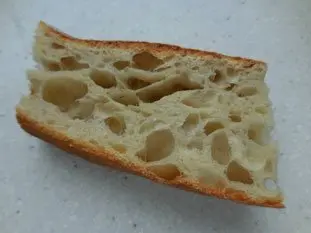
...of good French baguettes.
Remarks
You can make baguettes as for other bread: plain or with different flours, or with added seeds, grains, etc.
If you want more information about making your own bread, you can look at this dedicated page.
If you want more information about making your own bread, you can look at this dedicated page.
Keeping
For the crunchy, only a few hours, but can easily be froozen.
Source
From Thomas marie.
Nutritional information
| Whole recipe | |||
|---|---|---|---|
| Energetic value | Proteins | Carbohydrates | Fats |
| 3,681 Kcal or 15,412 Kj | 113 gr | 845 gr | 18 gr |
| 184 % | 43 % | 80 % | 3 % |
| Per 100 g | |||
|---|---|---|---|
| Energetic value | Proteins | Carbohydrates | Fats |
| 202 Kcal or 846 Kj | 6 gr | 46 gr | 1 gr |
| 10 % | 2 % | 4 % | <1 % |
| Per baguettes | |||
|---|---|---|---|
| Energetic value | Proteins | Carbohydrates | Fats |
| 614 Kcal or 2,571 Kj | 19 gr | 141 gr | 3 gr |
| 31 % | 7 % | 13 % | <1 % |
How much will it cost?
- For 6 baguettes : 2.13 €
- Per baguettes : 0.36 €
Note: Be careful, these prices are only an estimate, you can consult the table of prices by ingredients used for this estimate.
Some recipes that use this recipe

Mini cheese and mustard toasts
For an aperitif snack with a difference, try these little toasted slices of baguette topped with cheese and mustard. Easy to make and can be served in a jiffy.
56K 24 min.
Seb's Italian-style aperitif slices
These Italian-inspired snacks are ideal for a light supper or with an aperitif: a thin slice of bread spread with pesto, sliced potatos, hard-boiled egg and a generous sliver of Parmesan. Pop them in the oven just long enough to melt the cheese.
17K 49 min.

Bisto-style canapés
This recipe captures the hearty and slightly raffish style of French bistro cuisine: fried rounds of baguette with egg, fried ham and a topping of melted cheese.
25K 39 min.

Smoky canapés
These tasty morsels combine the freshness of a pistachio and spinach pesto with the smoky flavours of Morteau sausage and cheese. They make original aperitif snacks or starters.
17K 50 min.
Bistro sandwich
The filling for this indulgent baguette sandwich is made with hard-boiled eggs and cold meat in a rémoulade dressing.
38K 18 min.
This recipe uses (among others)
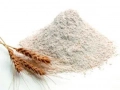 | Plain white flour (French Type 65): You can get more informations, or check-out other recipes which use it, for example: Roscoff loaf, Bacon rolls, Jura bread, Ali Baba bread, Cretan Bread, ... All |
 | Water: You can get more informations, or check-out other recipes which use it, for example: Cooking sugar, Langoustine gratin, Two-olive ciabatta, Special small breads, Toffee apple upside-down cake, ... All |
 | Leaven: You can get more informations, or check-out other recipes which use it, for example: Franche-Comté sticks, Jura bread, Seeded loaf, Yeast-based flaky dough (for croissants), Pogne de Romans, ... All |
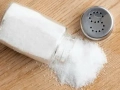 | Salt: You can get more informations, or check-out other recipes which use it, for example: Escalope of veal in a cream sauce, Eggs en Cocotte à la Française, Endive and walnut salad, Fish terrine with spinach and tomatoes, Scrambled eggs (Oeufs brouillés), ... All |
Other recipes you may also like
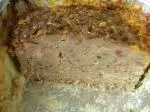
Pâté de campagne
Here is a personal version of the famous country pâté. It's an interesting recipe to prepare in large quantities because it keeps well and freezes easily. The secret of a good pâté is of course the ingredients, but also how it is cooked.2.0M 23.7 7 hours 54 min. October 3rd 2019

Soft fruits in sabayon
This recipe is made by briefly cooking an assortment of soft fruits (raspberries, blackcurrants, blackberries, blueberries, currants...) with a little sugar to glaze them. They are served in a small dish, covered with a delicious sabayon which can be lightly "burned" on surface.257K3.9 46 min. February 21th 2011
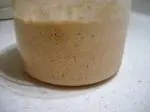
Natural leaven
Leaven is a natural raising agent, a fermented mixture of water, flour and the microscopic yeasts which are present in the air. It's a delicate living substance, sensitive to the external environment. The recipe is around 4000 years old and dates back to the Egypt of the Pharaohs, via a beautiful...1.7M 304.0 7 days 15 min. April 3rd 2020
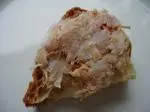
Potted meat (rillettes)
Potted meat (rillettes) is cooked long and slow in fat. Rillettes can be of pork or duck. Here is the pork version.423K 25 6 hours 46 min. October 3rd 2019
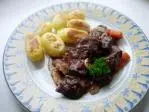
Boeuf (beef) bourguignon
Bœuf bourguignon is a traditional recipe of French cuisine (bourguignon means from Burgundy). It's chunks of meat cooked slowly with bacon, onions, carrots and mushrooms in red wine.460K 32.5 4 hours 20 min. February 21th 2011
News list of cooking-ez.com
Sign up to receive the latest recipes (next batch due to be sent on 2024-04-28)
Note: We'll never share your e-mail address with anyone else.
Follow this recipe (as 23 people already do)
If you are interested in this recipe, you can "follow" it, by entering your email address here. You will then receive a notification immediately each time the recipe is modified or a new comment is added. Please note that you will need to confirm this following.
Note: We'll never share your e-mail address with anyone else.
Alternatively: you can subscribe to the mailing list of cooling-ez.com , you will receive a e-mail for each new recipe published on the site.
That's OK too for instant yeast, but reduce weight of yeast by 25-50% in this case.
Can I use instant yeast to replace fresh yeast?
It was noisy indeed but so much fun, that's why I'd like to try making the baguette with this method :)
And thank you for the info about Respectus pannis! Very interesting. I understand that we could just leave the dough resting with very little kneading and it would turn out just fine but I'm surprised to read that this new movement really does rely on a very long resting time and a very little levain...
I just received Manitoba and T65 flours; might try both your baguette and bread with respectus pannis system this weekend. Merci bcp JH!
According to that, there is in the French bakery a new movement that is growing up, for a different way of making bread: less salt, less kneading, less yeast or leaven, but much more resting time at almost ambient temperature (16-18°C), it's called "Respectus pannis" if you want to check out.
I come with another question; instead of using a mixer/kitchen machine, can I use Bertinet's method (slap&fold) to knead the dough?
I understand that it will take longer than using a machine, but is it possible?
I will try your baguette recipe this weekend. Super excited!
It is, but please notice that's a different way that using leaven to make bread.
Keeping a part of your dough, in the fridge for one night, and using it in your daily dough (usually 10-20% of the weight of normal dough), is a way of making bread.
Using leaven in your dough (and in that case soured dough is useless) is another one, and different.
Using soured dough is easier, but less tasty than using leaven.
Have fun in bakery!
I also heard that you can keep a portion of your old dough as 'soured dough' and add it when you are making a new batch of baguette dough and this will enhance your dough.
Is that true?
If I'm using your recipe for 3 baguettes (500 gr) flour, how many soured dough should I keep/add from the previous batch?
Thank you again JH!
Yes, you can.
Can I still use it for the recipe without changing the weight measurement?
Thank you!
For this recipe you could start by a French one (50%), and see what you got?
Yes, you can add seeds (very good idea btw) , about 20% of the weight of flour. Check out this recipe for some advices: seeded loaf.
I would like to add some seeds, but how many grams and do I have to add more water?
Merci beaucoup!
The old one was coming from the web, and the new one from a great French baker who teach me.
Where the old one came from? Actually I saw a french baker in Youtube ising that method, playing the dough in a big plastic box. Is that method a traditional one?
Salut!
Sorry, no, but this one is much better and give tastier baguettes.
I was using the old version, could youpls keep it for reference? thanks!
Here's a new version of the recipe, more simple and more efficient.