New leavened bread
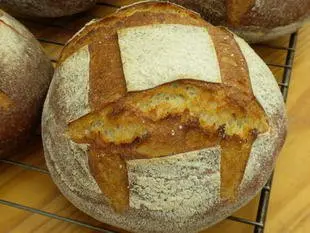
This new recipe for leavened bread is simple and delicious, but needs rather long resting times.
If you'd like more more information about making your own bread, look at this dedicated page.
If you'd like more more information about making your own bread, look at this dedicated page.
Last modified on: December 30th 2019
Keywords for this recipe:For 2 loaves, you will need:
- 1
 1 kg plain white flour (French Type 65)
 - 2
 550 ml water
 - 3
 18 g fine (or table) salt
 - 4
 500 g leaven
 - 5
 2 g yeast
 - Total weight: 2,070 grams


How long does it take?
Time required for this recipe:
| Preparation | Resting | Cooking | Start to finish |
|---|---|---|---|
| 50 min. | 5 hours 30 min. | 40 min. | 7 hours |
At what time:
- When will I finish if I start the recipe at ... ?
When should I start for the recipe to be ready at ... ? - Work this out...
Step by step recipe
Stage 1 - 5 min.
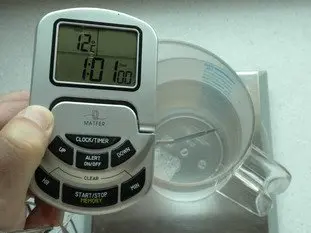
In bread-making, the water temperature is always important. It's not a fixed value, but related to 3 other temperatures: 1) the temperature of your flour, 2) the room temperature in your kitchen, and 3) the basic temperature of this recipe, which is 56-60°C.
You can calculate the temperature of the water for this recipe in one click, using this small calculator.
You can calculate the temperature of the water for this recipe in one click, using this small calculator.
Stage 2 - 5 min.
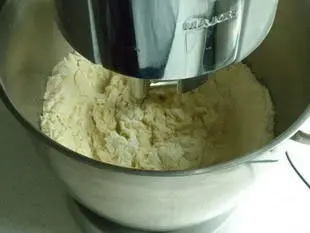
Put into the mixer bowl just 1 kg plain white flour (French Type 65) and 550 ml water at the right temperature.
Knead at minimum speed for 3 minutes.
Knead at minimum speed for 3 minutes.
Stage 3 - 1 hour
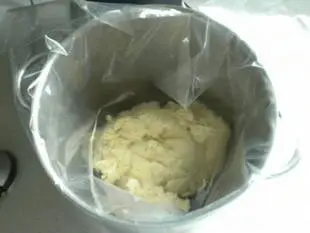
Leave the dough in the mixer, cover with a plastic sheet, and leave to rest for 1 hour.
Stage 4 - 3 min.
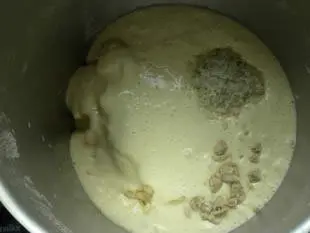
Stage 5 - 10 min.
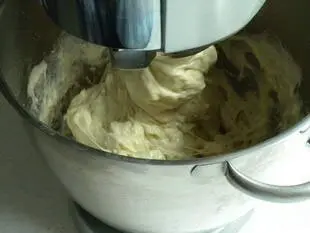
Knead at minimum speed for 10 minutes.
Note: For the best way to knead, see: A few tips for effective kneading at home.
Note: For the best way to knead, see: A few tips for effective kneading at home.
Stage 6
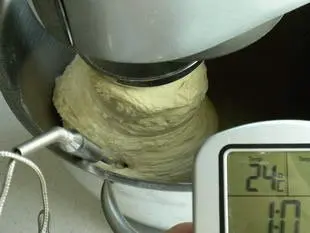
After kneading, you can check the temperature of the dough, which should be 75°F (24°C), or better try the window-pane test.
Stage 7 - 3 min.
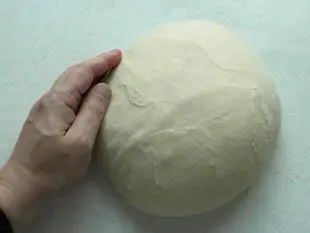
Turn the ugh out onto the worktop and gather into a rough ball.
Stage 8 - 2 hours
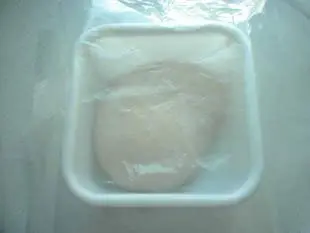
Put the dough into a large floured bowl.
Cover with a plastic sheet, and leave to rest in a warm place for 1.5 to 2 hours.
Cover with a plastic sheet, and leave to rest in a warm place for 1.5 to 2 hours.
Stage 9 - 3 min.
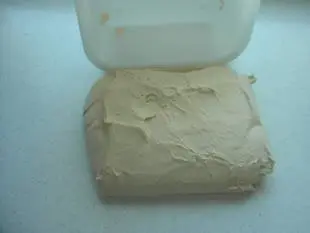
After resting, tip the dough onto your worktop.
Stage 10 - 10 min.
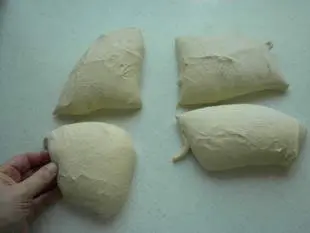
Divide into lumps of 500 grams (small loaves) or 1 kilo (large loaf).
Stage 11 - 30 min.
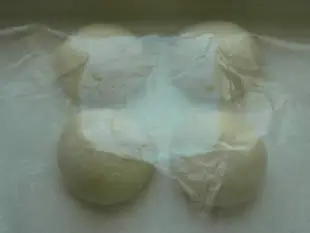
Shape each lump of dough into a ball, cover with a plastic sheet and leave to rest for 30 minutes.
Stage 12 - 5 min.
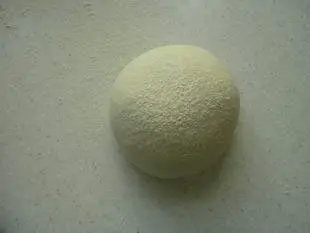
Press the dough flat again before shaping into round or long loaves.
Stage 13 - 3 min.
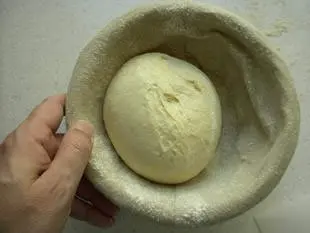
Put into floured bannetons (rising baskets).
Stage 14 - 2 hours
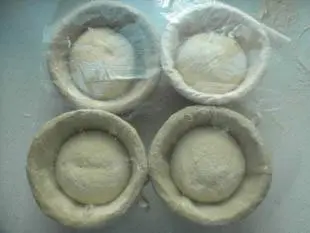
Cover with a plastic sheet and leave to rest for 2 hours.
Stage 15
As these actions are rather difficult to describe, you can watch this short demonstration video on the right.
Stage 16 - 3 min.
Preheat the oven to 240°C or 464°F.
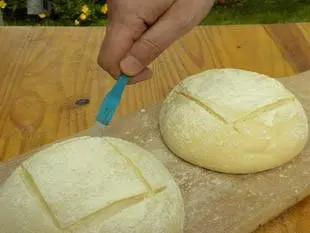
Dust each loaf with flour, then turn it over onto the peel (bread oven "shovel") and slash it across the top.
Dust each loaf with flour, then turn it over onto the peel (bread oven "shovel") and slash it across the top.
Stage 17 - 40 min.
Put in the for approximately 40 minutes (check near the end of cooking time).
Note: As when baking any bread, you should ensure that the oven is filled with steam for the first 15 minutes of baking. This page shows you how; it really is the secret of golden-brown, crusty loaves..
Note: As when baking any bread, you should ensure that the oven is filled with steam for the first 15 minutes of baking. This page shows you how; it really is the secret of golden-brown, crusty loaves..
Remarks
If you can, try a slow rising by replacing the last 2 hours of resting (stage 8) by 10 hours at 50°F (10°C).
If you'd like more information on making your own bread, you can consult this special page.
Many of you are puzzled by the presence of yeast in a leaven-raised bread. Here is a little clarification of the matter:
The yeast is there to make things easier; for a beginner leaven-raised bread is not easy to get right, especially first time. This is why these few added grams of yeast help. The dough rises more easily, even if your leaven is not at its best, and it makes a lighter crust.
There's nothing shocking in this. You should be aware that even some commercially produced breads advertised as "leavened", also contain a little (more) yeast, for similar reasons, and it's perfectly legal.
In any case, there's no reason to be worried about yeast; it's not a chemical product. It too is a living organism, and it's not added to work against the leaven, rather something you can use alongside if you wish. Being able to proclaim proudly, "I don't use any yeast!" is, in my humble opinion, rather overrated.
That said, adding a little yeast does have one slight drawback, in that it dulls the flavour of the bread somewhat. If you want to make leavened bread for its characteristic flavour, you'll lose a little, even with a small quantity of yeast.
In conclusion, I advise the following approach: if you are just starting out, add a little yeast. Then, once you have mastered the basics and can produce good bread, leave it out. You can then compare both methods and choose.
If you'd like more information on making your own bread, you can consult this special page.
Yeast in leaven-raised bread?
Many of you are puzzled by the presence of yeast in a leaven-raised bread. Here is a little clarification of the matter:
The yeast is there to make things easier; for a beginner leaven-raised bread is not easy to get right, especially first time. This is why these few added grams of yeast help. The dough rises more easily, even if your leaven is not at its best, and it makes a lighter crust.
There's nothing shocking in this. You should be aware that even some commercially produced breads advertised as "leavened", also contain a little (more) yeast, for similar reasons, and it's perfectly legal.
In any case, there's no reason to be worried about yeast; it's not a chemical product. It too is a living organism, and it's not added to work against the leaven, rather something you can use alongside if you wish. Being able to proclaim proudly, "I don't use any yeast!" is, in my humble opinion, rather overrated.
That said, adding a little yeast does have one slight drawback, in that it dulls the flavour of the bread somewhat. If you want to make leavened bread for its characteristic flavour, you'll lose a little, even with a small quantity of yeast.
In conclusion, I advise the following approach: if you are just starting out, add a little yeast. Then, once you have mastered the basics and can produce good bread, leave it out. You can then compare both methods and choose.
Keeping
Several days in a linen bag.
Source
From Thomas Marie of INBP.
Nutritional information
| Whole recipe | |||
|---|---|---|---|
| Energetic value | Proteins | Carbohydrates | Fats |
| 3,782 Kcal or 15,834 Kj | 121 gr | 936 gr | 20 gr |
| 189 % | 46 % | 88 % | 3 % |
| Per 100 g | |||
|---|---|---|---|
| Energetic value | Proteins | Carbohydrates | Fats |
| 183 Kcal or 766 Kj | 6 gr | 45 gr | 1 gr |
| 9 % | 2 % | 4 % | <1 % |
| Per loave | |||
|---|---|---|---|
| Energetic value | Proteins | Carbohydrates | Fats |
| 1,891 Kcal or 7,917 Kj | 60 gr | 468 gr | 10 gr |
| 95 % | 23 % | 44 % | 2 % |
How much will it cost?
- For 2 loaves : 2.29 €
- Per loave : 1.15 €
Note: Be careful, these prices are only an estimate, you can consult the table of prices by ingredients used for this estimate.
This recipe uses (among others)
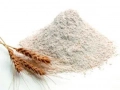 | Plain white flour (French Type 65): You can get more informations, or check-out other recipes which use it, for example: Mustard baps, Cretan Bread, Olive and pesto bread, Benoîton, Jura bread, ... All |
 | Water: You can get more informations, or check-out other recipes which use it, for example: Pitta bread, Sugar syrup, Aperitif rolls, Rum babas, Valay-Brest, ... All |
 | Leaven: You can get more informations, or check-out other recipes which use it, for example: Sandwich bread, Seeded loaf, Pogne de Romans, Jura bread, Saucipain, ... All |
 | Fine (or table) salt: You can get more informations, or check-out other recipes which use it, for example: Crackers, Spicy hot toasted cashew nuts, Cubed salad, Cramique, Kugelhof for Nanou, ... All |
Other recipes you may also like
Natural leaven
Leaven is a natural raising agent, a fermented mixture of water, flour and the microscopic yeasts which are present in the air. It's a delicate living substance, sensitive to the external environment. The recipe is around 4000 years old and dates back to the Egypt of the Pharaohs, via a beautiful...1.7M 304.0 7 days 15 min. April 3rd 2020

Mexican ceviche
Ceviche is typical of South American cuisine, made with avocados, tomatoes and fish fillet cured in lime juice. This is a personal version of Mexican-style ceviche.351K 15 3 hours 9 min. October 13th 2010
How to cook pasta properly
Here is some advice for pasta that's properly cooked and doesn't stick.1.1M4.4 22 min. July 18th 2019

Gratin Dauphinois
This recipe is a bit sensitive for people from Dauphiné (a French area around the city of Grenoble), many of them are sure to have the "true" recipe. Here is the version of the famous French chef Michel Guérard. The most interesting thing about gratin Dauphinois, is that it has a delicate hint of...380K 25 1 hour 3 min. August 13th 2016

Liège waffles
Liège waffles have a very distinctive texture: quite dense with the crunch of sugar crystals. They also have a characteristic form: round and fairly small. Then there's that special flavour that comes with the delicious light caramel crust.249K5 1 hour 55 min. July 12th 2011
News list of cooking-ez.com
Sign up to receive the latest recipes (next batch due to be sent on 2024-04-28)
Note: We'll never share your e-mail address with anyone else.
Follow this recipe (as 10 people already do)
If you are interested in this recipe, you can "follow" it, by entering your email address here. You will then receive a notification immediately each time the recipe is modified or a new comment is added. Please note that you will need to confirm this following.
Note: We'll never share your e-mail address with anyone else.
Alternatively: you can subscribe to the mailing list of cooling-ez.com , you will receive a e-mail for each new recipe published on the site.
I have just finished a deep improve of the recipe, more simple, more tasty, I'm sure you'll enjoy it!