Chive flowers


Chive flowers
Did you know that? Chive flowers are not only a beautiful purple color, but they are also edible and delicious.
48 K 4.4/5 (36 reviews)
Grade this page:
Keywords for this post:FlowersChivesSaladEdible
Last modified on: May 29th 2019
For this post: Comment Follow Ask me a question Send to a friend
Chive flowers
If you have a chive plant in your garden or on your balcony (which is a very good idea, by the way) you should be seeing beautiful purple flowers like this one as I write this:

fleur de ciboulette


The stem of these flowers is very hard, but the flower itself consists of small heads that can be easily detached by pulling on them.
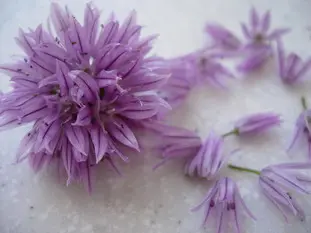
sommités de fleur de ciboulette


It is not at all obvious, but these chive flowers can be eaten, and better than that, they bring a delicious fresh and garlicky taste that goes perfectly with a salad for example.

Moreover, their pretty mauve color is also a decorative asset, they make very well by bringing a note of color which makes its small effect in the salads already mentioned but also for, for example, the decoration of a fish fillet just before the service to your guests.
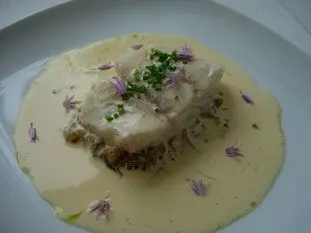
Pavé de poisson à la vapeur de romarin


Two drawbacks to this mini concert of praise: 1) systematically throw away the stem, which although green is tasteless and very hard and 2) flowers like chives do not like cooking, where they quickly lose all their taste, hence the preference for dishes without cooking, or adding just when serving.
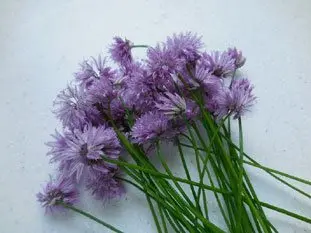
tiges des fleurs de ciboulette


To sum up: Use chive flowers for taste and/or decoration of your dishes, preferably without cooking.
Lasts posts
Butter vs. grease
Butter vs. grease
We often read in a recipe where a pastry is put into a mould that, just before pouring, the mould should be buttered or greased. But what's the difference between these 2 terms?
December 1st 20254575
Getting out of the fridge early
Very often when you're cooking, you need to take food or preparations out of the fridge, to use them in the recipe in progress. There's nothing tricky about this: you just take them out of the fridge and use them, usually immediately, in the recipe. But is this really a good method?
November 24th 20258935
Who's making the croissants?
When you look at a bakery from the outside, you naturally think that in the bakery, the bakers make the bread, and in the laboratory, the pastry chefs make the cakes. It's very often like that, with each of these professions having quite different ways of working, but sometimes there's also one...
November 23th 2025790
Oven height
Oven height
When we put a dish or cake in the oven, we naturally tend to put it on the middle shelf, and that's what we usually do. But in some cases, this position and height can be a little tricky, so let's find out why.
October 8th 20252,3655
The importance of sieving
In recipes that use a fine powder (flour, powdered sugar, etc.), you'll often see the advice to sift before using it. To sift is to pass the powder in question through a sieve (a very fine strainer) before incorporating it into your recipe. It's often advice, but is it really useful?
September 3rd 20257,2963

Other pages you may also like
The baker always gild twice
I've already told you about gilding, the beaten whole egg that is spread with a brush on anything that needs to brown in the oven: puff pastry, pastries, etc. and that professionals use a lot, I'm going to come back to this to clarify a bit how to do it, and give you a professional tip.
June 9th 201935 K4.2
What can I use for blind baking a pastry case?
When it comes to home-made desserts, tarts are always popular. They can be divided into two basic types: those cooked with their filling, such as an apricot and almond cream tart, and those where the filling is added after baking the pastry case, such as a strawberry tart or chocolate tart. For...
May 2nd 2017112 K4.5
Tranché, dissociated, failed, in short... missed!
When preparing a sauce or a cream, there's always a (small) risk that the creamy preparation you're working on will suddenly separate into two parts of different textures: a liquid part, for example, and a more or less solid part, or even become lumpy. It's terribly frustrating, but we'll see...
June 19th 202312 K5
Should I believe my oven?
Can you really trust your oven? This is an important question as we are always tempted to take the temperature indicated as gospel truth and, unfortunately, this is rarely very precise. .
July 4th 201132 K4.6
Artichoke stalks
Artichoke stalks
When preparing artichokes for cooking, you may well already know that we often need to remove the first round of leaves, if they are tatty or dirty, as well as the inedible stalk. The operative word here is “remove” , rather than “cut off”.
October 25th 201653 K4.3
Post a comment or question
Posted by:
I am not a leaving thing

Follow this page
If you are interested in this page, you can "follow" it, by entering your email address here. You will then receive a notification immediately each time the page is modified or a new comment is added. Please note that you will need to confirm this following.
I am not a leaving thing
Note: We'll never share your e-mail address with anyone else.
Alternatively: you can subscribe to the mailing list of cooling-ez.com , you will receive a e-mail for each new recipe published on the site.

Back to top of page