Flours
On this page: Overview - Types - Some examples - It's so complicated... - Where to buy flour?
Other pages: Follow this page - Back to homepage
Overview
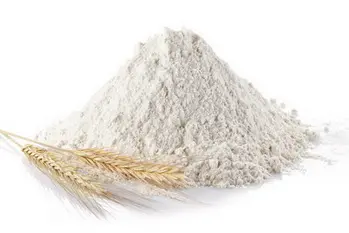
At the most basic level, wheat grain is put through a mill, which produces a white-ish powder flour... Well, actually it's not quite that simple.![]() | ![]() |
First of all we need to distinguish between the different grains that can be made into flour: wheat of course, but also rye, barley, buckwheat, etc. So we use "flour" (pure and simple) to mean wheat flour, then talk of rye flour, barley flour, buckwheat flour, chestnut flour, etc.

Then a further distiction is made according to how much of the outside of the grain (bran) is left in. The purest, whitest flour (but not inevitably the best), contains only the inner part of the grain, the others contain a variable proportion of bran, right up to whole: wholemeal flour.
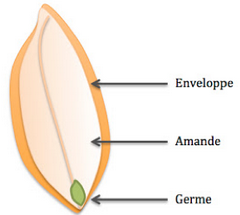
In France this proportion of bran included is indicated by a type (T). This number indicates the ash ratio of the flour, the proportion of minerals remaining after the flour has been burned at 900°C. The higher this number is, the higher the proportion of bran there is in the flour.
At the lower end there is Type 45 flour (T45), this is the purest white flour, mainly used for patisserie, then Type 55 (T55) used for bakery, then T65, T80, etc...
![]() | ![]() |
A third distinction can be made according to the milling method. If nothing is indicated, it means that the flour has beeen made by industrial steel mills. If it's labelled "de meule" (stone-ground) it means that the flour has been ground using real millstones which give it a special flavour (and price, which is to be expected).
In addition, "organic" quality ensures that flour is of high quality, without chemical products used on the grain, or added after milling.
Types
This table summarises the main types of flour and their uses:| Type | Called | Usage |
|---|---|---|
| 45 | Cake/Pastry | Cakes and pastries |
| 55 | White | Bread |
| 65 | White | Bread, Type 65 "tradition" without added ascorbic acid. |
| 80 | Brown | Brown bread |
| 110 | Wheatmeal | Brown and speciality breads |
| 180 | Wholemeal | Wholemeal and speciality breads |
Some examples
T45 Flour: white wheat flour, usually reserved for patisserie (cakes, fancy pastries).T65 "Tradition" flour: special French government-regulated flour, used for normal French loaves and baguettes.
T55 "de force" (strong) flour: special flour with high gluten content which rises well, for viennoiseries (croissants, brioches, ...)
T80 "de meule" (stone-ground) flour: Wheat flour milled with traditional millstones.
T150 organic rye flour: Whole rye flour produced to organic standards.
It's so complicated...
Yes, as you can see it's a professional classification system and beginners can get lost in the jungle of numbers. To avoid that, in answer to the question "Which flour should I use?" we can summarize simply as follows:- I'm making a cake or pastry: use T45 if possible, otherwise T65 is fine
- I'm making bread: use T55 minimum, ideally T65 up to T80.
- I'm making a speciality bread: use T80 and above.
[Translator's note: Both the UK and USA use "strong" flours for breadmaking. French flour grades do not correspond exactly to UK types, but are at least fairly close the the US percentage system for "soft" flours.]
Where to buy flour?
As soon as you need a flour that's a little out of the ordinary, it's difficult to find it in the local supermarket. The best way is to look in yellow pages to find flour-mills, then call to find out if they will supply to individual customers (See about that my best addresses page). This is ofen the case now because of the widespread use of bread-making machines.You may well be able to buy a range of several different flours at cheap prices, and if you're lucky you can chat with the miller, which is always a good and instructive experience.
If you're in the department of Finistère in Brittany (France), try to visit the mill in Lanhouarneau, or Mr. Siohan in Coat-Meret. This man is a real encyclopaedia about milling, flour and grain, and the mill is impressive.
Last modified on: October 23th 2012
Your 23 comments or questions on this page:
I would like to use a french recipe for pains a semoule et carottes, semoule being semolina. In the list of ingredients, however, there is no mention of 'semoule, the main ingredient is T65 flour. Are they the same flour?
Comment #1 posted on january 6th 2011 at 12:35 by pam.eastham@gmail.com.
No they rae different: semoule or semolina is made of very smalls grains of hard wheat powder, and T65 is flour.
Strange recipe without one of the main ingredient listed?
Comment #2 posted on january 6th 2011 at 17:09 by jh.
I found your information about flour very useful. I live in France and am adjusting my recipes from using UK flour to French flour with varying results. I used T45 (all purpose) for short crust pastry for use in Quiches or Pies but found that the pastry had risen?? But the taste and texture excellent. I would appreciate your comments on this. I am also having difficulty english recipe cakes too. Is it possible to obtain the equivalent of Uk plain flour in France? Your advice would be appreciated.
Comment #3 posted on may 26th 2011 at 06:47 by Whie Mist.
To prevent pastry from rise, you should pick it with a fork when in his mould, before furnish it or put in the oven. The steam made by the heat of the oven could go away by the small holes and so not make bubbles.
If you plan to cook a crust alone (in French "à blanc") it's more efficient because pastry could not rise with the weight of lentils (or anything else you use) on top.
Unfortunately I'm not easy with UK plain flour, but I guess it's a matter of "T", T45 seems to be a French exception, so you could try a T55 instead?
Comment #4 posted on may 26th 2011 at 07:10 by jh.
Hi, just to clarify things, can i also put baking powder (levure) in T45 flour for cakes? Thanks
Comment #5 posted on june 23th 2011 at 00:09 by Anonymous.
Hi, yes you can, no problems.
Comment #6 posted on june 26th 2011 at 08:29 by jh.
Hello...
Can any one help me by providing me the Specifications of Flour T-80 "de meule" (stone-ground) flour.
Comment #7 posted on november 19th 2011 at 10:02 by G.K.
I live in France and am looking for a suitable flour to make pizzas. Any suggestions?
Comment #8 posted on november 20th 2011 at 15:09 by marty.
You can easily found T55 or better T65 in many shops in France
Comment #9 posted on november 20th 2011 at 16:13 by jh.
Hi, many thanks for the speedy reply. Am using a T65 with a Paul Hollywood recipe for great white bread. Can get different types of flour here (incl T65) a few kilometres away straight from a working water mill. Will explore. Thanks again.
Comment #10 posted on november 20th 2011 at 16:27 by marty.
No offence intended - just that I got the PH recipe before I found this great site. Have been looking at the traditionelle flours available here and have found ble noir. Any ideas?
Comment #11 posted on november 21th 2011 at 12:40 by marty.
Hi have been in france now for 5yrs and have always found the flour confusing so thank you for your time and trouble you go to to help us all
Comment #12 posted on november 21th 2011 at 18:55 by blip.
@marty : Be careful with blé noir, it's not really a flour for bread or cake, it's mostly use for special, salted, pancakes called "galettes".
You can also use it in breads or cakes, but always in addition with classical flour and in small proportions (something like 20% of ble noir only).
Comment #13 posted on december 4th 2011 at 14:57 by jh.
Many thanks for your comments jh.
Comment #14 posted on december 7th 2011 at 10:13 by marty.
i want to use the equivelant to english plain flour in france so confused with the flour in france
Comment #15 posted on april 30th 2012 at 14:44 by sandra.
I guess it's T55, but I'm not sure, anyone else ?
Comment #16 posted on may 1st 2012 at 10:41 by jh.
I leav in france i want to make wheat chapathis so plz tel me the flour name in french.
Comment #17 posted on july 2nd 2012 at 15:17 by shilpa.
It's "farine complète"
Comment #18 posted on july 9th 2012 at 19:28 by jh.
Thanks a lot it is very helpful i have tried the french recipe of croissant but it did not go well since i took the cake flour by lake of knowlegde i did not know that T55 meant white bread flour... Thank you!
Comment #19 posted on september 1st 2012 at 07:44 by Happiness.
You're welcome!
By the way, the french croissants and chocolate rolls recipe on this site is going to be deeply modified, in September: more technical but also better results, like professional bakers (or almost).
Comment #20 posted on september 1st 2012 at 10:28 by jh.
Does anyone know what the flour equivalent for the French "farine T150" is in Ireland and the UK?
Comment #21 posted on september 6th 2012 at 15:27 by Anonymous.
Maybe whole-wheat?
Comment #22 posted on september 7th 2012 at 13:52 by Lucy.
What is the UK equivilent of T45?
Comment #23 posted on december 31th 2012 at 11:27 by scullery maid.
Post a comment or question:
Follow this page
Recipes: My EZ Cooking: | Know How: All about this site: | Do-it-yourself: Miscellanous: Contacts: |