This site uses only a few technical cookies necessary for its operation. By continuing to browse, you accept their use.
To find out more...
To find out more...
Cleaning endives
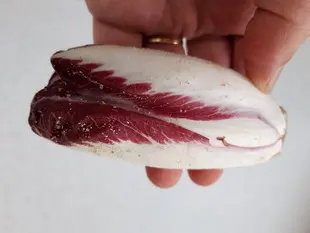
If you buy your endives elsewhere than in supermarkets, and in this case the best is of course from a market gardener, he or she is the one who planted and harvested them, in this case you will have endives full of earth or sand, depending on where they were grown, which is normal and reassuring, we know where they come from.
How to wash/clean them efficiently? That's what we'll see in this post.
How to wash/clean them efficiently? That's what we'll see in this post.
28 K 4.6/5 (18 reviews)
Keywords for this post:EndivesCleaningSoilSandAdviceLast modified on: March 24th 2020
Cleaning endives
When it comes to cleaning, the classic way is to cut the base, then remove the leaves from around the endive, until you have a very clean vegetable. Classic, but not great, the loss is important, especially if the endive comes from the sand, you have to remove a lot of leaves (too many), to have one ready to be used in a recipe.
Can we do better?
Yes, it is better to wash it in fact, before trimming it, but this washing should not be done like for another vegetable, by soaking them in water for example. On the contrary, on the one hand they get waterlogged if you do that, but on the other hand a small part of the sand that was on the turn will end up in the endive, and when tasted it will crunch under the tooth very unpleasantly.
No, here's the thing, in fact it's better to proceed like this: Run a trickle of warm water from the tap, and put the endive underneath one by one, with the head down, like this:
This way, the sand goes into the sink, the endive does not get waterlogged, and the peeling after drying with a cloth, will consist in removing 1 or 2 leaves from the turn, not more, or even none.
You will note that on the photographs they are red endives, with the season alas even shorter, but which are less bitter than the yellow ones, and of a superb esthetics which make it possible, inter alia, to make a little of decoration in your receipts/plates at little expenses.
One last point about the plastic endive from the supermarket, you have probably noticed that they are absolutely clean, not a grain of sand or dirt. Is it normal knowing that it comes from the earth or sand? To look like this on the shelves, you have to imagine that they must have received a shock treatment, probably not neutral, which have scoured them, or even more. In short, trust your local grower who plants locally.
To sum up: Wash your endives under a trickle of warm water, upside down, before drying them and trimming them.
Can we do better?
Yes, it is better to wash it in fact, before trimming it, but this washing should not be done like for another vegetable, by soaking them in water for example. On the contrary, on the one hand they get waterlogged if you do that, but on the other hand a small part of the sand that was on the turn will end up in the endive, and when tasted it will crunch under the tooth very unpleasantly.
No, here's the thing, in fact it's better to proceed like this: Run a trickle of warm water from the tap, and put the endive underneath one by one, with the head down, like this:
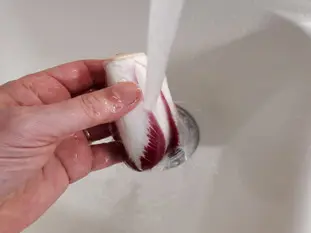
This way, the sand goes into the sink, the endive does not get waterlogged, and the peeling after drying with a cloth, will consist in removing 1 or 2 leaves from the turn, not more, or even none.
You will note that on the photographs they are red endives, with the season alas even shorter, but which are less bitter than the yellow ones, and of a superb esthetics which make it possible, inter alia, to make a little of decoration in your receipts/plates at little expenses.
One last point about the plastic endive from the supermarket, you have probably noticed that they are absolutely clean, not a grain of sand or dirt. Is it normal knowing that it comes from the earth or sand? To look like this on the shelves, you have to imagine that they must have received a shock treatment, probably not neutral, which have scoured them, or even more. In short, trust your local grower who plants locally.
To sum up: Wash your endives under a trickle of warm water, upside down, before drying them and trimming them.
Lasts posts

The other use for bowl scraper
Your kitchen or bakery utensils may include a horn (left) or a pastry cutter (right). These practical utensils are normally used to scoop the contents of a bowl or salad bowl - the horn - or to cut dough - the pastry cutter. But they also have another, very practical use - let's see what it is.May 9th 2026501

The strange foam of potatoes in milk
As you may have already noticed, when you cook potatoes in milk, especially in small pieces (slices or cubes) for a gratin for example, a surprisingly abundant white foam forms on the surface. Where does it come from?April 26th 2026932

A little leftover butter
Very often when you're making a cake, your recipe will tell you to melt some butter and mix it into the batter - a classic for cookies, cakes, moelleux and the like. And every time you do this, you'll have to butter the baking tin to prevent the dough from sticking during baking. Naturally,...April 16th 20261,0085

A tablet holder
Perhaps you too cook by consulting your recipe on a tablet or phone, and putting it down on your worktop? It's practical, but not the best solution. Here's a look at how you can make an inexpensive, almost universal stand.March 14th 20261,7415

Pre-calibrated pastry dough
When making pie dough (shortbread, shortcrust, sweet...), it's always a good idea to make a lot at once, and then divide it into pieces, which you can freeze. I've already pointed out the mistake not to make, which is to form a ball before freezing. It's difficult to roll out afterwards because...March 9th 20261,5475
Other pages you may also like

Fruits which can ruin your jelly
There are many ways of making a fruit mousse, but one of the simplest is to prepare a fruit jelly (basically a fresh fruit coulis with gelatine) and then mix this jelly before it sets completely with whipped cream. The result is perfect for filling a charlotte, for example. But do beware;...March 6th 201380 K4.0

The beautiful story of the croissants
As you may have already noticed, cooking, baking and pastry-making are full of stories or legends, usually very romantic, about this or that product or recipe. This is often the case for named recipes, for example tarte tatin, peach melba, paris-brest and many others, but it also applies to very...October 10th 201821 K5

Cooking time for pasta
What is as good and simple as pasta? Not much, I think, and it's so easy to prepare: boiling water, salted (or not, depending on your taste), a few minutes of boiling and it's ready. The only "difficulty", so to speak, is the respect of the cooking time and the risk of, unfortunately, overcooking...July 18th 201925 K4.6

What is the difference between bakery and patisserie?
This is a question that you may well have asked yourself and which I will attempt to answer. In France the two trades of "boulangerie" (bakery) and "pâtisserie" (patisserie and confectionery) have always been quite distinct, but where exactly do the boundaries lie? .February 7th 2017136 K 14.2

Candied fruits: don't get ripped off
Do you like candied fruit? You might like to nibble a handful or add it to a recipe, like a classic fruit cake or delicious Italian specialities like panettone or sicilian epiphany pie.June 21th 201770 K 24.2
Post a comment or question
Follow this page
Receive an e-mail as soon as this page is modified or receives a new comment.
We'll never share your e-mail address with anyone else.
Alternatively: you can subscribe to the mailing list of cooling-ez.com , you will receive a e-mail for each new recipe published on the site.