This site uses only a few technical cookies necessary for its operation. By continuing to browse, you accept their use.
To find out more...
To find out more...
How to sprinkle well?
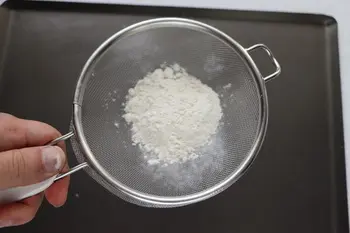
When in a recipe you need to sprinkle something, that is to say to spread a fine layer of powder (flour, sugar, etc.) on something, powdered sugar on a pie for example, you will probably use a fine strainer or a sieve, this is the best way to proceed.
But is that all?
But is that all?
11 K 4.7/5 (18 reviews)
Keywords for this post:TipsTricksStrainerPowderSprinkleSprinklingLast modified on: May 23th 2023
How to sprinkle well?
At the beginning you will realize that it is not that easy, and that it is very easy to put a little bit everywhere badly distributed vs a thin regular layer.
Especially if you go fast enough (with a spoon for example), the best way to make small piles of powder badly distributed on the targeted surface.
The use of a sieve or a sprinkler, which I have already mentioned, is almost indispensable in practice, as it contains the powder to be spread evenly and allows it to be spread "in the rain", thus sprinkling.
But, in a very natural reflex you will probably do this:
The practical trick is to block the colander with your hand when it reaches the limit of the right surface.
So you take a little momentum to the right (green arrow), and you go to the left where your hand blocks the colander (red arrow) with a tiny shock against your hand, a shock that still helps the sprinkling.
Of course, if you are left-handed, you will reverse the direction.
It is a very simple and effective gesture, try it the next time you have to sprinkle.
Especially if you go fast enough (with a spoon for example), the best way to make small piles of powder badly distributed on the targeted surface.
The use of a sieve or a sprinkler, which I have already mentioned, is almost indispensable in practice, as it contains the powder to be spread evenly and allows it to be spread "in the rain", thus sprinkling.
But, in a very natural reflex you will probably do this:
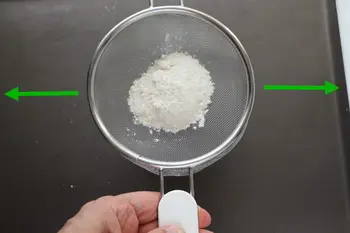
The practical trick is to block the colander with your hand when it reaches the limit of the right surface.
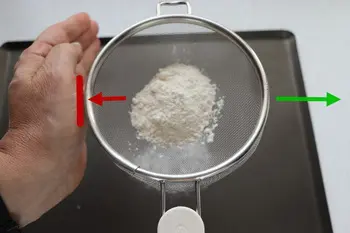
So you take a little momentum to the right (green arrow), and you go to the left where your hand blocks the colander (red arrow) with a tiny shock against your hand, a shock that still helps the sprinkling.
Of course, if you are left-handed, you will reverse the direction.
It is a very simple and effective gesture, try it the next time you have to sprinkle.
Lasts posts

A tablet holder
Perhaps you too cook by consulting your recipe on a tablet or phone, and putting it down on your worktop? It's practical, but not the best solution. Here's a look at how you can make an inexpensive, almost universal stand.March 14th 20261,3135

Pre-calibrated pastry dough
When making pie dough (shortbread, shortcrust, sweet...), it's always a good idea to make a lot at once, and then divide it into pieces, which you can freeze. I've already pointed out the mistake not to make, which is to form a ball before freezing. It's difficult to roll out afterwards because...March 9th 20261,2135

Butter vs. grease
We often read in a recipe where a pastry is put into a mould that, just before pouring, the mould should be buttered or greased. But what's the difference between these 2 terms?December 1st 20253,2505

Getting out of the fridge early
Very often when you're cooking, you need to take food or preparations out of the fridge, to use them in the recipe in progress. There's nothing tricky about this: you just take them out of the fridge and use them, usually immediately, in the recipe. But is this really a good method?November 24th 20252,1625

Who's making the croissants?
When you look at a bakery from the outside, you naturally think that in the bakery, the bakers make the bread, and in the laboratory, the pastry chefs make the cakes. It's very often like that, with each of these professions having quite different ways of working, but sometimes there's also one...November 23th 20251,983
Other pages you may also like

The bitterness of endives
As I write these lines, we are entering the endive season, and if you like it, it's time to enjoy it, if possible with your local producers. Endive is good, but the reproach that is often made of it, and children in particular, is: "It's bitter! And it is (somewhat) true of course, endives...February 9th 201915 K4.9

Don't throw away your pizza crusts
You've probably already noticed that at the end of a pizza meal, at least half of the participants have left the crusts in the boxes or on the plates that many don't eat. Naturally, one would tend to put them "to the birds", or worse, to throw them away, and it's a shame because they are in fact...April 22th 202311 K4.9

Should I believe my oven?
Can you really trust your oven? This is an important question as we are always tempted to take the temperature indicated as gospel truth and, unfortunately, this is rarely very precise. .July 4th 201134 K4.6

Tranché, dissociated, failed, in short... missed!
When preparing a sauce or a cream, there's always a (small) risk that the creamy preparation you're working on will suddenly separate into two parts of different textures: a liquid part, for example, and a more or less solid part, or even become lumpy. It's terribly frustrating, but we'll see...June 19th 202314 K5

Half milk, half cream
In a multitude of recipes, savoury or sweet, milk is used as the main ingredient, or at least as the main liquid ingredient. Milk is used instead of water, for example, because milk contains a proportion of fat, which adds roundness and softness to the recipe. This mellowness is very pleasant on...February 27th 202410 K5
Post a comment or question
Follow this page
If you are interested in this page, you can "follow" it, by entering your email address here. You will then receive a notification immediately each time the page is modified or a new comment is added. Please note that you will need to confirm this following.
Note: We'll never share your e-mail address with anyone else.
Alternatively: you can subscribe to the mailing list of cooling-ez.com , you will receive a e-mail for each new recipe published on the site.