Another

random page?
Traffic
  • Page seen 52,608 times
  • Commented 4 times
  • Rating
  • Already noted 52 times
  • Average note : 2.8/3


Breads

Slashing loaves


On this page: Overview - Slashing tools - How to slit ? - Blade cut - Conclusion

Other pages: Follow this page - Back to homepage - Back to preceding page

Overview

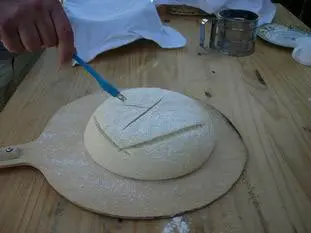
At baking time, loaves should be slashed. This means that cuts are made on top with a very sharp blade.

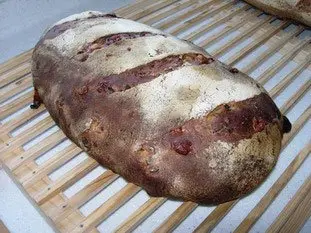
These cuts are to create weak spots in the crust, and it's from these (like chimneys), that steam and CO2 can escape from the dough and that's how you get well risen bread. It's not just a decorative thing, but cut well your bread will have a professional look.

If you don't slash your bread, it will rise less and have a stronger/harder crust.

Slashing tools

To slash well, it's no secret, you need a very sharp blade. A knife, even a sharp one, is not enough.

The best tool is a professional baker's blade, a kind of razor blade on a plastic handle. But it's rather expensive and hard to find.
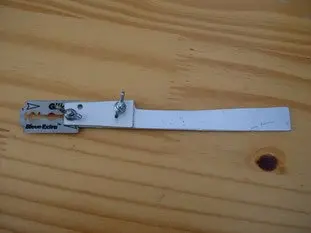
A cheaper solution is to make your own tool, by putting a razor blade on an aluminium handle with two screws. It can then be held safely, and can be dipped in water during use.

How to slit ?

It's simple and complicated at the same time. Simple because you just have to makes slits in the dough, and complicated because their shape and direction influence how the bread cooks. Basically there are 3 main French ways to slash bread: classic, saucisson or polka.

Classic:

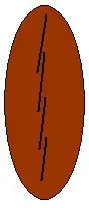
the bread is slashed with medium sized cuts, more or less along the loaf, but which overlap for about 1/3 of their length.

Saucisson:

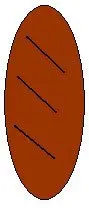
This time the cuts are parallel and diagonally across the loaf.

Polka:

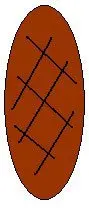
Cuts are crossed, in both directions. It's a cut usually reserved for round loaves.

Personal:

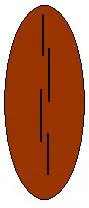
I almost never succeed with the classic cut, so I do my personal version by making cuts along the length but staggered.

Blade cut

Once the style has been choosen, the cutting angle is also important:

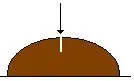
If you cut vertically, you bread will not get "ears" when cooking, those characteristic forms on the top.

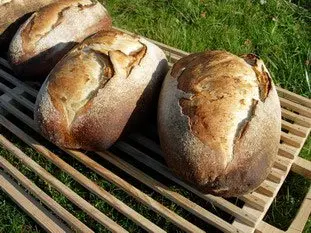
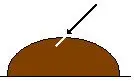
If you cut with the blade at a 45° angle, your bread will get its "ears" during baking, and have a professional look.

Conclusion

Slashing bread is not a simple affair, in fact it's an art, the baker's signature. This page only shows a few ways to do it, you can now try to find your own.

Back to top of page

Last modified on: December 28th 2011


Your 4 comments or questions on this page:

- - -

Why not use an plastic box cutter with a retractable blade? i am very comfortable with knives and blades, but an exposed double sided blade like that is a dangerous proposition(at least use a single edge)especially if it ends up in a sink. the bread looks beautiful and i am sure it tastes great.

Comment #1 posted on august 23th 2009 at 15:48 by jac.

To jac: Yes you're right, it could be dangerous if considered as a classical cooking tool, but (of course) I don't, and I always wash it apart. Are you sure that an usual cutter, with plastic box, is sharpen enough to cut bread dough? Sometimes with very soft ones, even razor blade is just enough.

Comment #2 posted on august 23th 2009 at 16:45 by jh.

I was trying to understand the French breads I enjoy so much when in Paris. first learned of the Levain and having brewed beer in my basenment ws looking for5 more information on levain. Your excplanation was the best I found after some time and I believe I can suspend research until making some breads.

Tbanks for the translations as wellI am learning to speak french, but when baking I have come to the understanding that to succeed I need both the ingredients , measurements and technique.

Merci

Comment #3 posted on august 23th 2009 at 21:51 by willy.

For willy : Thank you, appreciated comments on my translations because I'm always scared to make huge English mistakes...

Comment #4 posted on august 24th 2009 at 14:37 by jh.


Post a comment or question:

You are welcome, if you wish, to comment on this page: why you like it or not, what you have changed, what results it gave, point out a mistake or omission, etc. You can also ask a question. I answer all questions (in a broken English, sorry) unless someone else does it before me.
Please feel free to say what you think, I'm always very interested in your opinion. Your comment will appear on line with the page, so please write in standard readable English, not SIM or only in CAPITALS, otherwise your comment may be rejected.

Please look at advice for submitting a comment or image (what you should or should not do). By the way, don't type your e-mail address in the comment, otherwise you might be spammed.

Your first name or pseudo: (optional).

Please check/tick this box to show that you are a real human being (protection against Spam)*.


I am not a leaving thing


Follow this page

If you are interested in this page, you can "follow", ie you enter here your e-mail address, and then each time the page is modified, or commented, you will immediately receive a personal e-mail to warn you.
Note: You will need to confirm that you want to follow this page.
My e-mail address is:

Please check/tick this box to show that you are a real human being (protection against Spam).


I am not a leaving thing