Sausage broth


Sausage broth
I've already talked to you about vegetable cooking water, which becomes a precious broth after cooking that would be a shame to throw away. Now let's look at the special case of meat cooking broth, and in particular sausages, which are often poached.
15 K 5/5 (1 reviews)
Grade this page:
Keywords for this post:BrothJuiceCookingWaterSausageTasteRecovery
Last modified on: June 28th 2023
For this postComments Lasts posts Follow
For this post: Comment Follow Ask me a question Send to a friend
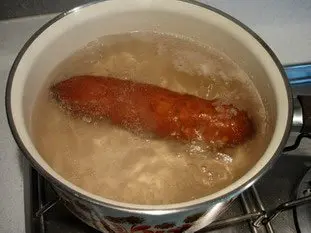
When you cook a piece of meat in boiling water, in cooking parlance, you poach it. The most common case is a sausage: you buy it raw and poach it in simmering water for a while (depending on its size) until it's cooked.
Once cooked, you drain it and use it in your recipe or dish - it's pretty classic.

What about the cooking water?

Well, it's not just water any more: during the cooking process, there's been an exchange between the water and the sausage, and you now have a cooking broth, more or less spicy depending on the number and type of sausages you've cooked in it.
It's even more fragrant if you've cooked a smoked sausage, like a Morteau sausage (the best sausage in the world, let's not forget ;-) its smoky taste will make your broth even better.
As with vegetable stock, it would be a shame to throw it away, when you can use it to great advantage in other cooking techniques.

Cooking with sausage stock

Sausage broth can be used in any type of cooking that is normally done in salted water. Here are a few ideas:
The same applies to sausage broth as to vegetable broth: if you use it again as a broth (cooking vegetables, for example), there's no end to it, and it can be reused as often as you like, topping up with water.
Best of all, each time you cook it, it gets a little tougher, and there's nothing to stop you cooking another sausage in it.

To sum up: keep the water you use to cook your sausages. It's a cooking broth that can be reused for other purposes.
Lasts posts
With vinegar?
With vinegar?
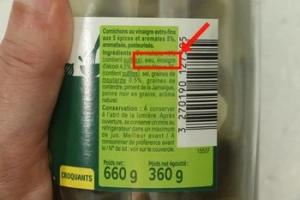
When you buy a jar of pickles labeled “in vinegar,” you’re looking for their tangy, crunchy flavor to go with cold cuts, sandwiches, or salads. You expect to find small gherkins preserved in vinegar, with salt and herbs, but is that really the case?
July 15th 20261,5304.8
Congratulate the chef
You've just finished a meal that you really enjoyed. The server approaches with the usual question: “How was it?” And then, as a natural reflex, you simply reply, “Yes, it was very good.” However, when the meal was truly outstanding, this brief exchange deserves a little more. .
July 7th 20261,007 25
Cut twice as fast
Cut twice as fast
When you need to cut something long into small pieces, for example chopped chives or the stem of a spring onion, there's a simple gesture that doubles your cutting speed. Let's see how.
May 21th 20262,4105
The other use for bowl scraper
Your kitchen or bakery utensils may include a horn (left) or a pastry cutter (right). These practical utensils are normally used to scoop the contents of a bowl or salad bowl - the horn - or to cut dough - the pastry cutter. But they also have another, very practical use - let's see what it is.
May 9th 20262,1553
The strange foam of potatoes in milk
As you may have already noticed, when you cook potatoes in milk, especially in small pieces (slices or cubes) for a gratin for example, a surprisingly abundant white foam forms on the surface. Where does it come from?
April 26th 20262,5015
Other articles you might also like
Is it really necessary to cream egg yolks?
Let’s try and answer a question that crops up in cookery and patisserie, even if it verges on the existential: do the egg yolks in a custard recipe really need to be beaten until pale, or not?
February 28th 201846 K4.3
Double cooking of vegetables
When you cook vegetables, it's not easy to capture and preserve the flavours. It is easy to undercook, but you can make up for it, or overcook, and then it is unfortunately a bit cooked (in the sense of "ruined"). But above all, how to get the maximum of the taste of the vegetable in the pan, then...
July 12th 201926 K4.1
The  "pith" of the cauliflower
The "pith" of the cauliflower
When using cauliflower in a recipe, there is a lot of preparation work at the beginning: removing the leaves, taking the tops or florets, etc. It's a bit tedious, but in the end you're left with the best of the cauliflower, ready to be used in your recipe.
February 5th 202216 K4.9
Don't throw away your pizza crusts
You've probably already noticed that at the end of a pizza meal, at least half of the participants have left the crusts in the boxes or on the plates that many don't eat. Naturally, one would tend to put them "to the birds", or worse, to throw them away, and it's a shame because they are in fact...
April 22th 202311 K4.9
What is the difference between bakery and patisserie?
This is a question that you may well have asked yourself and which I will attempt to answer. In France the two trades of "boulangerie" (bakery) and "pâtisserie" (patisserie and confectionery) have always been quite distinct, but where exactly do the boundaries lie? .
February 7th 2017137 K 14.2
Post a comment or question
Posted by
I am not a leaving thing
Follow this page

Receive an e-mail as soon as this page is modified or receives a new comment.

I am not a leaving thing
We'll never share your e-mail address with anyone else.
Alternatively: you can subscribe to the mailing list of cooling-ez.com , you will receive a e-mail for each new recipe published on the site.

Back to top of page