Should a sausage be pricked before cooking?


Should a sausage be pricked before cooking?
If you are using sausages in a recipe, you may have already asked yourself the question: Should you prick it before cooking it, or not?
You will certainly find as many opinions "you should prick" as "you should not".

Let's try to untangle all this.
48 K 4.1/5 (18 reviews)
Grade this page:
Keywords for this post:SausageCookingNeedleForkKnifeBrothBrioche
Last modified on: September 29th 2018
For this post: Comment Follow Ask me a question Send to a friend
Should a sausage be pricked before cooking?
A sausage, well a good one, that is to say not an industrial by-product, is a piece of gut in which is threaded a mixture of meat, spices and salt. The casing is closed at both ends, and the sausage thus formed is put to dry or to smoke. Molène sausage for example, Morteau sausage (the best in the world, no less...), or many others.

So obviously if you cook it by poaching it, i.e. in boiling water, pitting it will cause some of the cooking water to enter the sausage and "steal" some of its taste, its smoke. So, okay, it's better not to prick it.
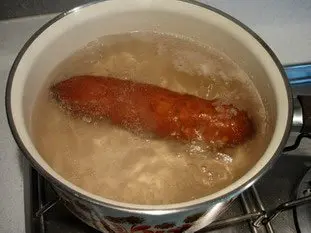
saucisse pochée


That said, cooking a sausage by poaching is not the best way to cook it, even if it is not pricked, the contact with boiling water is not necessarily interesting for the taste.

You will get a much better result with an oven cooking: Roll the sausage in a sheet of aluminium foil, put it on a plate or a dish and put it in the oven at 180° for about 40/45 minutes (in the case of a Morteau, 30 minutes for a Molène), the sausage will cook of course, but it will also caramelize a bit, and its taste will be sublimated by this long cooking at a reasonable temperature.

And by the way, spiked or not in this case? Well, a little bit as you want, if you prick some of the fat will escape and you will have a sausage a little less fatty, but also a little drier, it's up to you.

If you make a sausage in a bun for example, I strongly advise you to cook it in the oven.
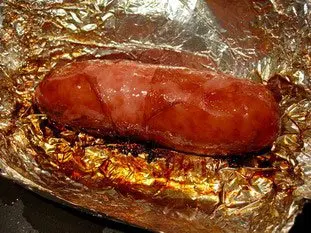
saucisse cuite au four


In another case, the sausage is cooked in, or in contact with, its filling: potatoes, beans, lentils,..., then it's quite clear: you MUST prick, this way the taste of the sausage will fall (or go down) on the filling, the potatoes for example, and you will have an exceptional dish in taste!
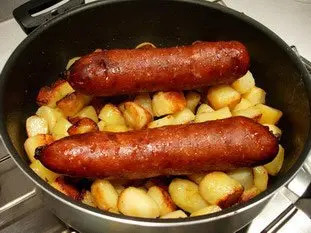
saucisse de gîte


I come back to the poached sausage, which is not pricked, in principle. I say "in principle" because in fact you can poach it if you want to do a double job, that is to say cook the sausage, but also obtain a very fragrant cooking broth from the water.

In this case, you will notice that the cooking water becomes cloudy and a little fatty as it cooks, because of the exchange that takes place with the sausage. At the end of the cooking process, remove the sausage, and you will have in the pan not only water but a "Molène broth" or "Morteau broth" that you can happily use to cook rice for example, vegetables, pasta, or a little bit of everything you want, and this cooking with broth will be much more tasty than a "l'anglaise" cooking (boiling salted water).


To sum up: Should a sausage be pricked before cooking? Well, it depends on the cooking method, and can we draw a general rule from this? Let's try it...
  • Poached => do not poach, unless you want to obtain a broth at the same time
  • Oven cooking => do not poach if you want to reduce the fat, but be careful => sausage is drier, otherwise do not poach
  • Cooked in contact with the filling => we prick!

Lasts posts
Butter vs. grease
Butter vs. grease
We often read in a recipe where a pastry is put into a mould that, just before pouring, the mould should be buttered or greased. But what's the difference between these 2 terms?
December 1st 20256845
Getting out of the fridge early
Very often when you're cooking, you need to take food or preparations out of the fridge, to use them in the recipe in progress. There's nothing tricky about this: you just take them out of the fridge and use them, usually immediately, in the recipe. But is this really a good method?
November 24th 20259695
Who's making the croissants?
When you look at a bakery from the outside, you naturally think that in the bakery, the bakers make the bread, and in the laboratory, the pastry chefs make the cakes. It's very often like that, with each of these professions having quite different ways of working, but sometimes there's also one...
November 23th 2025870
Oven height
Oven height
When we put a dish or cake in the oven, we naturally tend to put it on the middle shelf, and that's what we usually do. But in some cases, this position and height can be a little tricky, so let's find out why.
October 8th 20252,4705
The importance of sieving
In recipes that use a fine powder (flour, powdered sugar, etc.), you'll often see the advice to sift before using it. To sift is to pass the powder in question through a sieve (a very fine strainer) before incorporating it into your recipe. It's often advice, but is it really useful?
September 3rd 20257,3483

Other pages you may also like
Different kinds of pastry and dough
When cooking in general, and particularly in baking, we can make and use many different kinds of pastry and dough. All built on the same "base": flour - a powder to which we add fat, liquid or both to produce the dough which is then cooked. .
November 6th 2012111 K 14.0
Fruits which can ruin your jelly
There are many ways of making a fruit mousse, but one of the simplest is to prepare a fruit jelly (basically a fresh fruit coulis with gelatine) and then mix this jelly before it sets completely with whipped cream. The result is perfect for filling a charlotte, for example. But do beware;...
March 6th 201378 K4.0
The golden-brown finish on puff pastry
Let's take a look at the tricky matter of producing puff pastry with an attractive, golden-brown finish. French pastry chefs call this "dorure" (literally, "gilding"). Behind this quirky term there lurks a real problem (and the solution): when using puff pastry (pâte feuilletée) for a pie, or...
February 8th 201847 K 24.6
Baking cakes
Baking cakes
Where we see that to put a cake in the oven, once the dough is finished and in its mould, there is no hurry and that the cold is your friend.
June 28th 201945 K4.1
Cooking time for pasta
What is as good and simple as pasta? Not much, I think, and it's so easy to prepare: boiling water, salted (or not, depending on your taste), a few minutes of boiling and it's ready. The only "difficulty", so to speak, is the respect of the cooking time and the risk of, unfortunately, overcooking...
July 18th 201923 K4.6
Post a comment or question
Posted by:
I am not a leaving thing

Follow this page
If you are interested in this page, you can "follow" it, by entering your email address here. You will then receive a notification immediately each time the page is modified or a new comment is added. Please note that you will need to confirm this following.
I am not a leaving thing
Note: We'll never share your e-mail address with anyone else.
Alternatively: you can subscribe to the mailing list of cooling-ez.com , you will receive a e-mail for each new recipe published on the site.

Back to top of page