Steam for baking bread


Steam for baking bread
What does steam have to do with bread-making? This is not only a bakers' secret, it is something you might not think of at all: if you make bread and bake it like a cake, you will end up with bread, but pale and with a thick, hard crust – a long way from the golden-brown crusty loaf you had in mind.

This is because, when baking bread in an oven, it is vital that right at the start, the loaf goes into an atmosphere that is hot, of course, (around 480°F or 250°C), but also very humid: saturated with steam, in fact. Some of the water suspended in the air inside the oven will settle out evenly on the bread and will react with the dough to form sugars (in the chemical sense). These will help brown the crust in the famous Maillard reactions, producing this bread a more appetising colour, but that is not all. It also helps to form a thin, crisp crust.
146 K 4.5/5 (38 reviews)
Grade this page:
Last modified on: June 16th 2021
For this post: Comment Follow Ask me a question Send to a friend
Steam for baking bread
So steam is indispensable: there are no beautifully browned, crusty loaves without it. You should note that once the crust is formed in the oven, after about 15 or 20 minutes, the steam is no longer necessary, so there is no need to keep adding it for the rest of the cooking time.

Creating steam in the oven

Professional bakers have the advantage of a special "Steam" control on their electric ovens. This injects water into the oven, which lands on very hot metal elements and vaporises to create the steam. They simply press a button and “pshhhh!” , that's it.

For amateur bakers like us, things are rather different, but here are a few ways to achieve a similar effect:

Conventional kitchen oven

For this set up, preheat the oven with an empty oven tray sitting directly on the bottom (oven floor or sole) and leave it in the oven to heat up.
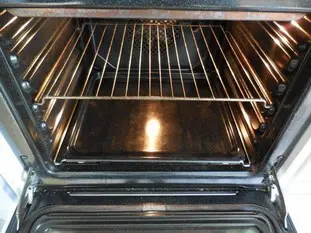
La lèchefrite dans le four


When you put the bread in the oven, before closing the door, pour a large glassful of water into the burning-hot tray (do be careful not to scald yourself),
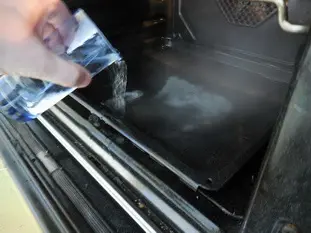
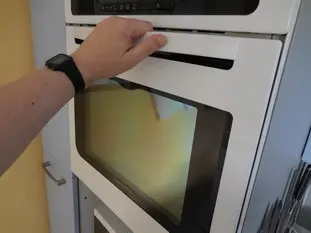
De l'eau pour faire de la buée dans le four

then close the door quickly.

On ferme la porte du four rapidement

The water hitting the hot tray will vaporise and create the steam in the oven, just as required.
If all the water has evaporated in under 15 minutes, add a second glassful.

Bread oven

If you are fortunate enough to have a proper bread oven, you will need to use a special technique, shown on this page which explains the Steam Machine.

To sum up: Without steam, no beautiful, good bread. You need to have steam in the oven during the first 15 minutes of baking.
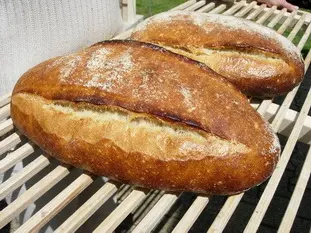
Breads cooked with steam


Lasts posts
Getting out of the fridge early
Very often when you're cooking, you need to take food or preparations out of the fridge, to use them in the recipe in progress. There's nothing tricky about this: you just take them out of the fridge and use them, usually immediately, in the recipe. But is this really a good method?
November 24th 20257365
Who's making the croissants?
When you look at a bakery from the outside, you naturally think that in the bakery, the bakers make the bread, and in the laboratory, the pastry chefs make the cakes. It's very often like that, with each of these professions having quite different ways of working, but sometimes there's also one...
November 23th 2025728
Oven height
Oven height
When we put a dish or cake in the oven, we naturally tend to put it on the middle shelf, and that's what we usually do. But in some cases, this position and height can be a little tricky, so let's find out why.
October 8th 20252,2515
The importance of sieving
In recipes that use a fine powder (flour, powdered sugar, etc.), you'll often see the advice to sift before using it. To sift is to pass the powder in question through a sieve (a very fine strainer) before incorporating it into your recipe. It's often advice, but is it really useful?
September 3rd 20257,2333
The grease spray
The grease spray
As soon as you have something in a recipe that sticks to the mold, the question always arises as to how difficult it is to remove from the mold. There's nothing more frustrating than breaking your cake when unmolding it, because part of it has stuck in the mold. The classic way to avoid this is...
August 26th 20256,7645

Other pages you may also like
What is the difference between bakery and patisserie?
This is a question that you may well have asked yourself and which I will attempt to answer. In France the two trades of "boulangerie" (bakery) and "pâtisserie" (patisserie and confectionery) have always been quite distinct, but where exactly do the boundaries lie? .
February 7th 2017134 K 14.1
The right weight of pastry for a pie
Let's try to solve a thorny problem: How much dough will I need when I make my next pie? You're planning to make a pie, you're going to use your favourite mould or circle, but how much pastry will you need to fill it completely with a well spread pastry, without being too thin, or on the contrary...
March 20th 202066 K4.3
The window-pane test in bread-making
The home bread-makers often ask themselves “Have I kneaded my dough long enough?” . A good question, as dough that is insufficiently kneaded will not rise properly or will fall flat when the top is slashed, which is very frustrating. To know when the dough is ready, one can rely on the length...
June 16th 202196 K 23.9
Is it really necessary to cream egg yolks?
Let’s try and answer a question that crops up in cookery and patisserie, even if it verges on the existential: do the egg yolks in a custard recipe really need to be beaten until pale, or not?
February 28th 201844 K4.3
Incise some meats before cooking
Have you ever had this rather unpleasant phenomenon: you grill a meat, a pork chop or a veal cutlet for example, and during cooking it becomes completely deformed? It takes a very strange shape, a bit difficult to describe, a sort of cone around the central area of the meat, which also hinders...
June 19th 202112 K4.9
Post a comment or question
Posted by:
I am not a leaving thing

Follow this page (as 11 people already do)
If you are interested in this page, you can "follow" it, by entering your email address here. You will then receive a notification immediately each time the page is modified or a new comment is added. Please note that you will need to confirm this following.
I am not a leaving thing
Note: We'll never share your e-mail address with anyone else.
Alternatively: you can subscribe to the mailing list of cooling-ez.com , you will receive a e-mail for each new recipe published on the site.

Back to top of page