This site uses only a few technical cookies necessary for its operation. By continuing to browse, you accept their use.
To find out more...
To find out more...
When should I change my knife?
I already spoke to you in a previous post about knives, those without which nothing is possible (or almost) in the kitchen, so I'm going to come back to them a bit and try to answer the question "When should I change my knife?
16 K 4.7/5 (15 reviews)
Last modified on: November 2nd 2017
When should I change my knife?
You may remember how important it is to pay a lot of money for your knives, and to choose models with a stainless steel blade, a handle made of a composite material often called "plastic", etc. This is still true, and I dwell a little on the blade, which being made of steel, with time dulls, sharpens and must therefore be regularly sharpened. This is always true, and I dwell a little on the blade, which being steel, with time dulls, de-sharpens and must therefore be regularly sharpened.
The best way to do this is to use a sharpener, and in an elegant gesture (but unfortunately not easy to catch) you sharpen the blade again. To make a long story short, you should always have razor-sharp knives, it's always much more pleasant to cook with.
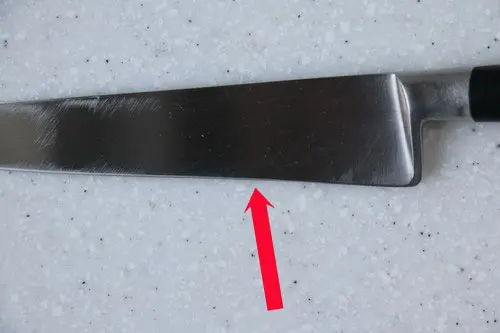
Let's come back to this knife sharpening, it turns out that in the gesture of sharpening, one naturally accentuates one's effort on the middle-lower part of the knife blade, and therefore it is there that the wear will be the fastest. This wear can be seen over time, it creates in the blade of the knife, very slowly, a small hollow, a slight curvature, which you can see on this photo (red arrow):
This hollow, if visible, is a sign that your knife is at the end of its life in "kitchen" mode: You will find it difficult to sharpen it, more and more, so it will cut less well, and will not be ideal for cooking.
To make a comparison, see these 2 knives side by side:
The top one is new, the bottom one has lived well, note the hollow of the blade at the bottom, and the nice rounding of the top one.
It's time to change the bottom one, of course you shouldn't throw it away, but use it for something else than cooking (garden, DIY, ?) or recycle it.
Well, it's not always easy, we are often attached to our tools, that we have well in hand, but it is necessary to take the step, the old knives even if they have a sentimental value, can become a brake to your good cooking.
To sum up: When the blade of your knife starts to get hollow, it is time to think about changing it.
The best way to do this is to use a sharpener, and in an elegant gesture (but unfortunately not easy to catch) you sharpen the blade again. To make a long story short, you should always have razor-sharp knives, it's always much more pleasant to cook with.
Let's come back to this knife sharpening, it turns out that in the gesture of sharpening, one naturally accentuates one's effort on the middle-lower part of the knife blade, and therefore it is there that the wear will be the fastest. This wear can be seen over time, it creates in the blade of the knife, very slowly, a small hollow, a slight curvature, which you can see on this photo (red arrow):
This hollow, if visible, is a sign that your knife is at the end of its life in "kitchen" mode: You will find it difficult to sharpen it, more and more, so it will cut less well, and will not be ideal for cooking.
To make a comparison, see these 2 knives side by side:
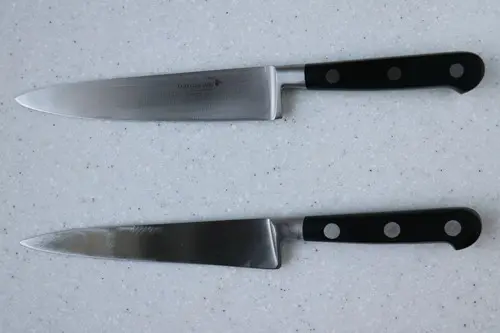
The top one is new, the bottom one has lived well, note the hollow of the blade at the bottom, and the nice rounding of the top one.
It's time to change the bottom one, of course you shouldn't throw it away, but use it for something else than cooking (garden, DIY, ?) or recycle it.
Well, it's not always easy, we are often attached to our tools, that we have well in hand, but it is necessary to take the step, the old knives even if they have a sentimental value, can become a brake to your good cooking.
To sum up: When the blade of your knife starts to get hollow, it is time to think about changing it.
Lasts posts

Cut twice as fast
When you need to cut something long into small pieces, for example chopped chives or the stem of a spring onion, there's a simple gesture that doubles your cutting speed. Let's see how.May 21th 2026869

The other use for bowl scraper
Your kitchen or bakery utensils may include a horn (left) or a pastry cutter (right). These practical utensils are normally used to scoop the contents of a bowl or salad bowl - the horn - or to cut dough - the pastry cutter. But they also have another, very practical use - let's see what it is.May 9th 20261,215

The strange foam of potatoes in milk
As you may have already noticed, when you cook potatoes in milk, especially in small pieces (slices or cubes) for a gratin for example, a surprisingly abundant white foam forms on the surface. Where does it come from?April 26th 20261,458

A little leftover butter
Very often when you're making a cake, your recipe will tell you to melt some butter and mix it into the batter - a classic for cookies, cakes, moelleux and the like. And every time you do this, you'll have to butter the baking tin to prevent the dough from sticking during baking. Naturally,...April 16th 20261,3395

A tablet holder
Perhaps you too cook by consulting your recipe on a tablet or phone, and putting it down on your worktop? It's practical, but not the best solution. Here's a look at how you can make an inexpensive, almost universal stand.March 14th 20262,0625
Other pages you may also like

Baking cakes
Where we see that to put a cake in the oven, once the dough is finished and in its mould, there is no hurry and that the cold is your friend.June 28th 201947 K4.1

Cleaning endives
If you buy your endives elsewhere than in supermarkets, and in this case the best is of course from a market gardener, he or she is the one who planted and harvested them, in this case you will have endives full of earth or sand, depending on where they were grown, which is normal and reassuring, we...March 24th 202028 K4.6

The "caves" in the bakery and pastry shop
Maybe you've already done this? You want to make a brioche or a cake with fruit inside, you decide to proceed with your usual recipe, but also to add in the dough pieces of fresh and raw fruit, or whole fruit, for example pieces of apples or pears, good idea. When you bake it, everything seems to...March 27th 202113 K4.9

Don't throw away your pizza crusts
You've probably already noticed that at the end of a pizza meal, at least half of the participants have left the crusts in the boxes or on the plates that many don't eat. Naturally, one would tend to put them "to the birds", or worse, to throw them away, and it's a shame because they are in fact...April 22th 202311 K4.9

The ideal restaurant
Like all passionate cooks (I suppose), from time to time I dream of opening my own restaurant. I imagine loads of things: it will be like this or like that, we'll do this, I'll cook that, the room will have this or that – in short, I dream.October 15th 201217 K4.4
Post a comment or question
Follow this page (as 3 people already do)
Receive an e-mail as soon as this page is modified or receives a new comment.
We'll never share your e-mail address with anyone else.
Alternatively: you can subscribe to the mailing list of cooling-ez.com , you will receive a e-mail for each new recipe published on the site.