When should you salt?


When should you salt?
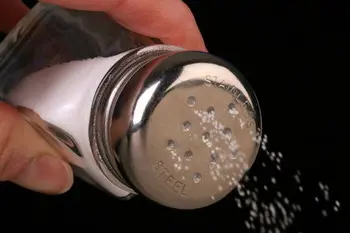
In the kitchen, we salt very frequently, almost all the time, and we must be careful because this salt can influence the texture of what you are cooking.
I'm not going to talk about the amount of salt here, that's for another time, but rather about : When do you salt?
18 K 4.5/5 (22 reviews)
Grade this page:
Keywords for this post:SaltSaltTimeCooking
Last modified on: August 13th 2019
For this post: Comment Follow Ask me a question Send to a friend
When should you salt?
Let's imagine that you are going to prepare leeks. There are thousands of ways to do it, but one of the most classic is "sautéed".

poireaux sautés


How do you do it?
  1. You peel, wash, dry and slice your leeks
  2. You do the same thing with a shallot
  3. In a saucepan or a frying pan, you heat a littleoil or butter or clarified butter
  4. Once it's hot, you pour in the shallot, stir a little and add a little salt and pepper

    sel et échalote

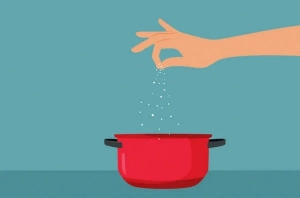
    Here is the first salt shaker, note that it is light, and concerns (for the moment) only the shallot, we continue...
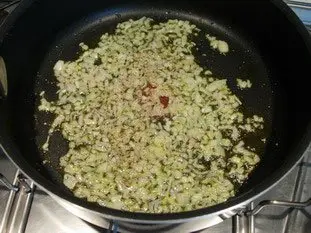
  5. Cook the shallot, 1 minute maximum, it must not colour or turn brown (we say"without colouring")
  6. Add the leeks, stir well to mix, and do not add any salt.
    Why not? Well, because the salt with its hygroscopic side, if you add it now, will "pump" the water out of the leeks, water that will end up at the bottom of the pan, and that you will have to remove later by overcooking.

    Moreover, if the water is extracted from the leeks, they will become excessively soft and less appetizing, losing their beautiful green colour more easily. Let's continue...
  7. You cook/sauté the leeks like this, uncovered, stirring from time to time, until they are soft to your taste, but still green
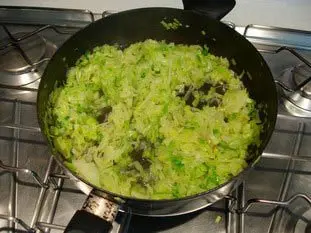
  8. And finally, off the heat, you add salt and pepper to taste
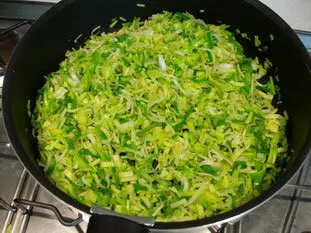
sel et poireaux

You will have understood, it is just a question of timing, we will salt anyway, but we will also try to do it late, so that the salt is not too much in contact with raw vegetables. This is valid for "soft" vegetables, but also for mushrooms.

By doing so, you will have a cooking that preserves the structure of the vegetable, and you avoid the excess of liquid at the bottom of your pan.


To sum up: When cooking vegetables or mushrooms, it is best to add salt only once the cooking is finished, to keep your vegetables in good condition.
Lasts posts
The other use for bowl scraper
Your kitchen or bakery utensils may include a horn (left) or a pastry cutter (right). These practical utensils are normally used to scoop the contents of a bowl or salad bowl - the horn - or to cut dough - the pastry cutter. But they also have another, very practical use - let's see what it is.
May 9th 2026758
The strange foam of potatoes in milk
As you may have already noticed, when you cook potatoes in milk, especially in small pieces (slices or cubes) for a gratin for example, a surprisingly abundant white foam forms on the surface. Where does it come from?
April 26th 2026995
A little leftover butter
Very often when you're making a cake, your recipe will tell you to melt some butter and mix it into the batter - a classic for cookies, cakes, moelleux and the like. And every time you do this, you'll have to butter the baking tin to prevent the dough from sticking during baking. Naturally,...
April 16th 20261,0815
A tablet holder
A tablet holder
Perhaps you too cook by consulting your recipe on a tablet or phone, and putting it down on your worktop? It's practical, but not the best solution. Here's a look at how you can make an inexpensive, almost universal stand.
March 14th 20261,8155
Pre-calibrated pastry dough
When making pie dough (shortbread, shortcrust, sweet...), it's always a good idea to make a lot at once, and then divide it into pieces, which you can freeze. I've already pointed out the mistake not to make, which is to form a ball before freezing. It's difficult to roll out afterwards because...
March 9th 20261,6125

Other pages you may also like
The so-called "nervous" meats
You've probably heard this before, we're talking about "nervous" meat, or meat with nerves, to describe what is indicated by the blue arrow on the left. This is a piece of beef, and what we call a nerve is not a nerve, it is in fact collagen (chemists sometimes call it a "collagen sink"), a...
April 16th 202139 K4.5
No need to boil gelatin
Gelatin is a magical ingredient for making light, creamy, structured desserts, yet it's often misused in the kitchen. A common mistake in some recipes is the idea that it needs to be boiled for it to work properly, but this is a mistake indeed: gelatin melts at a much lower temperature, around...
November 21th 202410 K5
Making the most of seeds: Dry roasting
In cooking, and particularly in baking, there are a lot of seeds we can use, such as linseed, sesame, poppy, etc. Usually, recipes simply say to add them just as they are to the mixture or dough. To make a seeded loaf, for example, prepare a plain bread dough as usual, then, towards the end of...
January 30th 201564 K4.0
The baker always gild twice
I've already told you about gilding, the beaten whole egg that is spread with a brush on anything that needs to brown in the oven: puff pastry, pastries, etc. and that professionals use a lot, I'm going to come back to this to clarify a bit how to do it, and give you a professional tip.
June 9th 201936 K4.2
Croutons
Croutons
Do you use croutons, that typically French trick of toasting small pieces of bread on the side to add to a recipe? They're just delicious, but you need to know 2 or 3 things about them. .
December 30th 202011 K5
Post a comment or question
Posted by
I am not a leaving thing

Follow this page

Receive an e-mail as soon as this page is modified or receives a new comment.

I am not a leaving thing
We'll never share your e-mail address with anyone else.
Alternatively: you can subscribe to the mailing list of cooling-ez.com , you will receive a e-mail for each new recipe published on the site.

Back to top of page