Flaky chocolate brioche
A recipe from cooking-ez.com November 6th 2020107 K4.1
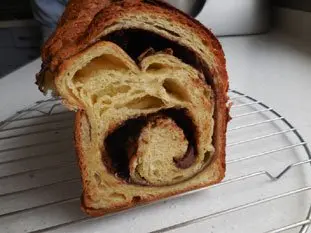
For 1 brioche, you will need:
- 1 500 g brioche dough
- 2 150 g butter
- 3 20 g beaten egg
- 4 150 g chocolate ganache
- Total weight: 820 grams
Times:
| Preparation | Resting | Cooking | Start to finish |
|---|---|---|---|
| 45 min. | 15 hours | 30 min. | 16 hours 15 min. |
Step by step recipe
- 1: The day before, make 500 g brioche dough.
- 2:
Make the flaky layers in the dough
Next day, prepare the square of butter, as for french croissants with ing7.
See this video for more details. - 3: Once the square of butter is ready, take the dough out of the fridge and roll it out into a rectangle the same width as the butter, but twice as long.
- 4: Place the butter in the centre of the dough...
- 5: ...then fold it over...
- 6: ...to seal the butter inside.
- 7: Press down lightly with the rolling pin.
- 8: If necessary, even up the edges by trimming with a knife.
Don't throw away these offcuts; they can become the soured dough for your next batch of viennoiseries (such as brioches, croissants or other types). - 9: Roll out the dough again, keeping the rectangular shape...
- 10: ...then fold the ends into the middle...
- 11: ...and in half again.
Make a 1/4 turn and repeat this whole operation.
Leave to rest for 1 hour in the fridge. - 12:
Add chocolate filling and shape the brioche
Roll out the brioche dough (now with flaky layers of butter) into a large rectangle as wide as your mould or tin is long, like in this photo. - 13: Moisten the end of your rectangle with dorure, using a brush.
- 14: Spread ing9 over the dough, leaving the end with the beaten egg bare.
- 15: Roll the dough up...
- 16: ...using a ruler to help if you can; it's much easier.
- 17: Finish with the seam underneath and Glaze the top of the roll.
- 18: A variation you might like to try (Oriane's idea) - rolled and twisted brioche: split the roll in two along almost its full length...
- 19: ...and twist the 2 sections around each other.
- 20: Place the brioche in the tin or mould, twisted...
- 21: ...or not.
Leave to rise in a warm place for 2 hours. - 22:
Bake the flaky chocolate brioche
Preheat the oven to 360°F (180°C).
Glaze a last time... - 23: ...then bake for about 30 minutes.
- 24: The twisted brioche looks most attractive, very different from the usual style.
Remarks
If you don't have any chocolate ganache, you can use a chocolate spread, such as Nutella, which gives good results, too.View this recipe : https://cooking-ez.com/four/recipe-flaky-chocolate-brioche.php
September 16th 2026.