This site uses only a few technical cookies that are necessary for its operation.
By continuing to browse, you agree to their use (learn more...).
By continuing to browse, you agree to their use (learn more...).
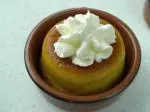
Lemon creams

These light and flavoursome lemon creams are "set" by the curdling action of the lemon juice on the heated cream, so no thickening agent is needed.
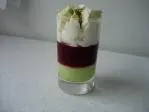
They are served in individual glasses, topped with a layer of fruit coulis (blackcurrant here).
They are served in individual glasses, topped with a layer of fruit coulis (blackcurrant here).
63 K 4.2/5 (37 reviews)481452
Last modified on: December 6th 2017
For 6 people, you will need:
- 1
 250 ml liquid cream
 - 2
 80 g caster sugar
 - 3
 1 lemon
 - 4
 120 g blackcurrant coulis
 - Total weight: 580 grams
Times for this recipe
Preparation
1 min.
Resting
30 min.
Cooking
10 min.
All in all
45 min.
When should you start or finish this recipe?
If you start now, at , you will finish around : ?.Change start time
To finish around 7pm, you'll need to have started before: .Change end time
Step by step recipe
Stage 1
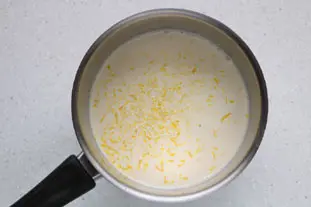
Put 250 ml liquid cream and 80 g caster sugar into a small saucepan. Add the zest of 1 lemon and mix well.
Stage 2 - ⌛ 10 min.

Heat gently up to 176°F (80°C). A thermometer is useful for this, but if you don't have one, just be careful not to allow the cream to boil.
Stage 3 - ⌛ 1 min.
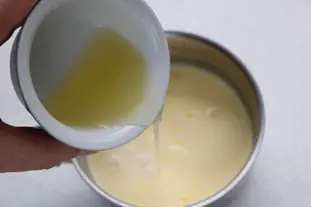
Take off the heat and add the lemon juice all at once.
Stage 4 - ⌛ 30 min.
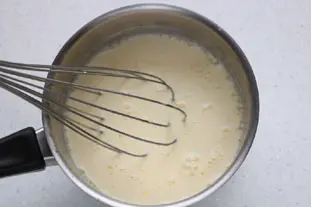
Mix well - you should notice it thicken slightly - then leave at room temperature to cool for 30 minutes.
Stage 5
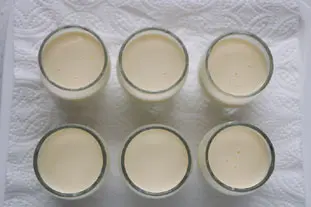
When it has cooled to room temperature,
divide the cream between the individual glasses. Stand these on a cloth laid on a baking sheet.
Cover with plastic film and refrigerate for at least 2 hours.
Stage 6
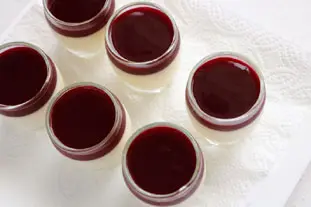
Just before serving, top with a thin layer of fruit coulis, such as blackcurrant.
Stage 7
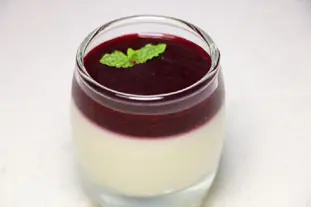
Decorate with a sprig of mint, if you wish, and serve.
Remarks
The quantities given are for a small, accompanying dessert. If they will be the main dessert feature, it would be better to double the quantities and the size of the dish.
Keeping: A few hours in the fridge, covered with plastic film.
Source: Based on a recipe by Jonathan Blot.
Support the site ❤️
This site has been around for years, with no advertising, no pop-ups, no traps, no information gathering, and I maintain it alone, out of passion.
If you liked this recipe, your support helps me to keep going.
Support cuisine-facile.com
If you liked this recipe, your support helps me to keep going.
Support cuisine-facile.com
Nutritional information
| Proteins | Carbohydrates | Fats | Calories | Energy | |
|---|---|---|---|---|---|
| Per 100 g | 3 g RDI=6 % | 46 g RDI=18 % | 12 g RDI=18 % | 205 kcal RDI=10 % | 858 kJ RDI=10 % |
| Per person | 3 g RDI=5 % | 44 g RDI=17 % | 12 g RDI=17 % | 198 kcal RDI=10 % | 830 kJ RDI=10 % |
| Whole recipe | 20 g RDI=32 % | 269 g RDI=102 % | 75 g RDI=103 % | 1,189 kcal RDI=59 % | 4,978 kJ RDI=59 % |
How much will it cost?
For 6 people
2.00 €
Per person
0.35 €
Note: Be careful, these prices are only an estimate, you can consult the table of prices by ingredients used for this estimate.
This recipe uses (among others)
Liquid cream
Like these other recipes:




Blackcurrant coulis
You can get more informations, or check-out other recipes which use it, for example:

Caster sugar
Like these other recipes:

Lemon
Like these other recipes:

Other recipes you may also like

News list of cooking-ez.com
Sign up to receive the latest recipes, next batch due to be sent on 2026-10-28
We'll never share your e-mail address with anyone else.
Post a comment or question
Follow this recipe
Receive an e-mail as soon as this recipe is modified or receives a new comment.
We'll never share your e-mail address with anyone else.
Alternatively: you can subscribe to the mailing list of cooling-ez.com , you will receive a e-mail for each new recipe published on the site.