Materials required
- A mirror: yes, it's pretty obvious, take a medium-sized mirror that's "naked", i.e. unadorned and with the back directly accessible => no lining or adornment - you need to see the back of the mirror, which is a gray, brown or dark purple coating. The shape doesn't matter; a rectangular mirror is just a little easier to dress (see below).
- Resistive wire: this isn't easy to find, but you can try electronic component stores, stationery shops, paint or art stores and model-making stores. This wire (sometimes called "constantan") is sold by the metre and comes in various diameters. We use 4/10ths but it doesn't really matter.
- Aluminum chimney tape: this is a kind of wide, heat-resistant aluminum foil tape. You can find it in DIY stores in the fireplace section.
- A piece of styrodur: or expanded polystyrene, 1cm thick and the size of a mirror. This is intended to thermally insulate the bottom of the mirror once the resistor has been fitted, to protect the wall against which it will be mounted.
- A current source: Anything that delivers a voltage of around 15V. It doesn't have to be direct current; if you can find an old transformer, that's fine too. I use an old PC power supply on a 12V output (yellow and black wire), through a switch like a room light. As for recycling PC power supplies, see this excellent site on the subject.
- Miscellaneous: electrical wire, spray glue, an electric domino and a coat hook to hang the mirror once it's finished...
How it's done
Once you've got the idea down, you can do it your own way.
Here's one way, inspired by the one at home.
Clean the back of the mirror well with a little degreaser (trichloroethylene, acetone) to facilitate adhesion of the tape and glue. To work comfortably, lay the mirror flat on an old piece of carpet.
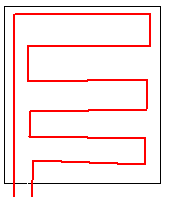
Snake the resistive wire along the mirror, as evenly as possible. The wire should protrude a little at the start and "arrive" near the start, also protruding a little, to allow connection to the current via a domino. A bit like the diagram opposite, but "tighter".
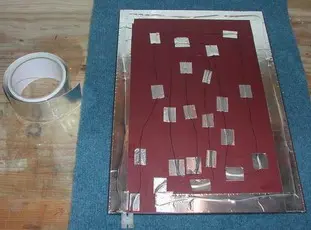
As you lay the wire, hold it against the mirror using pieces of aluminum tape. Note that there should be no crossing of the wire.
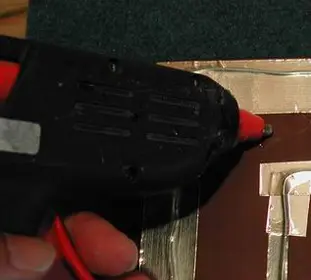
Once all the wire has been laid, glue the styrodur plate to the mirror using a glue gun, putting a little between the wire's passages.
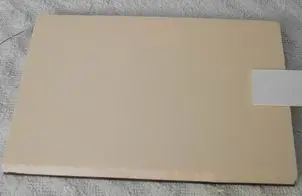
Ideally, the plate should be a little larger before being glued, and then its size should be matched to the edge of the mirror with a cutter or, better still, a filicutter.
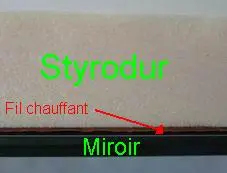
Detail of a cut seen from the side
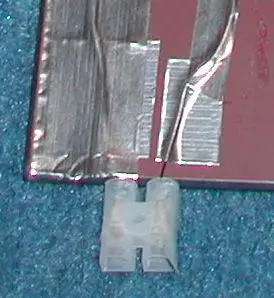
Connect both ends of the wire to a domino to facilitate connection to the power source.
This can be done before or after installing the styrodur.
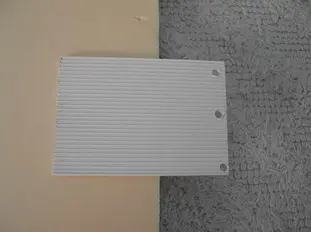
The mirror itself is finished, all that's left to do is add a hook to hang it from (I used an ordinary scrap of plastic glued together with a glue gun), and possibly improve its aesthetics by framing it with mouldings to your taste.
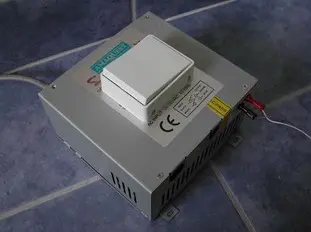
Then connect the domino to the chosen power source to heat up the mirror.
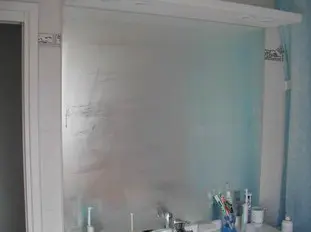
A normal mirror after a good shower...
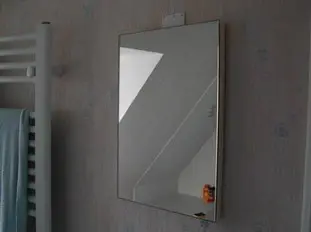
The anti-fog mirror in action!
Second version
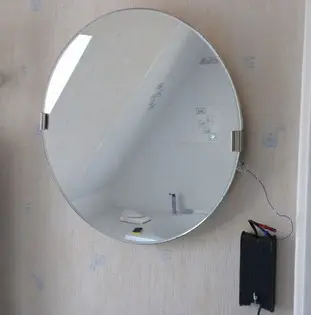
After almost a year of good service, I've tried to improve the mirror by making a slightly less cobbled-together version with a larger, circular mirror. Here are the technical changes:
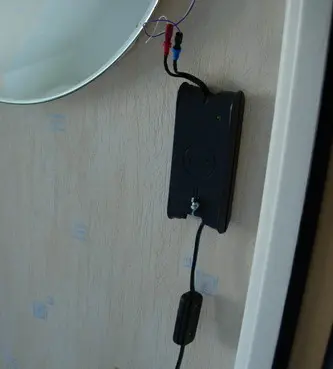
The PC power supply is replaced by an old DELL laptop power supply, which delivers around 20 volts. This is ideal in terms of power and voltage, plus the power supply has an indicator light and its own protection mechanism against short-circuits and overheating. I just added a switch on the mains input.
Conclusion
Well, there's certainly room for improvement, but it's up to you to decide what you need. Here are a few suggestions if you feel like it:
- Install a temperature control system, so that when the temperature reaches 30°C, the mirror switches itself off.
- There's certainly a calculation to be made between the voltage of the electrical source (around 20 volts at no load) and the length of the resistive wire (U=RI?).
- If you have a large mirror in your bathroom, why not consider heating it, thus giving it a dual role: anti-fog and room heating? The difficulty will undoubtedly be to lay a large quantity of resistive wire on a large mirror that's already in place, but I still think there's an idea to be explored here. And I wonder if, for a large surface like that, a wire is really suitable? It's a shame we haven't heard more about the famous "heated paint" of a few years ago, as its use would undoubtedly have been ideal for this...
Of course, if you'd like more information or to make a contribution, please don't hesitate to contact me.



The 1 comment already posted on this page