This site uses only a few technical cookies that are necessary for its operation.
By continuing to browse, you agree to their use (learn more...).
By continuing to browse, you agree to their use (learn more...).
How to beat egg whites (Slideshow version)
Stage 5/5 :
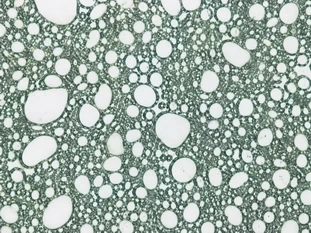
Whisking egg whites essentially involves incorporating air to create a foam composed of increasingly smaller air bubbles and droplets of egg white (albumin + water); see the microscope photo on the left.This observation allows us to establish a few rules regarding egg whites:
- If you add water or a liquid containing water (fruit juice, etc.) to egg whites while they’re being whipped, you’ll end up with a larger volume of foam.
- Fat is the enemy of whipped egg whites because it hinders or prevents the formation of the foam; therefore, you must be very careful to ensure that the egg whites contain no traces of yolk (not a single drop) and that the bowl you’ll be using to whip them is thoroughly clean (be especially careful with plastic bowls).
Remarks
Fresh egg whites are thick, viscous, and gelatinous, but over time they become more liquid, making them easier to beat into stiff peaks.Contrary to popular belief, adding a little salt to the egg whites before beating them serves no purpose.