Steam for baking bread


Steam for baking bread
What does steam have to do with bread-making? This is not only a bakers' secret, it is something you might not think of at all: if you make bread and bake it like a cake, you will end up with bread, but pale and with a thick, hard crust – a long way from the golden-brown crusty loaf you had in mind.

This is because, when baking bread in an oven, it is vital that right at the start, the loaf goes into an atmosphere that is hot, of course, (around 480°F or 250°C), but also very humid: saturated with steam, in fact. Some of the water suspended in the air inside the oven will settle out evenly on the bread and will react with the dough to form sugars (in the chemical sense). These will help brown the crust in the famous Maillard reactions, producing this bread a more appetising colour, but that is not all. It also helps to form a thin, crisp crust.
151 K 4.5/5 (38 reviews)
Grade this page:
Last modified on: June 16th 2021
For this postComments Lasts posts Follow
For this post: Comment Follow Ask me a question Send to a friend
So steam is indispensable: there are no beautifully browned, crusty loaves without it. You should note that once the crust is formed in the oven, after about 15 or 20 minutes, the steam is no longer necessary, so there is no need to keep adding it for the rest of the cooking time.

Creating steam in the oven

Professional bakers have the advantage of a special "Steam" control on their electric ovens. This injects water into the oven, which lands on very hot metal elements and vaporises to create the steam. They simply press a button and “pshhhh!” , that's it.

For amateur bakers like us, things are rather different, but here are a few ways to achieve a similar effect:

Conventional kitchen oven

For this set up, preheat the oven with an empty oven tray sitting directly on the bottom (oven floor or sole) and leave it in the oven to heat up.
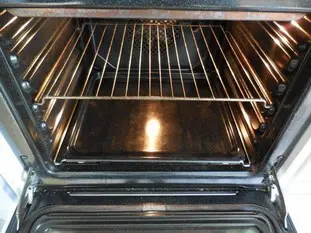
La lèchefrite dans le four


When you put the bread in the oven, before closing the door, pour a large glassful of water into the burning-hot tray (do be careful not to scald yourself),
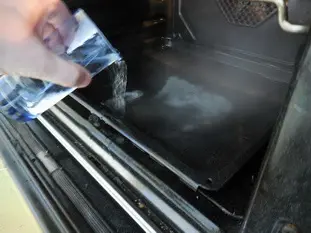
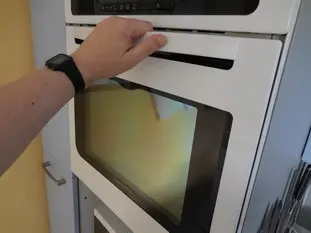
De l'eau pour faire de la buée dans le four

then close the door quickly.

On ferme la porte du four rapidement

The water hitting the hot tray will vaporise and create the steam in the oven, just as required.
If all the water has evaporated in under 15 minutes, add a second glassful.

Bread oven

If you are fortunate enough to have a proper bread oven, you will need to use a special technique, shown on this page which explains the Steam Machine.

To sum up: Without steam, no beautiful, good bread. You need to have steam in the oven during the first 15 minutes of baking.
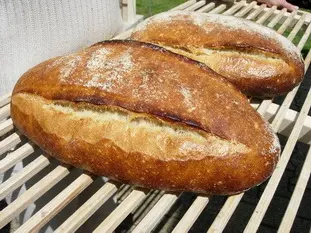
Breads cooked with steam


Lasts posts
Serving Temperature for Wine
When it comes to serving wine, you may (like me) have a fairly simple rule of thumb: red wine at room temperature, and white, rosé, and yellow wines in the fridge until it’s time to serve them. It’s very easy to remember, but it’s a bit simplistic, and you’ll see that there’s a much...
September 23th 20263295
Hot Emulsified Sauces
In French cuisine, sauces are a very important part of a recipe—not just a side dish. In fact, they’re so important that, especially since the time of Auguste Escoffier, they’ve been classified into categories. And among these categories are “hot emulsified sauces,” or lukewarm ones. ...
September 9th 20261,0505
Hot Dishes and Cold Dishes
When plating or serving a dish—whether hot or cold—on a plate, it’s very important to make sure they’re both the right temperature; in other words: if the dish is hot, the plate should be hot, and conversely, if the dish is cold, the plate should be cold. Is this really important? Let’s...
September 2nd 20268623
In baking, cold is your friend
When you bake at home—especially when making pie crusts—you’ve probably noticed that it’s quite difficult to work with the dough when it’s hot. It gets soft, is hard to roll out, and breaks or crumples very easily. And this doesn’t just happen when it’s hot—even in a comfortable...
August 26th 20269015
With vinegar?
When you buy a jar of pickles labeled “in vinegar,” you’re looking for their tangy, crunchy flavor to go with cold cuts, sandwiches, or salads. You expect to find small gherkins preserved in vinegar, with salt and herbs, but is that really the case?
July 15th 20261,8614.8
Other articles you might also like
Making the most of seeds: Dry roasting
In cooking, and particularly in baking, there are a lot of seeds we can use, such as linseed, sesame, poppy, etc. Usually, recipes simply say to add them just as they are to the mixture or dough. To make a seeded loaf, for example, prepare a plain bread dough as usual, then, towards the end of...
January 30th 201566 K4.0
Artichoke stalks
When preparing artichokes for cooking, you may well already know that we often need to remove the first round of leaves, if they are tatty or dirty, as well as the inedible stalk. The operative word here is “remove” , rather than “cut off”.
October 25th 201655 K4.3
One should cover a pan while heating?
You've probably heard it before: "Cover your pan, it'll boil faster", but is it true? Let's find out.
February 27th 201533 K 13.4
Raising (or leavening) agents
When we want to make a dough or batter rise when baking, either in patisserie or bread-making, we need to use a raising agent or leavening agent, one of which is called leaven. In the context of baking, a raising agent is simply what "makes something rise". It is a substance which, when added to...
June 16th 202159 K4.8
5 really useful cooking tips
Cooking is about recipes, of course, but it is also an impressive collection of small gestures, ways of doing things, knowing what to do and what not to do. All these little tips and tricks can be very important: they can affect the way a recipe turns out, simply because you did just the right...
March 29th 201625 K4.9
Post a comment or question
Posted by
I am not a leaving thing
Follow this page (as 11 people already do)

Receive an e-mail as soon as this page is modified or receives a new comment.

I am not a leaving thing
We'll never share your e-mail address with anyone else.
Alternatively: you can subscribe to the mailing list of cooling-ez.com , you will receive a e-mail for each new recipe published on the site.

Back to top of page