The green of leeks


The green of leeks
We are all, consciously or not, very sensitive to the colour of our food. That's why a red strawberry will always seem more appetizing than a pale one, even if it's not necessarily true.

This is true for red, but it is also true for the green of certain vegetables.
21 K 4.0/5 (26 reviews)
Grade this page:
Keywords for this post:LeekGreenWhiteStorageCookingChlorophyll
Last modified on: March 30th 2020
For this postComments Lasts posts Follow
For this post: Comment Follow Ask me a question Send to a friend
And this sensitivity to colors is also sometimes a question of taste, we are a little conditioned by that, so much so that when a panel of testers do so-called "blind" tastings, for example of chocolate, the room where they are is only lit by a red light that masks everything, so as not to influence the testers. Indeed, if they like the color of the chocolate, they will tend to find it better than another chocolate less "pretty".

dégustation lumière rouge


It is therefore a question of color, of the appetite that follows, and indirectly of taste: a beautiful food with beautiful colors will please us more than something ugly and shriveled. In the bowl of apples on the table, you will surely and instinctively take the most beautiful available.

All this to say that making beautiful dishes is not only a question of aesthetics, it is also a question of how your guests will have their first impression, and it counts a lot.

In all this quest for beautiful colors, we have two almost antinomic things in the kitchen: green and cooking. Indeed, a lot of green vegetables are very beautiful and green when raw, but if you cook them (too) long, the chlorophyll they contain will degrade and they will become greenish or beige, in short, much less pretty, even if their taste is there.

An emblematic example: leeks, beautiful and green at the beginning, become dull after a long cooking, and a dish that illustrates it well is the leek-potato soup which is in full season as I write these lines.
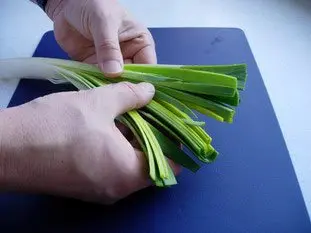
poireau bien vert


If you're going to make potato leek soup, you're going to put potatoes and leeks together and cook them, normal, classic. That's a bit of a problem, the potatoes will cook much slower than the leeks, and to get the potatoes to cook properly, the leeks will be overcooked, and a bit dull in color.

Is there anything we can do?

Yes, it's just a matter of cooking time, finely sliced leek is cooked in 4-5 minutes max, potatoes definitely more. So for the ideal soup, cook the potatoes and onion first, and 5 minutes before the end, add the leek and finish cooking until it is tender.
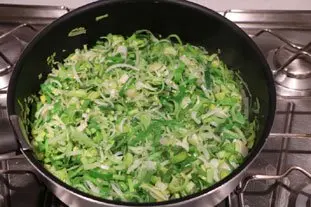
poireaux cuits bien verts


This will give you the ideal leek-potato soup, tasty and with a beautiful, clean green colour, very appetizing.


To sum up: As a rule, green vegetables do not stand long cooking times, so if they have to be cooked with other products, it is always a good idea to cook them last and for as little time as possible.
Lasts posts
With vinegar?
With vinegar?
When you buy a jar of pickles labeled “in vinegar,” you’re looking for their tangy, crunchy flavor to go with cold cuts, sandwiches, or salads. You expect to find small gherkins preserved in vinegar, with salt and herbs, but is that really the case?
July 15th 20261,4194.8
Congratulate the chef
You've just finished a meal that you really enjoyed. The server approaches with the usual question: “How was it?” And then, as a natural reflex, you simply reply, “Yes, it was very good.” However, when the meal was truly outstanding, this brief exchange deserves a little more. .
July 7th 2026954 25
Cut twice as fast
Cut twice as fast
When you need to cut something long into small pieces, for example chopped chives or the stem of a spring onion, there's a simple gesture that doubles your cutting speed. Let's see how.
May 21th 20262,3155
The other use for bowl scraper
Your kitchen or bakery utensils may include a horn (left) or a pastry cutter (right). These practical utensils are normally used to scoop the contents of a bowl or salad bowl - the horn - or to cut dough - the pastry cutter. But they also have another, very practical use - let's see what it is.
May 9th 20262,0833
The strange foam of potatoes in milk
As you may have already noticed, when you cook potatoes in milk, especially in small pieces (slices or cubes) for a gratin for example, a surprisingly abundant white foam forms on the surface. Where does it come from?
April 26th 20262,4275
Other articles you might also like
The so-called "nervous" meats
You've probably heard this before, we're talking about "nervous" meat, or meat with nerves, to describe what is indicated by the blue arrow on the left. This is a piece of beef, and what we call a nerve is not a nerve, it is in fact collagen (chemists sometimes call it a "collagen sink"), a...
April 16th 202141 K4.5
The bitterness of endives
As I write these lines, we are entering the endive season, and if you like it, it's time to enjoy it, if possible with your local producers. Endive is good, but the reproach that is often made of it, and children in particular, is: "It's bitter! And it is (somewhat) true of course, endives...
February 9th 201916 K4.9
The skin side of the fish first?
When it comes to cooking fresh fish, if it's filleted with its skin on and you're planning to pan-fry it in a little olive oil, for example, you might ask yourself the following question: Which side, skin or flesh, should come into contact with the pan first?
February 13th 202128 K4.4
The importance of sieving
In recipes that use a fine powder (flour, powdered sugar, etc.), you'll often see the advice to sift before using it. To sift is to pass the powder in question through a sieve (a very fine strainer) before incorporating it into your recipe. It's often advice, but is it really useful?
September 3rd 202511 K3
Raising (or leavening) agents
When we want to make a dough or batter rise when baking, either in patisserie or bread-making, we need to use a raising agent or leavening agent, one of which is called leaven. In the context of baking, a raising agent is simply what "makes something rise". It is a substance which, when added to...
June 16th 202159 K4.8
Post a comment or question
Posted by
I am not a leaving thing
Follow this page

Receive an e-mail as soon as this page is modified or receives a new comment.

I am not a leaving thing
We'll never share your e-mail address with anyone else.
Alternatively: you can subscribe to the mailing list of cooling-ez.com , you will receive a e-mail for each new recipe published on the site.

Back to top of page