Toss the salad


Toss the salad
When you've finished preparing a salad, green or otherwise, it's usually time to add the dressing and toss.
It's often said to "toss the salad", which means to season and mix.

Is it easy? Not so easy...
12 K 5/5 (2 reviews)
Grade this page:
Keywords for this post:TipsTricksSaladDressingMixingCutleryHands
Last modified on: March 8th 2024
For this post: Comment Follow Ask me a question Send to a friend
Toss the salad
Imagine, your salad bowl is well filled, almost full, with the delicious salad you've just prepared, and you're about to sit down to dinner, so you need to add the dressing, and above all mix it well so that all the dressing is evenly distributed over the salad.

So what's the problem? you might be thinking, just pour in the dressing and toss.
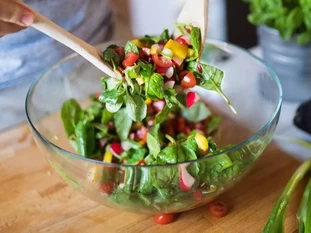
tourner une salade avec des couverts

In principle, of course, there's nothing revolutionary about it, but in practice, it's not so easy, especially if you have large pieces in your salad, for example a green salad with its leaves whole, not cut into chiffonade.

Pouring the dressing over it is no problem, but mixing it is not so easy. Naturally, you use your (salad) cutlery and try to do the best you can to mix it.
There's no secret about it, though: there's a big risk of getting a lot of sauce on the side (especially if the salad bowl is quite full), and it's very easy to get a few drops of sauce on your clothes.
When we were kids, my grandmother used to let us toss the salad, and we loved it. When we succeeded, she'd take one look at the contents of the salad bowl and say "You're ready for your wedding!" Maybe yours is too?

But let's face it, this cutlery method isn't very efficient, nor very quick, so how can we do it any other way?

Let's take a look at what's done in restaurants: they make all kinds of salads, and how do they turn them?
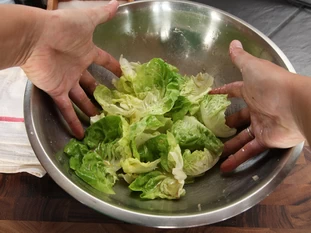
tourner salade à la main

It's both simple and ultra-efficient: they pour the dressing over the salad, often in a high-sided container, and then a cook stirs the whole thing with his or her hands, often gloved, which takes a few seconds for a perfectly turned salad, which is then arranged on the serving plates.

It's as simple as I said, you just don't have to be afraid of getting your hands "sauced".

To sum up: to turn a salad quickly and efficiently, it's best to go at it with both hands.
Lasts posts
Butter vs. grease
Butter vs. grease
We often read in a recipe where a pastry is put into a mould that, just before pouring, the mould should be buttered or greased. But what's the difference between these 2 terms?
December 1st 20257045
Getting out of the fridge early
Very often when you're cooking, you need to take food or preparations out of the fridge, to use them in the recipe in progress. There's nothing tricky about this: you just take them out of the fridge and use them, usually immediately, in the recipe. But is this really a good method?
November 24th 20259755
Who's making the croissants?
When you look at a bakery from the outside, you naturally think that in the bakery, the bakers make the bread, and in the laboratory, the pastry chefs make the cakes. It's very often like that, with each of these professions having quite different ways of working, but sometimes there's also one...
November 23th 2025876
Oven height
Oven height
When we put a dish or cake in the oven, we naturally tend to put it on the middle shelf, and that's what we usually do. But in some cases, this position and height can be a little tricky, so let's find out why.
October 8th 20252,4855
The importance of sieving
In recipes that use a fine powder (flour, powdered sugar, etc.), you'll often see the advice to sift before using it. To sift is to pass the powder in question through a sieve (a very fine strainer) before incorporating it into your recipe. It's often advice, but is it really useful?
September 3rd 20257,3613

Other pages you may also like
How to avoid lumps
How to avoid lumps
You've probably come across this unpleasant phenomenon where, when you try to incorporate an ingredient (usually a solid or powder) into a preparation (usually a liquid), the mixture doesn't mix properly and you end up with little "balls" or little lumps of the solid part that refuse to mix with the...
October 9th 202022 K4.8
What is the difference between bakery and patisserie?
This is a question that you may well have asked yourself and which I will attempt to answer. In France the two trades of "boulangerie" (bakery) and "pâtisserie" (patisserie and confectionery) have always been quite distinct, but where exactly do the boundaries lie? .
February 7th 2017134 K 14.1
Egg yolks and caster sugar
We often come across recipes where we need to mix egg yolks with caster sugar. This would appear to be a very ordinary and simple thing to do but, be warned, these two ingredients can behave oddly together.
February 15th 201882 K 24.3
The beautiful story of the croissants
As you may have already noticed, cooking, baking and pastry-making are full of stories or legends, usually very romantic, about this or that product or recipe. This is often the case for named recipes, for example tarte tatin, peach melba, paris-brest and many others, but it also applies to very...
October 10th 201819 K5
Tranché, dissociated, failed, in short... missed!
When preparing a sauce or a cream, there's always a (small) risk that the creamy preparation you're working on will suddenly separate into two parts of different textures: a liquid part, for example, and a more or less solid part, or even become lumpy. It's terribly frustrating, but we'll see...
June 19th 202312 K5
Post a comment or question
Posted by:
I am not a leaving thing

Follow this page
If you are interested in this page, you can "follow" it, by entering your email address here. You will then receive a notification immediately each time the page is modified or a new comment is added. Please note that you will need to confirm this following.
I am not a leaving thing
Note: We'll never share your e-mail address with anyone else.
Alternatively: you can subscribe to the mailing list of cooling-ez.com , you will receive a e-mail for each new recipe published on the site.

Back to top of page