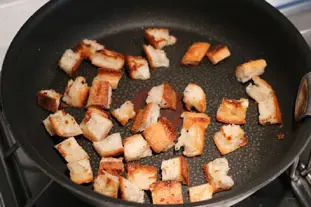
Croutons


Croutons
Do you use croutons, that typically French trick of toasting small pieces of bread on the side to add to a recipe?

They're just delicious, but you need to know 2 or 3 things about them.
10 K 5/5 (17 reviews)
Grade this page:
Keywords for this post:BreadCroutonsRecoveryToasted
Last modified on: December 30th 2020
For this post: Comment Follow Ask me a question Send to a friend
Croutons

Don't buy them

Commercial croutons are overpriced compared to what they cost in real life, they're generally made with industrial bread of very mediocre quality, and above all they're made with a lot of more or less dodgy stuff: lots of salt, artificial flavoring, extra fat, etc. Avoid them at all costs. Avoid at all costs.
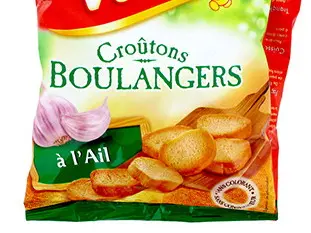
croutons industriels

A great way to recycle stale bread

There's no need to use fresh bread to make them; on the contrary, they're much easier to make and detail when the bread is a little dry.

How to make them?

It's very simple:

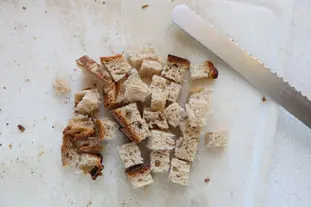
découpe croutons


- Cut one or two slices of slightly stale bread with a saw knife, ideally into 1 cm cubes. Depending on your taste, you can use only the crumb of the bread (whiter), or the crumb + crust (more color and flavor).
- In a frying pan over high heat, heat either a little olive oil or a little butter ( clarified if possible), depending on your taste.
- When it's hot, add the bread cubes all at once, stirring quickly to distribute the fat evenly.

Note that the bread cubes act like sponges, sucking up all the fat, but you mustn't add any more, as it would be sucked up again, and this time it would be too greasy.
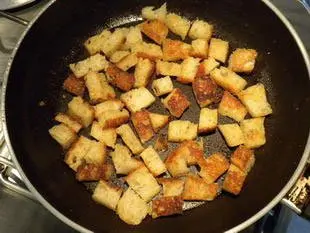
croutons


- Brown the croutons, stirring regularly to evenly brown them.
- Season with salt and pepper at the end of cooking

Use in your chosen recipe, croutons transcend salads in particular, where they bring a contrast of crunchiness, and even of hot-cold if incorporated right out of the pan.

Possible variations:

- Rub the bread pieces with a clove of garlic or 1/2 shallot before cooking.
- Instead of salt and pepper, sprinkle cooked croutons with curry powder, paprika, turmeric or other spices of your choice.

Tosum up: It's much better to make your own croutons, as they taste better and cost less.
Lasts posts
Butter vs. grease
Butter vs. grease
We often read in a recipe where a pastry is put into a mould that, just before pouring, the mould should be buttered or greased. But what's the difference between these 2 terms?
December 1st 20251,7105
Getting out of the fridge early
Very often when you're cooking, you need to take food or preparations out of the fridge, to use them in the recipe in progress. There's nothing tricky about this: you just take them out of the fridge and use them, usually immediately, in the recipe. But is this really a good method?
November 24th 20251,3295
Who's making the croissants?
When you look at a bakery from the outside, you naturally think that in the bakery, the bakers make the bread, and in the laboratory, the pastry chefs make the cakes. It's very often like that, with each of these professions having quite different ways of working, but sometimes there's also one...
November 23th 20251,214
Oven height
Oven height
When we put a dish or cake in the oven, we naturally tend to put it on the middle shelf, and that's what we usually do. But in some cases, this position and height can be a little tricky, so let's find out why.
October 8th 20253,5855
The importance of sieving
In recipes that use a fine powder (flour, powdered sugar, etc.), you'll often see the advice to sift before using it. To sift is to pass the powder in question through a sieve (a very fine strainer) before incorporating it into your recipe. It's often advice, but is it really useful?
September 3rd 20258,1103

Other pages you may also like
Clean your mixer easily
If you use a "bowl" or "blender" mixer, as opposed to a plunger, you've probably noticed that it's a bit of a hassle to clean it after use. And yet, with a simple trick, it can be done very quickly. See how here.
June 26th 20248,3035
Artichoke stalks
Artichoke stalks
When preparing artichokes for cooking, you may well already know that we often need to remove the first round of leaves, if they are tatty or dirty, as well as the inedible stalk. The operative word here is “remove” , rather than “cut off”.
October 25th 201654 K4.3
Foie gras service
Foie gras service
For the upcoming christmas meals you too may be sacrificing to the tradition of foie gras? If so, I suggest you take a look at everything that revolves around serving foie gras: how to serve it, and what to eat and drink with it.
December 23th 201716 K4.9
Rosemary in recipes
Rosemary in recipes
Rosemary, as I’m sure you know, is a culinary herb, one of the famous French "herbes de Provence", and is very effective in bringing a real taste of the Mediterranean to any dish. The classic way to use it in a recipe is to add a sprig or two and leave it in during cooking as a way of...
April 18th 201824 K4.7
The first breads of humanity?
I have already told you in a previous article the beautiful story of the croissants, but do you know what it is about the bread, who "invented" it, where and when? Well, you can imagine that recent discoveries, in 2018, have profoundly changed the history of bread.
February 16th 201914 K5
Post a comment or question
Posted by:
I am not a leaving thing

Follow this page
If you are interested in this page, you can "follow" it, by entering your email address here. You will then receive a notification immediately each time the page is modified or a new comment is added. Please note that you will need to confirm this following.
I am not a leaving thing
Note: We'll never share your e-mail address with anyone else.
Alternatively: you can subscribe to the mailing list of cooling-ez.com , you will receive a e-mail for each new recipe published on the site.

Back to top of page