When should I change my knife?


When should I change my knife?
I already spoke to you in a previous post about knives, those without which nothing is possible (or almost) in the kitchen, so I'm going to come back to them a bit and try to answer the question "When should I change my knife?
16 K 4.7/5 (15 reviews)
Grade this page:
Last modified on: November 2nd 2017
For this postComments Lasts posts Follow
For this post: Comment Follow Ask me a question Send to a friend
You may remember how important it is to pay a lot of money for your knives, and to choose models with a stainless steel blade, a handle made of a composite material often called "plastic", etc. This is still true, and I dwell a little on the blade, which being made of steel, with time dulls, sharpens and must therefore be regularly sharpened. This is always true, and I dwell a little on the blade, which being steel, with time dulls, de-sharpens and must therefore be regularly sharpened.

The best way to do this is to use a sharpener, and in an elegant gesture (but unfortunately not easy to catch) you sharpen the blade again. To make a long story short, you should always have razor-sharp knives, it's always much more pleasant to cook with.

Let's come back to this knife sharpening, it turns out that in the gesture of sharpening, one naturally accentuates one's effort on the middle-lower part of the knife blade, and therefore it is there that the wear will be the fastest. This wear can be seen over time, it creates in the blade of the knife, very slowly, a small hollow, a slight curvature, which you can see on this photo (red arrow):
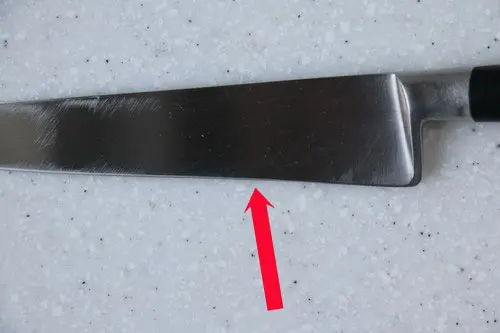
used knife


This hollow, if visible, is a sign that your knife is at the end of its life in "kitchen" mode: You will find it difficult to sharpen it, more and more, so it will cut less well, and will not be ideal for cooking.

To make a comparison, see these 2 knives side by side:
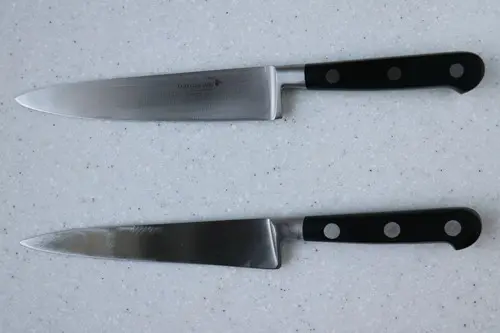
worn knife vs. new knife


The top one is new, the bottom one has lived well, note the hollow of the blade at the bottom, and the nice rounding of the top one.

It's time to change the bottom one, of course you shouldn't throw it away, but use it for something else than cooking (garden, DIY, ?) or recycle it.

Well, it's not always easy, we are often attached to our tools, that we have well in hand, but it is necessary to take the step, the old knives even if they have a sentimental value, can become a brake to your good cooking.


To sum up: When the blade of your knife starts to get hollow, it is time to think about changing it.
Lasts posts
Serving Temperature for Wine
When it comes to serving wine, you may (like me) have a fairly simple rule of thumb: red wine at room temperature, and white, rosé, and yellow wines in the fridge until it’s time to serve them. It’s very easy to remember, but it’s a bit simplistic, and you’ll see that there’s a much...
September 23th 20268155
Hot Emulsified Sauces
In French cuisine, sauces are a very important part of a recipe—not just a side dish. In fact, they’re so important that, especially since the time of Auguste Escoffier, they’ve been classified into categories. And among these categories are “hot emulsified sauces,” or lukewarm ones. ...
September 9th 20261,2355
Hot Dishes and Cold Dishes
When plating or serving a dish—whether hot or cold—on a plate, it’s very important to make sure they’re both the right temperature; in other words: if the dish is hot, the plate should be hot, and conversely, if the dish is cold, the plate should be cold. Is this really important? Let’s...
September 2nd 20269713
In baking, cold is your friend
When you bake at home—especially when making pie crusts—you’ve probably noticed that it’s quite difficult to work with the dough when it’s hot. It gets soft, is hard to roll out, and breaks or crumples very easily. And this doesn’t just happen when it’s hot—even in a comfortable...
August 26th 20261,0005
With vinegar?
When you buy a jar of pickles labeled “in vinegar,” you’re looking for their tangy, crunchy flavor to go with cold cuts, sandwiches, or salads. You expect to find small gherkins preserved in vinegar, with salt and herbs, but is that really the case?
July 15th 20261,9544.8
Other articles you might also like
How to sprinkle well?
When in a recipe you need to sprinkle something, that is to say to spread a fine layer of powder (flour, sugar, etc.) on something, powdered sugar on a pie for example, you will probably use a fine strainer or a sieve, this is the best way to proceed. But is that all?
May 23th 202312 K4.7
Clean your mixer easily
If you use a "bowl" or "blender" mixer, as opposed to a plunger, you've probably noticed that it's a bit of a hassle to clean it after use. And yet, with a simple trick, it can be done very quickly. See how here.
June 26th 20249,8285
5 really useful cooking tips
Cooking is about recipes, of course, but it is also an impressive collection of small gestures, ways of doing things, knowing what to do and what not to do. All these little tips and tricks can be very important: they can affect the way a recipe turns out, simply because you did just the right...
March 29th 201625 K4.9
Drawing a pattern in pastry
Often in the kitchen, in pastry-making, or in baking, we need to trace a pattern on a pastry. It's just a question of aesthetics but it has its effect after baking on a galette, pithiviers, pâté en croute (terrine in a pie crust), etc.
May 23th 201939 K4.1
The right way to cook potatoes
If you simply boil them (not steam them), or bake them in the oven, at some point you will have to ask yourself the question "are they well cooked?".
March 23th 202018 K4.7
Post a comment or question
Posted by
I am not a leaving thing
Follow this page (as 3 people already do)

Receive an e-mail as soon as this page is modified or receives a new comment.

I am not a leaving thing
We'll never share your e-mail address with anyone else.
Alternatively: you can subscribe to the mailing list of cooling-ez.com , you will receive a e-mail for each new recipe published on the site.

Back to top of page