The right weight of pastry for a pie


The right weight of pastry for a pie
Let's try to solve a thorny problem: How much dough will I need when I make my next pie?

You're planning to make a pie, you're going to use your favourite mould or circle, but how much pastry will you need to fill it completely with a well spread pastry, without being too thin, or on the contrary end up with a lot of extra pastry?
67 K 4.3/5 (42 reviews)
Grade this page:
Keywords for this post:BakingTipsWeightDoughPiePanDiameter
Last modified on: March 20th 2020
For this post: Comment Follow Ask me a question Send to a friend
The right weight of pastry for a pie
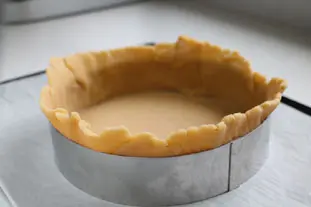
This is not at all obvious actually, as ideally once the mould is lined it should only stick out about 1cm.

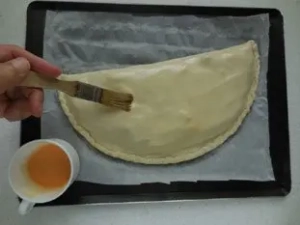
pie dough sticking out of the pan


You can of course use your own judgement, but at home I often use a 22 cm diameter (the small one), or sometimes 26 (the large one), and in any case I always get a 300 gr cake. And of course sometimes the big one is good, and sometimes the small one is too much. Well, it's not a tragedy either, if I have extra dough, I take advantage of it to make a few more tarts and it's fine.
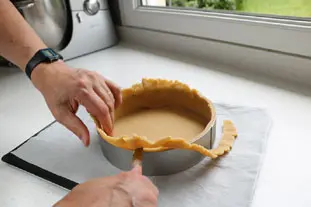
excess pastry pie


By the way, if it's shortcrust pastry, there will never be any excess pastry, because it will be eaten, as soon as my back is turned, by the raw pastry aficionados I have at home...

Well, it's not all that, but can we do a little better than au pif? Yes, it's a pastry chef's trick, this weight of dough thing, and as they are people of numbers, of rigour, of precision, of grams and degrees, they have invented a kind of magic formula for that, linked to the diameter of your mould. It looks like this:

Weight of dough needed (gr) = diameter of the mould (mm) + 20.

For example, you have a 22 cm mould => 220 mm + 20 = 240 => you need 240 gr of batter.
Another example, 26 cm mould => 260 mm + 20 = 280 => you need 280 gr of batter.
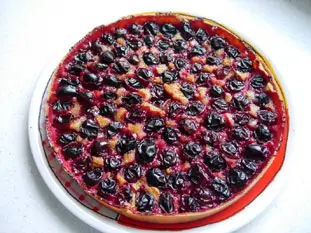
plum tart


Very simple, isn't it? Well, be careful we're only one cow away anyway, and if you're not comfortable with a rolling pin to roll out the dough feel free to increase the magic number, and go from 20 to 30, or even 40.

In summary: To determine the right weight of pastry you need with your tart tin, you can apply the "magic" formula: pastry weight in gr = tin diameter in mm + 20.
Lasts posts
Butter vs. grease
Butter vs. grease
We often read in a recipe where a pastry is put into a mould that, just before pouring, the mould should be buttered or greased. But what's the difference between these 2 terms?
December 1st 20251,1855
Getting out of the fridge early
Very often when you're cooking, you need to take food or preparations out of the fridge, to use them in the recipe in progress. There's nothing tricky about this: you just take them out of the fridge and use them, usually immediately, in the recipe. But is this really a good method?
November 24th 20251,1995
Who's making the croissants?
When you look at a bakery from the outside, you naturally think that in the bakery, the bakers make the bread, and in the laboratory, the pastry chefs make the cakes. It's very often like that, with each of these professions having quite different ways of working, but sometimes there's also one...
November 23th 20251,099
Oven height
Oven height
When we put a dish or cake in the oven, we naturally tend to put it on the middle shelf, and that's what we usually do. But in some cases, this position and height can be a little tricky, so let's find out why.
October 8th 20252,9745
The importance of sieving
In recipes that use a fine powder (flour, powdered sugar, etc.), you'll often see the advice to sift before using it. To sift is to pass the powder in question through a sieve (a very fine strainer) before incorporating it into your recipe. It's often advice, but is it really useful?
September 3rd 20257,6883

Other pages you may also like
The so-called "nervous" meats
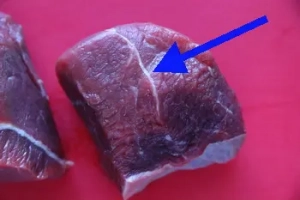
You've probably heard this before, we're talking about "nervous" meat, or meat with nerves, to describe what is indicated by the blue arrow on the left. This is a piece of beef, and what we call a nerve is not a nerve, it is in fact collagen (chemists sometimes call it a "collagen sink"), a...
April 16th 202137 K4.5
Candied fruits: don't get ripped off
Do you like candied fruit? You might like to nibble a handful or add it to a recipe, like a classic fruit cake or delicious Italian specialities like panettone or sicilian epiphany pie.
June 21th 201767 K 24.2
Perpetual stock
Perpetual stock
It's something you have probably have done yourself: cooked or pre-cooked vegetables before adding them to a recipe. This is almost always done the same way: peel the chosen vegetables (carrots, for example), cut them up, boil them in salted water (using a tablespoon or so of coarse salt per litre),...
November 22th 201631 K5
Egg yolks and caster sugar
We often come across recipes where we need to mix egg yolks with caster sugar. This would appear to be a very ordinary and simple thing to do but, be warned, these two ingredients can behave oddly together.
February 15th 201883 K 24.3
Drawing a pattern in pastry
Often in the kitchen, in pastry-making, or in baking, we need to trace a pattern on a pastry. It's just a question of aesthetics but it has its effect after baking on a galette, pithiviers, pâté en croute (terrine in a pie crust), etc.
May 23th 201935 K4.1
Post a comment or question
Posted by:
I am not a leaving thing

Follow this page
If you are interested in this page, you can "follow" it, by entering your email address here. You will then receive a notification immediately each time the page is modified or a new comment is added. Please note that you will need to confirm this following.
I am not a leaving thing
Note: We'll never share your e-mail address with anyone else.
Alternatively: you can subscribe to the mailing list of cooling-ez.com , you will receive a e-mail for each new recipe published on the site.

Back to top of page