This site uses only a few technical cookies necessary for its operation. By continuing to browse, you accept their use.
To find out more...
To find out more...
Preserving egg yolks
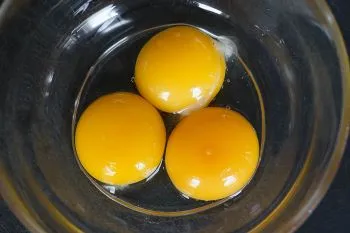
If you're using only the egg whites in a recipe (such as meringues ), you'll need to store the yolks until you're ready to use them again.
There's nothing very complicated about this in principle - all you have to do is chill them, but there are a few pitfalls to be avoided in practice.
There's nothing very complicated about this in principle - all you have to do is chill them, but there are a few pitfalls to be avoided in practice.
9,832 5/5 (35 reviews)
Keywords for this post:YolkEggStorageFridgeColdLast modified on: June 18th 2024
Preserving egg yolks
Intact yolks if possible
Here's something to keep in mind: whole, or intact, yolks keep much better than if they're punctured, or liquid.This is because the thin film that forms them, the membrane, also protects them from the outside, and prevents them from drying out.
So, as long as possible, keep them in their intact form, even if in your next recipe you'll have to crack them to incorporate them. It's best to do this at the last minute.
The enemy of yolks: dryness
The simplest and most natural way to chill yolks is to put them in a ramekin (or other small container), and place it in the fridge.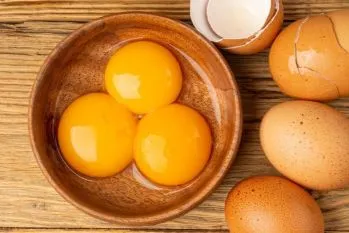
Well-preserved yolks
So how do you keep your yolks in good condition?You just need to do 2 things:
1) Put 1 teaspoon of neutral oil or even water in the bottom of the container before the yolks, then pour in the yolks.
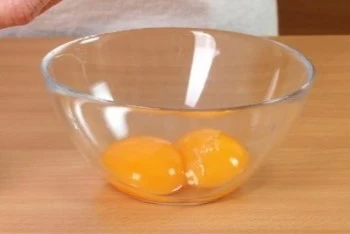
2) Wrap the container with the yolks at all costs, or use a container with a lid, to isolate them from the air as much as possible.
Don't worry either, if you get one or more yolks punctured, it's no big deal, just a little less easy to handle, as the liquid yolks are very thick and sticky, and you'll have a bit of trouble emptying the container completely without loss (a maryse will be almost indispensable).
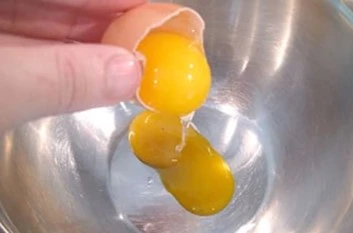
To sum up: try to keep your yolks intact, in a filmed or closed container, over a teaspoon of oil or water to prevent them from sticking.
Lasts posts

Cut twice as fast
When you need to cut something long into small pieces, for example chopped chives or the stem of a spring onion, there's a simple gesture that doubles your cutting speed. Let's see how.May 21th 20261,717

The other use for bowl scraper
Your kitchen or bakery utensils may include a horn (left) or a pastry cutter (right). These practical utensils are normally used to scoop the contents of a bowl or salad bowl - the horn - or to cut dough - the pastry cutter. But they also have another, very practical use - let's see what it is.May 9th 20261,619

The strange foam of potatoes in milk
As you may have already noticed, when you cook potatoes in milk, especially in small pieces (slices or cubes) for a gratin for example, a surprisingly abundant white foam forms on the surface. Where does it come from?April 26th 20261,839

A little leftover butter
Very often when you're making a cake, your recipe will tell you to melt some butter and mix it into the batter - a classic for cookies, cakes, moelleux and the like. And every time you do this, you'll have to butter the baking tin to prevent the dough from sticking during baking. Naturally,...April 16th 20261,8005

A tablet holder
Perhaps you too cook by consulting your recipe on a tablet or phone, and putting it down on your worktop? It's practical, but not the best solution. Here's a look at how you can make an inexpensive, almost universal stand.March 14th 20262,3985
Other pages you may also like

Different kinds of pastry and dough
When cooking in general, and particularly in baking, we can make and use many different kinds of pastry and dough. All built on the same "base": flour - a powder to which we add fat, liquid or both to produce the dough which is then cooked. .November 6th 2012113 K 14.0

The different cooking modes
In cooking, cooking means bringing food into contact with a source of heat, to transform it: improving its taste, and sometimes its texture. This contact with the heat source can be achieved in a number of ways: these are the cooking methods, and let's take a look at the main ones.July 24th 202410 K4.7

Is it really necessary to cream egg yolks?
Let’s try and answer a question that crops up in cookery and patisserie, even if it verges on the existential: do the egg yolks in a custard recipe really need to be beaten until pale, or not?February 28th 201845 K4.3

The "pith" of the cauliflower
When using cauliflower in a recipe, there is a lot of preparation work at the beginning: removing the leaves, taking the tops or florets, etc. It's a bit tedious, but in the end you're left with the best of the cauliflower, ready to be used in your recipe.February 5th 202215 K4.9

Toss the salad
When you've finished preparing a salad, green or otherwise, it's usually time to add the dressing and toss. It's often said to "toss the salad", which means to season and mix. Is it easy? Not so easy...March 8th 202414 K5
Post a comment or question
Follow this page
Receive an e-mail as soon as this page is modified or receives a new comment.
We'll never share your e-mail address with anyone else.
Alternatively: you can subscribe to the mailing list of cooling-ez.com , you will receive a e-mail for each new recipe published on the site.