Roasting spices


Roasting spices
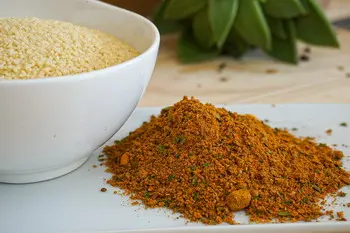
If you like your food a little, or a lot, spicy, you'll no doubt have a jar or sachets of mixed spices in your cupboards from which to draw when preparing a dish.
I'm thinking, for example, of curries, chili and couscous, all of which fill the kitchen, and sometimes far beyond...
10 K 4.9/5 (16 reviews)
Grade this page:
Keywords for this post:TastesFlavorsSpicesRoasting
Last modified on: October 30th 2020
For this post: Comment Follow Ask me a question Send to a friend
Roasting spices
At some point in the creation of your recipe, you will add the spices of your choice, in proportions to suit your own taste or that of your guests. The question is: when should you add them, is there a better time than another?

In most recipes, spices are added at just about any time, so it doesn't really matter, as the dish usually cooks for a long time and the aromas have plenty of time to develop.
This isn't quite true: in truth, there is an optimum moment, and it's not when the dish is practically finished - quite the contrary.

What we're all trying to achieve is that the spices reveal themselves completely with cooking, especially if they've been in their jars or sachets for (a little too) long, where they've had a chance to "pass through" a little.
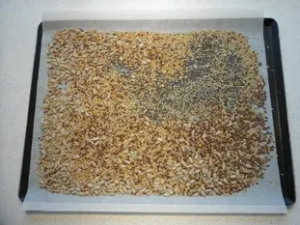
The ideal way to cook spices is to roast them, i.e. cook them, almost on their own, to reveal their flavours before putting them in contact with all the other foods.

For the recipes mentioned above, you'll have a meat base that will be cooked for a long time with spices, so here's how to do it:

- To begin with, place the meat, generally cut into pieces, in your saucepan, casserole or stewpot, add a little fat, and brown it, i.e. grill just the surface, over a very high heat.
- Once it's done, it's time to add the spices all at once (the powerful smells will jump out at you, so light your hood if you haven't already), stirring well to coat the meat with them, it's very dry, a little strange, agglomerated, not to worry.
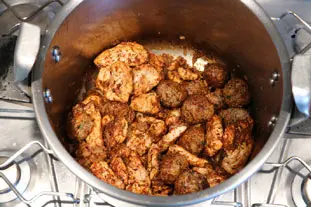
épices et viandes dans un couscous

- Cook and roast the spices and meats for 2 or 3 minutes, stirring regularly.
- Then continue as normal, adding the vegetables or kidney beans, water, etc. etc.
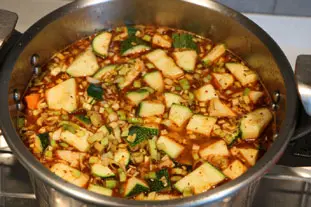
épices et légumes dans un couscous

By proceeding in this way, your spices will give the best of themselves, and marry even better, first with the meats, then with the rest of the foods in your recipe.
It's quite simple, with few constraints, and you'll see that the results are just as good.

To sum up: if you're making a recipe that contains powdered spices, try roasting them and cooking them on their own or with just the meats before continuing with the recipe, as they'll taste much better.
Lasts posts
XO Cognac Explained: Meaning, Aging, and Flavor Profile
XO Cognac always goes beyond the labels on the bottle: it is often associated with tradition and quality. You get to appreciate the artistry, character and ageing process when you understand what defines this smooth Cognac. The section below tackles everything about XO Cognac, from complex flavour...
January 28th 2026723 Sponsored article
Butter vs. grease
Butter vs. grease
We often read in a recipe where a pastry is put into a mould that, just before pouring, the mould should be buttered or greased. But what's the difference between these 2 terms?
December 1st 20252,5125
Getting out of the fridge early
Very often when you're cooking, you need to take food or preparations out of the fridge, to use them in the recipe in progress. There's nothing tricky about this: you just take them out of the fridge and use them, usually immediately, in the recipe. But is this really a good method?
November 24th 20251,6455
Who's making the croissants?
When you look at a bakery from the outside, you naturally think that in the bakery, the bakers make the bread, and in the laboratory, the pastry chefs make the cakes. It's very often like that, with each of these professions having quite different ways of working, but sometimes there's also one...
November 23th 20251,485
Oven height
Oven height
When we put a dish or cake in the oven, we naturally tend to put it on the middle shelf, and that's what we usually do. But in some cases, this position and height can be a little tricky, so let's find out why.
October 8th 20254,8825

Other pages you may also like
Kitchen ovens
Kitchen ovens
You certainly have one in your kitchen, an oven, the essential tool for all kinds of cooking, whether in the kitchen of course, but also in pastry, bakery, pizza, and many others. Here is some information on its structure and operation.
May 16th 202034 K4.4
The right weight of pastry for a pie
Let's try to solve a thorny problem: How much dough will I need when I make my next pie? You're planning to make a pie, you're going to use your favourite mould or circle, but how much pastry will you need to fill it completely with a well spread pastry, without being too thin, or on the contrary...
March 20th 202067 K4.3
The right way to cook potatoes
If you simply boil them (not steam them), or bake them in the oven, at some point you will have to ask yourself the question "are they well cooked?".
March 23th 202016 K4.7
Circles vs. moulds tins
If you like to bake or make quiches, pies etc. you must surely have one or more pie pans at home, in different diameters and perhaps materials. They are indispensable, without them there is no way to make beautiful pies, and they work very well, but you have another option, instead of moulds,...
October 2nd 202017 K5
 Pastry and bakery dough families
Pastry and bakery dough families
There are many kinds, or families, of pastry and bakery doughs, depending on whether you want to make a tart, a cake, a pie, a brioche, croissants and so on. I'll try to give you a quick overview of all these doughs, how they're classified, and what they're used for.
November 16th 202014 K4.9
Post a comment or question
Posted by:
I am not a leaving thing

Follow this page
If you are interested in this page, you can "follow" it, by entering your email address here. You will then receive a notification immediately each time the page is modified or a new comment is added. Please note that you will need to confirm this following.
I am not a leaving thing
Note: We'll never share your e-mail address with anyone else.
Alternatively: you can subscribe to the mailing list of cooling-ez.com , you will receive a e-mail for each new recipe published on the site.

Back to top of page