This site uses only a few technical cookies necessary for its operation. By continuing to browse, you accept their use.
To find out more...
To find out more...
In praise of Mont d'Or cheese
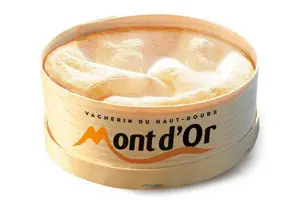
Do you know the Mont d'Or, this extraordinary cheese from the Haut-Doubs in France, with a unique taste and appearance, which can be eaten both raw and cooked?
I'll tell you a few words about it, and with some tips on how to choose it and cook it.
I'll tell you a few words about it, and with some tips on how to choose it and cook it.
14 K 5/5 (14 reviews)
Keywords for this post:CheeseFranche-comtéJuraDoubsCreamyVacherinLast modified on: November 27th 2021
In praise of Mont d'Or cheese
What is Mont d'Or?
The Mont d'Or is a cheese that comes exclusively from a small area of appellation that is located in the upper part of the Doubs department, in Franche-Comté, in the Jura mountains.It is a cow's cheese, whose milk, raw only, is strictly controlled: Montbéliarde or "pie rouge de l'est" breed exclusively, grass/hay feed only, no silage, and a production area delimited in surface and in altitude, 700 meters minimum.

It is also a seasonal cheese, it is only produced from 15 August to 15 March and only sold from 10 September to 10 May approximately, these dates are under the jurisdiction of the Prefect of the Doubs who publishes a decree each year authorising both.
Yes, it is a regulated cheese...
Add to all its specificities a unique packaging, the cheese is put in a spruce box, in which it is surrounded by a strap of inner bark of spruce, the liber.
This strap is collected by people called "sangliers" or "sanglières", just after the felling of the spruce trees and before their skidding, it contributes to the taste of the cheese, woody of course.

Once the scene is set, what do we have?
A rather exceptional cheese, AOC in 1981 and AOP in 1996, known since the Middle Ages, creamy, tasty and made only with good raw milk from local cows, which only graze, and always have horns and bells, the "clarines".
How to choose it?
Since it is strictly regulated and protected, you have very little risk of being cheated, just check on the box where it comes from, make sure it has a postcode starting with 25 or 39.You can easily find it in supermarkets, or better still at your local cheese shop.
At the beginning of its maturity the Mont d'Or is quite flat, then as it matures the top of the cheese becomes more undulating, creating "waves" that the people of France call "fesses" (buttocks), "A good Mont d'Or must have beautiful fesses" they like to say...
So if you have an irregular top of cheese (like on the picture below) it's a good sign, it is mature.
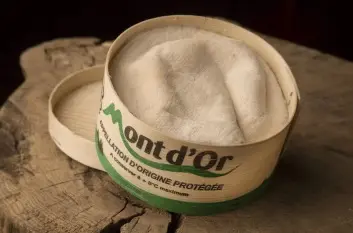
Keep it in the fridge if it is already well advanced, at room temperature or in the fridge if it is a bit young.
Tasting
If you eat it cold, like a classic cheese, it must be at room temperature and well done, it is then very creamy, almost runny.Traditionally, it is tapped vertically with a (small) spoon to serve it to yourself, no chunks are cut off like for a Camembert for example.
As with all cheeses, choose a bread of your own taste, a gogod one made by your baker, if possible with sourdough, but this is a very personal taste.
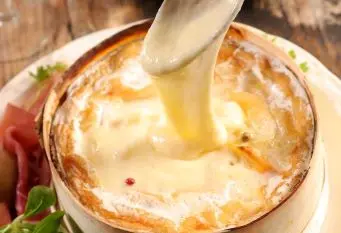
If you eat it hot, it is the famous "hot box", in this case put your oven at 360°F (180°C) and put your potatoes in.
After 15 minutes, add the Mont d'Or in its box, until it is melted and the top crust is well toasted, usually the potatoes are cooked at the same time.
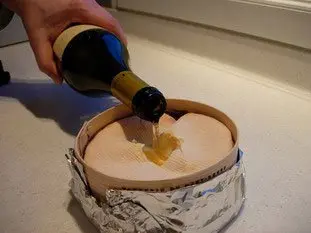
Traditionally, before putting the cheese in the oven, make a small hole in the middle with a spoon, and fill the cavity with dry white wine, from the Jura if possible.
Discreetly devour the piece of cheese removed on a small piece of bread, while serving yourself a glass of the same wine, guaranteed pleasure, certainly a little selfish, but it is the privilege of the one who puts the cheese in the oven.
Note that 360°F (180°C) is the right temperature, beyond that the cheese in a too hot oven can slice and dissociate.
Place the potato dish, the Mont d'Or and any delicatessen in the middle of the table, then each person helps himself or herself by peeling and cutting the potatoes and sprinkling them with melted cheese.
Always serve the same wine to your guests, and enjoy this fabulous moment of sharing...
I'll end by telling you that our Swiss neighbours make a very similar cheese which they call "Vacherin mont d'or", but which can be made from thermised milk, not just raw milk.
On the other hand, their AOP requires them to have locally produced straps, so Swiss or French, while some big French cheese factories buy cheap straps from Eastern Europe, for a question of cost of course.
What a pity this sad commercial logic, with all the spruce forests around.

In summary: Mont d'or is an extraordinary creamy and tasty cheese, which can be eaten both raw and cooked.
PS: If you taste Mont d'Or with a "traditional French" baguette (the best ones), not only is it delicious, but you will also be tasting the only bread-cheese association in the world that is regulated, as both this cheese and this bread are subject to regulations (decree and order). In France, food is a very serious matter...
Lasts posts

Cut twice as fast
When you need to cut something long into small pieces, for example chopped chives or the stem of a spring onion, there's a simple gesture that doubles your cutting speed. Let's see how.May 21th 20261,814

The other use for bowl scraper
Your kitchen or bakery utensils may include a horn (left) or a pastry cutter (right). These practical utensils are normally used to scoop the contents of a bowl or salad bowl - the horn - or to cut dough - the pastry cutter. But they also have another, very practical use - let's see what it is.May 9th 20261,684

The strange foam of potatoes in milk
As you may have already noticed, when you cook potatoes in milk, especially in small pieces (slices or cubes) for a gratin for example, a surprisingly abundant white foam forms on the surface. Where does it come from?April 26th 20261,887

A little leftover butter
Very often when you're making a cake, your recipe will tell you to melt some butter and mix it into the batter - a classic for cookies, cakes, moelleux and the like. And every time you do this, you'll have to butter the baking tin to prevent the dough from sticking during baking. Naturally,...April 16th 20261,9735

A tablet holder
Perhaps you too cook by consulting your recipe on a tablet or phone, and putting it down on your worktop? It's practical, but not the best solution. Here's a look at how you can make an inexpensive, almost universal stand.March 14th 20262,4695
Other pages you may also like

The perfect boiled egg
Making boiled eggs is always a delight and it pleases the young and old alike. This little transgenerational side puts them on the list of "things to do on Sunday evening when you don't know what to do" in many families (including mine)... That said, it's not that simple, you have to pay...January 30th 202119 K4.7

Baking cakes
Where we see that to put a cake in the oven, once the dough is finished and in its mould, there is no hurry and that the cold is your friend.June 28th 201947 K4.1

How to zest a fruit?
You will have no doubt noticed that many recipes call for the zest of citrus fruit. The zest is that outer layer of the skin which adds so much flavour to a dish. There are many different ways to peel off the zest and various tools are available. Here is a summary of the “dos and don'ts” of...November 5th 201349 K3.8

Cooking scallops
We are, as I write these lines, in the season of the scallops, if you like that it is necessary to benefit from it as much as possible, although it is alas not cheap. I like scallops a lot, but I have to admit that it has naturally little taste, or, said differently, it takes the taste of what...November 23th 202114 K5

Tranché, dissociated, failed, in short... missed!
When preparing a sauce or a cream, there's always a (small) risk that the creamy preparation you're working on will suddenly separate into two parts of different textures: a liquid part, for example, and a more or less solid part, or even become lumpy. It's terribly frustrating, but we'll see...June 19th 202315 K5
Post a comment or question
Follow this page
Receive an e-mail as soon as this page is modified or receives a new comment.
We'll never share your e-mail address with anyone else.
Alternatively: you can subscribe to the mailing list of cooling-ez.com , you will receive a e-mail for each new recipe published on the site.