The softness of sandwich bread


The softness of sandwich bread
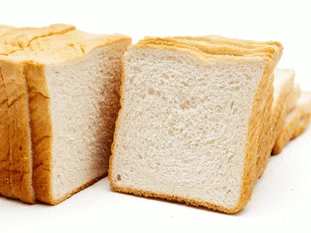
You're probably familiar with what's known in France as "pain de mie", a very white, molded and rather soft bread, widely used in cooking, particularly for croque-monsieur.

Let's find out what it's all about.
14 K 5/5 (1 reviews)
Grade this page:
Keywords for this post:BakeryBreadSandwich breadSoftAdditivesSugarIndustrialCrustCrumb
Last modified on: September 5th 2023
For this post: Comment Follow Ask me a question Send to a friend
The softness of sandwich bread
Bread is (or sometimes should be) simply wheat flour, water, salt and very little yeast and/or sourdough. This is the case for baguettes and a large proportion of breads in France.
Of course, many breads start from this base and are then enriched with a whole host of delicious additions such as seeds, fruit, cheese, etc. etc. to give so-called "special" (or "flavored") breads.
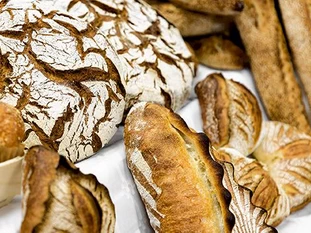
pains classiques
Another possibility is to use, in whole or in part, flours other than wheat flour, such as rye, oats, barley, etc.
You can even mix these 2 ways and obtain quite complex breads, sophisticated some would say, but delicious.

What about sandwich bread?

This is a very different matter: we're looking for a "simple" bread, rather white and soft, with very little crust and therefore no crispiness, but plenty of very white crumb.
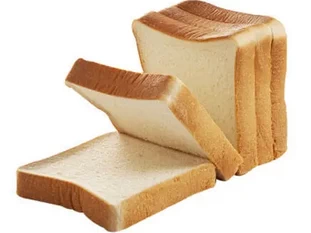
pains de mie
To achieve this, we modify the basic recipe (flour+water+salt+yeast) in 3 ways:
  • Replace the water with milk
  • Add a little sugar and butter
  • The amount of yeast is significantly increased.
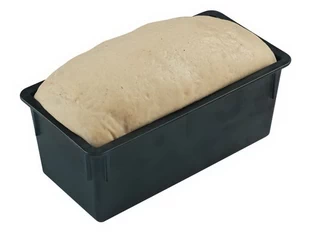
The resulting dough, which is rather rich, can be worked as for a normal loaf, but does not allow for the formation of conventional dough pieces, so the bread is pushed (puffed up) before baking in molds, which are generally square.
pains de mie en pousse

In practice, there are 2 different methods:
- Either the loaf is left to rise in an uncovered mold, which results in a colored loaf on top, with a typical rounded shape on top, due to the fact that the dough is contained on 3 sides, but the top is free.
- Alternatively, the bread can be baked in a closed mold to obtain a very regular loaf, known as a "molded" loaf.
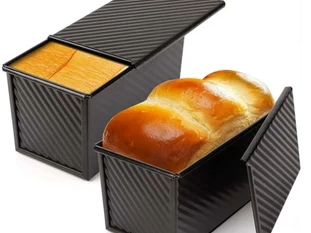
pains de mie moulé ou ouvert
These 2 methods only affect the shape of the bread, not its taste.

Sandwich bread is still bread?

Of course! It's a special kind of bread, quite different from the usual crusty bread, but it's the classic bread of Anglo-Saxon countries, among others.
Most sandwich loaves come from manufacturers, in plastic bags, molded into squares and already sliced.

So of course, whether you like sandwich loaves or not is a matter of taste, and of course that's debatable.
Like many people in France, I'm very attached to the crunchiness of bread, so I can't see myself eating only sandwich bread every day, but from time to time, and especially for a croque-monsieur or a welsh (for example), with pleasure.

But...

But there's a small "but", as much as a sandwich loaf can be very good if it's well made, we unfortunately find some very sad breads from these industrialists.
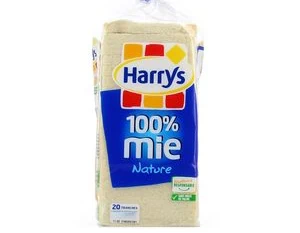
pains de mie industriel
Their obsession is with softness, and all their advertising and marketing is based on this ad nauseam, to see who can make the softest bread, even going so far as to remove the crust from some of their sandwich loaves.
This obsession with softness leads them to greatly increase the quantities of butter and sugar, and to add a host of chemical additives to ensure longer preservation.
You only have to read a label on an industrial sandwich loaf to realize the incredible list of additives in their products.

What's more, the taste of these industrial sandwich loaves is quite neutral, if not downright insipid, and they seem to be made only for toasting, where they (finally) take on a little taste.

A lost cause?

No, and fortunately there's your baker, who if he's a good craftsman, makes his own sandwich bread, and of a much higher quality than anything you'll find in the supermarket.
Trust him, he's put a lot of his knowledge and skill into his bread, and it would be a shame not to try it.

To sum up: Pain de mie is a variation on classic bread, oriented towards a loaf with very little crust and lots of white crumb. Industrial sandwich loaves are often of mediocre quality, so it's best to trust your baker.
Lasts posts
Cut twice as fast
Cut twice as fast
When you need to cut something long into small pieces, for example chopped chives or the stem of a spring onion, there's a simple gesture that doubles your cutting speed. Let's see how.
May 21th 2026644
The other use for bowl scraper
Your kitchen or bakery utensils may include a horn (left) or a pastry cutter (right). These practical utensils are normally used to scoop the contents of a bowl or salad bowl - the horn - or to cut dough - the pastry cutter. But they also have another, very practical use - let's see what it is.
May 9th 20261,143
The strange foam of potatoes in milk
As you may have already noticed, when you cook potatoes in milk, especially in small pieces (slices or cubes) for a gratin for example, a surprisingly abundant white foam forms on the surface. Where does it come from?
April 26th 20261,285
A little leftover butter
Very often when you're making a cake, your recipe will tell you to melt some butter and mix it into the batter - a classic for cookies, cakes, moelleux and the like. And every time you do this, you'll have to butter the baking tin to prevent the dough from sticking during baking. Naturally,...
April 16th 20261,2655
A tablet holder
A tablet holder
Perhaps you too cook by consulting your recipe on a tablet or phone, and putting it down on your worktop? It's practical, but not the best solution. Here's a look at how you can make an inexpensive, almost universal stand.
March 14th 20262,0025

Other pages you may also like
Cleaning endives
Cleaning endives
If you buy your endives elsewhere than in supermarkets, and in this case the best is of course from a market gardener, he or she is the one who planted and harvested them, in this case you will have endives full of earth or sand, depending on where they were grown, which is normal and reassuring, we...
March 24th 202028 K4.6
How to avoid lumps
How to avoid lumps
You've probably come across this unpleasant phenomenon where, when you try to incorporate an ingredient (usually a solid or powder) into a preparation (usually a liquid), the mixture doesn't mix properly and you end up with little "balls" or little lumps of the solid part that refuse to mix with the...
October 9th 202025 K4.8
The dissociation of a preparation
It may have already happened to you: You prepare a sauce, a cream, a ganache etc. and then suddenly or almost, the whole thing dissociates, and from a smooth mixture that you were preparing with love, you end up with a horrible thing with a more or less solid part and another liquid part. It's...
January 22th 202214 K4.9
Travel cakes
Travel cakes
You may have come across the term "travel cakes" ("gateaux de voyage" in french) for certain pastries, so let's take a look at what they're all about.
January 27th 20258,293
The importance of sieving
In recipes that use a fine powder (flour, powdered sugar, etc.), you'll often see the advice to sift before using it. To sift is to pass the powder in question through a sieve (a very fine strainer) before incorporating it into your recipe. It's often advice, but is it really useful?
September 3rd 202511 K3
Post a comment or question
Posted by
I am not a leaving thing

Follow this page

Receive an e-mail as soon as this page is modified or receives a new comment.

I am not a leaving thing
We'll never share your e-mail address with anyone else.
Alternatively: you can subscribe to the mailing list of cooling-ez.com , you will receive a e-mail for each new recipe published on the site.

Back to top of page