Parsley stems


Parsley stems
Parsley, whether curly or flat, is a delicious ingredient in many recipes, where it is used both raw and cooked.

When used raw, in a salad for example, where it always provides, alone or with other herbs, a remarkable freshness, only the leaves are kept.

And when used cooked?
8,815 3/5 (2 reviews)
Grade this page:
Keywords for this post:ParsleyHerbsStemsTasteSaucesCookingBouquet
Last modified on: July 28th 2025
For this post: Comment Follow Ask me a question Send to a friend
Parsley stems
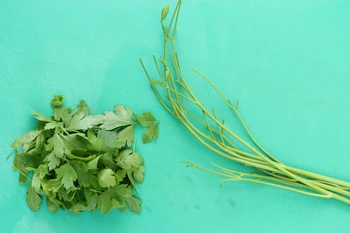
Parsley, unlike chives, for example, can be used both raw and cooked, but when cooking, don't neglect the stems, also known as "tails".

It's not obvious at first glance, but much of parsley's flavour is in the stems, so it's a good idea to put them in your saucepan for cooking.
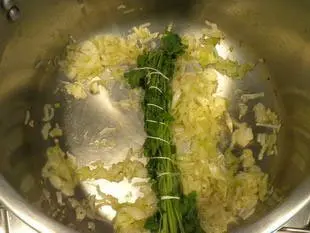
moules marinièresLet's take a recipe for mussels marinière as an example: heat a base of dry white wine with onion and parsley, and open the mussels (I'm oversimplifying).

Well, the big difference here is that the recipe uses the whole parsley, not just the leaves, because parsley tails are just as, if not more, important than the leaves when cooking. You can't eat them, but they add a lot to the taste, so you have to read "whole parsley sprigs (leaves + stems)" in the recipe, even if it says "parsley" in the list of ingredients, because it's very important for the recipe.

As they can't be eaten, it's a good idea to tie them with string into small bunches for easy removal at the end of cooking.

As a general rule, when a recipe calls for whole parsley, we often indicate "parsley sprig" instead of "parsley".

If you ever come across an old cookery book (before 1960/50, roughly speaking), you'll see that it's not uncommon to find recipes with "parsley tails" as an ingredient, mainly sauces in fact.
And parsley is one of the essential ingredients in the famous bouquet garni I've already told you about.

To sum up: for a recipe using cooked parsley, it's essential to use the whole sprig, leaves + stems.
Lasts posts
A little leftover butter
Very often when you're making a cake, your recipe will tell you to melt some butter and mix it into the batter - a classic for cookies, cakes, moelleux and the like. And every time you do this, you'll have to butter the baking tin to prevent the dough from sticking during baking. Naturally,...
April 16th 20265965
A tablet holder
A tablet holder
Perhaps you too cook by consulting your recipe on a tablet or phone, and putting it down on your worktop? It's practical, but not the best solution. Here's a look at how you can make an inexpensive, almost universal stand.
March 14th 20261,3815
Pre-calibrated pastry dough
When making pie dough (shortbread, shortcrust, sweet...), it's always a good idea to make a lot at once, and then divide it into pieces, which you can freeze. I've already pointed out the mistake not to make, which is to form a ball before freezing. It's difficult to roll out afterwards because...
March 9th 20261,2595
Butter vs. grease
Butter vs. grease
We often read in a recipe where a pastry is put into a mould that, just before pouring, the mould should be buttered or greased. But what's the difference between these 2 terms?
December 1st 20253,2825
Getting out of the fridge early
Very often when you're cooking, you need to take food or preparations out of the fridge, to use them in the recipe in progress. There's nothing tricky about this: you just take them out of the fridge and use them, usually immediately, in the recipe. But is this really a good method?
November 24th 20252,1905

Other pages you may also like
Making the most of seeds: Dry roasting
In cooking, and particularly in baking, there are a lot of seeds we can use, such as linseed, sesame, poppy, etc. Usually, recipes simply say to add them just as they are to the mixture or dough. To make a seeded loaf, for example, prepare a plain bread dough as usual, then, towards the end of...
January 30th 201564 K4.0
Drawing a pattern in pastry
Often in the kitchen, in pastry-making, or in baking, we need to trace a pattern on a pastry. It's just a question of aesthetics but it has its effect after baking on a galette, pithiviers, pâté en croute (terrine in a pie crust), etc.
May 23th 201937 K4.1
The so-called "nervous" meats
You've probably heard this before, we're talking about "nervous" meat, or meat with nerves, to describe what is indicated by the blue arrow on the left. This is a piece of beef, and what we call a nerve is not a nerve, it is in fact collagen (chemists sometimes call it a "collagen sink"), a...
April 16th 202139 K4.5
 The super powers of cornstarch
The super powers of cornstarch
I start this new year by evoking an old product, that you most probably have in your cupboards, a white powder, often in a small cardboard package with a slightly outdated look, only the "gluten free" is relatively recent, it is simply cornstarch, hence its name of maïzena. It's used for a lot...
January 14th 202216 K
No need to boil gelatin
Gelatin is a magical ingredient for making light, creamy, structured desserts, yet it's often misused in the kitchen. A common mistake in some recipes is the idea that it needs to be boiled for it to work properly, but this is a mistake indeed: gelatin melts at a much lower temperature, around...
November 21th 20249,8335
Post a comment or question
Posted by:
I am not a leaving thing
The 1 comment already posted on this page
  • A useful article, and that many younger folks may not have considered using the tails. (I always include full sprigs when making stock, for example.

    Thank you.
    Posted by Dave august 4th 2025 at 13:26 n° 1

Follow this page
If you are interested in this page, you can "follow" it, by entering your email address here. You will then receive a notification immediately each time the page is modified or a new comment is added. Please note that you will need to confirm this following.
I am not a leaving thing
Note: We'll never share your e-mail address with anyone else.
Alternatively: you can subscribe to the mailing list of cooling-ez.com , you will receive a e-mail for each new recipe published on the site.

Back to top of page