The importance of sieving


The importance of sieving
In recipes that use a fine powder (flour, powdered sugar, etc.), you'll often see the advice to sift before using it.
To sift is to pass the powder in question through a sieve (a very fine strainer) before incorporating it into your recipe.

It's often advice, but is it really useful?
7,315 3/5 (1 reviews)
Grade this page:
Keywords for this post:FloursPowdersSievesPelletsRebuletLumps
Last modified on: September 3rd 2025
For this post: Comment Follow Ask me a question Send to a friend
The importance of sieving
This problem arises with all fine powders, as I was saying, but we're going to continue this post by focusing on flour.

Sifting

The purpose of sifting is simply to ensure that you add a fine flour powder to your recipe, which will incorporate well with the other ingredients, without making lumps.
Unfortunately, flour always ends up clumping together, mainly due to humidity, and forms little balls, often invisible because they're drowned in the mass.
It's not a question of the product itself - even when agglomerated into pellets, it's still good flour. It's more a question of texture: pellets don't mix as well as fine powder, and they can cause lumps, or remain in a ball in your dough.
What's more, they are rarely visible: you pour flour into your preparation, everything seems normal, you have a nice fine powder, but the pellets may be there.

The easiest way to get rid of them is to sift the flour.
texte alt

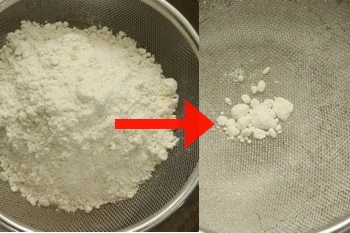
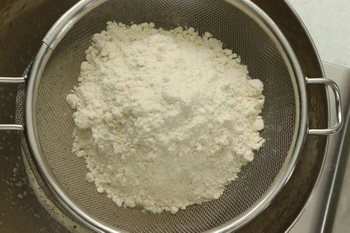
Look at the photo of T55 flour, before sifting...
texte alt

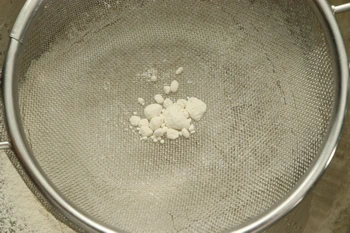
And after.


Once there are only pellets left in the bottom of your sieve, simply press down to reduce them to powder, sieve again, and continue your recipe undisturbed.

Is this really necessary?

You might think, well, it's flour, so it's still mostly fine powder, and I put it all in a mixer or whisk it carefully, so there's no need to sift.
Of course, in absolute terms, this is true, but it's still better to sift, because your dough will mix faster and better, and it's also an opportunity to eliminate any squatter insects that might be present in the flour, especially in organic flour.

Do I have to sift everything?
texte alt

A professional pastry chef would certainly say yes, but I think that if you limit yourself to the flours and powdered sugar, you'll already be in very good shape for the rest of your recipe.

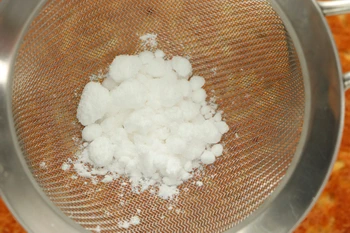
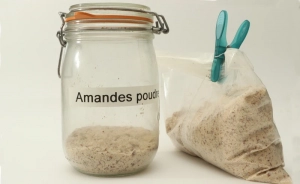
Special mention should be made of the chestnut flour and powdered sugar (see photo), which clump together very, very easily, as you'll soon see when you open the packet or box.


To sum up: it's best to sift all the fine powders that go into your recipe, as this is always better for the texture of the mixture you're about to make, and to avoid lumps.
And it's not Édith who will contradict me ;-)
Lasts posts
Butter vs. grease
Butter vs. grease
We often read in a recipe where a pastry is put into a mould that, just before pouring, the mould should be buttered or greased. But what's the difference between these 2 terms?
December 1st 20255765
Getting out of the fridge early
Very often when you're cooking, you need to take food or preparations out of the fridge, to use them in the recipe in progress. There's nothing tricky about this: you just take them out of the fridge and use them, usually immediately, in the recipe. But is this really a good method?
November 24th 20259285
Who's making the croissants?
When you look at a bakery from the outside, you naturally think that in the bakery, the bakers make the bread, and in the laboratory, the pastry chefs make the cakes. It's very often like that, with each of these professions having quite different ways of working, but sometimes there's also one...
November 23th 2025830
Oven height
Oven height
When we put a dish or cake in the oven, we naturally tend to put it on the middle shelf, and that's what we usually do. But in some cases, this position and height can be a little tricky, so let's find out why.
October 8th 20252,4185
The grease spray
The grease spray
As soon as you have something in a recipe that sticks to the mold, the question always arises as to how difficult it is to remove from the mold. There's nothing more frustrating than breaking your cake when unmolding it, because part of it has stuck in the mold. The classic way to avoid this is...
August 26th 20256,8595

Other pages you may also like
Oven height
Oven height
When we put a dish or cake in the oven, we naturally tend to put it on the middle shelf, and that's what we usually do. But in some cases, this position and height can be a little tricky, so let's find out why.
October 8th 20252,4185
Parsley stems
Parsley stems
Parsley, whether curly or flat, is a delicious ingredient in many recipes, where it is used both raw and cooked. When used raw, in a salad for example, where it always provides, alone or with other herbs, a remarkable freshness, only the leaves are kept. And when used cooked?
July 28th 20255,421 13
Thinning out herbs
Thinning out herbs
If you need to add a long-stemmed herb (tarragon, mint, verbena, thyme, etc.) to a recipe, you'll probably only need the leaves and not the stem, so you'll need to remove the leaves. Leaf removal means keeping only the beautiful leaves, and eliminating the ugly stems and leaves, but how do you do...
August 8th 20255,0085
The window-pane test in bread-making
The home bread-makers often ask themselves “Have I kneaded my dough long enough?” . A good question, as dough that is insufficiently kneaded will not rise properly or will fall flat when the top is slashed, which is very frustrating. To know when the dough is ready, one can rely on the length...
June 16th 202196 K 23.9
Add a bay leaf
Add a bay leaf
Bay leaf: small in size, but big in flavor. You'll find it in hundreds of recipes, and it's often added to cooking meat, in a sauce or broth, usually accompanied by other herbs or products. It's a staple of Provençal, Mediterranean and Oriental cuisine, but not the only one. Usually, in a...
July 31th 20255,0175
Post a comment or question
Posted by:
I am not a leaving thing

Follow this page
If you are interested in this page, you can "follow" it, by entering your email address here. You will then receive a notification immediately each time the page is modified or a new comment is added. Please note that you will need to confirm this following.
I am not a leaving thing
Note: We'll never share your e-mail address with anyone else.
Alternatively: you can subscribe to the mailing list of cooling-ez.com , you will receive a e-mail for each new recipe published on the site.

Back to top of page