Cut twice as fast


Cut twice as fast
When you need to cut something long into small pieces, for example chopped chives or the stem of a spring onion, there's a simple gesture that doubles your cutting speed.

Let's see how.
2,854 5/5 (1 reviews)
Grade this page:
Keywords for this post:CuttingKnifeTipUtensilMethodSpeed
Last modified on: May 21th 2026
For this postComments Lasts posts Follow
For this post: Comment Follow Ask me a question Send to a friend
new-onion-ready-for-cutting
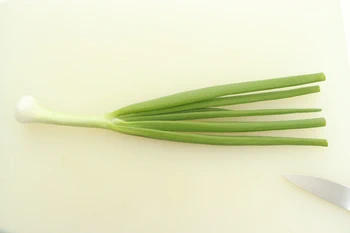
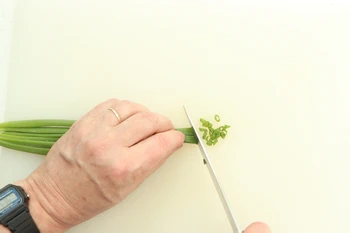
Imagine you need to slice the green part, the stems, of a spring onion.

You've prepared it, washed it and dried it.
onon nouveau en émincage
Naturally, you start slicing the green part you're interested in, starting with the tip.


It works, of course, but you can go twice as fast.
oignon nouveau tige isolées
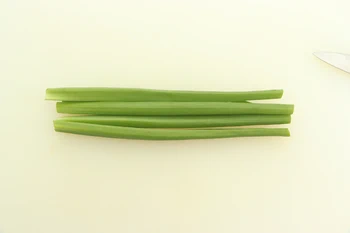
To do this, first separate the onion stems by cutting them apart.
oignon nouveau stems cut in 2
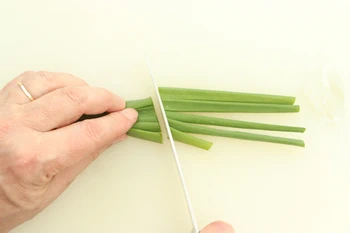
Then cut them in half, down the middle.
new bundle of stems
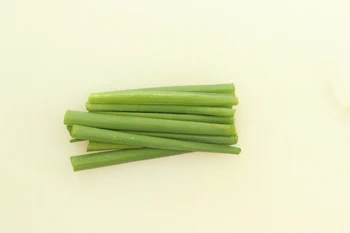
And combine the 2 bundles of stems, which are necessarily shorter, into a single bundle, which is necessarily thicker.
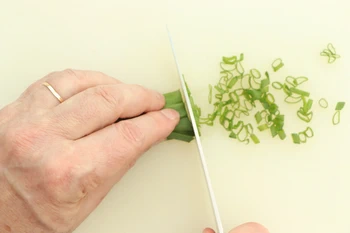
onon nouveau émincé 2x plus vite
Then slice as usual, but your previous cut makes...
onon nouveau complètement émincé
...that you go 2 times faster...


Here's a short video of the gesture.


As you can see, there's nothing revolutionary about this gesture, but it's both very simple and very effective, and it would be a shame to go without it.
And in the same spirit, and depending on the length of what you have to slice, you might even be able to cut into 3?

To sum up: if you have to slice something lengthwise, remember to first cut it in 2 and then combine the 2 parts, to double your slicing speed afterwards.
Lasts posts
Serving Temperature for Wine
When it comes to serving wine, you may (like me) have a fairly simple rule of thumb: red wine at room temperature, and white, rosé, and yellow wines in the fridge until it’s time to serve them. It’s very easy to remember, but it’s a bit simplistic, and you’ll see that there’s a much...
September 23th 20268155
Hot Emulsified Sauces
In French cuisine, sauces are a very important part of a recipe—not just a side dish. In fact, they’re so important that, especially since the time of Auguste Escoffier, they’ve been classified into categories. And among these categories are “hot emulsified sauces,” or lukewarm ones. ...
September 9th 20261,2335
Hot Dishes and Cold Dishes
When plating or serving a dish—whether hot or cold—on a plate, it’s very important to make sure they’re both the right temperature; in other words: if the dish is hot, the plate should be hot, and conversely, if the dish is cold, the plate should be cold. Is this really important? Let’s...
September 2nd 20269713
In baking, cold is your friend
When you bake at home—especially when making pie crusts—you’ve probably noticed that it’s quite difficult to work with the dough when it’s hot. It gets soft, is hard to roll out, and breaks or crumples very easily. And this doesn’t just happen when it’s hot—even in a comfortable...
August 26th 20269995
With vinegar?
When you buy a jar of pickles labeled “in vinegar,” you’re looking for their tangy, crunchy flavor to go with cold cuts, sandwiches, or salads. You expect to find small gherkins preserved in vinegar, with salt and herbs, but is that really the case?
July 15th 20261,9544.8
Other articles you might also like
Cake moulds
When we make a cake, or a cake of the same rectangular shape, we usually take out our usual mould and tell ourselves that the recipe is anyway "for a cake", but is it really that simple?
August 25th 202510 K5
Serving Temperature for Wine
When it comes to serving wine, you may (like me) have a fairly simple rule of thumb: red wine at room temperature, and white, rosé, and yellow wines in the fridge until it’s time to serve them. It’s very easy to remember, but it’s a bit simplistic, and you’ll see that there’s a much...
September 23th 20268155
The beautiful story of the croissants
As you may have already noticed, cooking, baking and pastry-making are full of stories or legends, usually very romantic, about this or that product or recipe. This is often the case for named recipes, for example tarte tatin, peach melba, paris-brest and many others, but it also applies to very...
October 10th 201822 K5
Salt and yeast
Let's take a look at an old baker's legend: You may have already read that somewhere in a recipe that uses baker's yeast(bread, pastries, leavened doughs in general) it is often specified "Don't put salt in contact with the yeast, you'll kill it (the yeast)"! Well, that's a belief, and there are...
March 15th 201976 K4.3
Drawing a pattern in pastry
Often in the kitchen, in pastry-making, or in baking, we need to trace a pattern on a pastry. It's just a question of aesthetics but it has its effect after baking on a galette, pithiviers, pâté en croute (terrine in a pie crust), etc.
May 23th 201939 K4.1
Post a comment or question
Posted by
I am not a leaving thing
Follow this page

Receive an e-mail as soon as this page is modified or receives a new comment.

I am not a leaving thing
We'll never share your e-mail address with anyone else.
Alternatively: you can subscribe to the mailing list of cooling-ez.com , you will receive a e-mail for each new recipe published on the site.

Back to top of page