In baking, cold is your friend


In baking, cold is your friend
When you bake at home—especially when making pie crusts—you’ve probably noticed that it’s quite difficult to work with the dough when it’s hot. It gets soft, is hard to roll out, and breaks or crumples very easily.

And this doesn’t just happen when it’s hot—even in a comfortable environment, say around 20°C (70°F), the dough will still soften after a while.

Let’s see why this happens and how to prevent it.
522 5/5 (2 reviews)
Grade this page:
Keywords for this post:PastryTemperatureDoughPreparationButterCold
Last modified on: August 26th 2026
For this postComments Lasts posts Follow
For this post: Comment Follow Ask me a question Send to a friend
data-ligne="All the problems with dough texture that we've encountered are due to practically one thing: the presence of butter in the dough and a temperature that's too high. Here's a brief summary of butter's textures based on its temperature:
  • 0 to 4 °C → Very firm, hard, sometimes brittle
  • 12–16 °C → Supple, malleable, still fairly firm
  • 18 to 22 °C → Creamy: smooth and very pliable
  • 23 to 28 °C → Very soft, increasingly greasy and shiny
  • 28 to 34 °C → Melted or nearly melted
  • +35 °C → Liquid
|/images/recettes/base/pates/34-1.webp|"Butter in Dough"
As you can see, butter—this essential ingredient for dough—is very sensitive to heat. When you take it out of the fridge, it’s at 4°C, but it warms up quickly, and the warmer it gets, the softer it becomes—and, more importantly, the softer your dough will become.
What’s more, everything works against you: the temperature in the kitchen, the temperature of your countertop, and even the rolling pin you use on the dough.
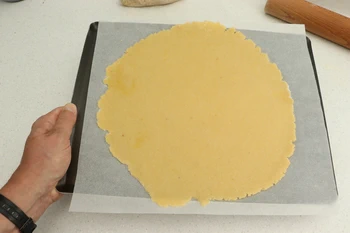

dough on a baking sheet in the fridge

That’s why, if you’re working with or rolling out dough and it’s difficult because it’s too soft, there’s no point in struggling: place the dough on a baking sheet and chill it, 15 minutes in the fridge or 5 minutes in the freezer, until it becomes just firm enough and pleasant to work with.

And you can repeat this process of chilling the dough as many times as necessary throughout your work.
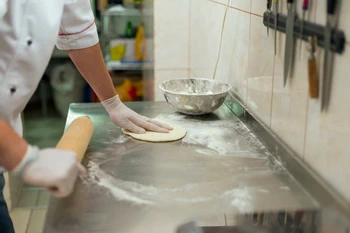

If you’re in the middle of a disaster because your dough has fallen apart, there’s no point in trying to play Tetris with the pieces (even if it’s doable), it’s better to start from scratch: gather all the pieces into a ball, then shape it into a flat disc, roll it out loosely, and put it back in the fridge for 30 minutes to let it come together again.


refrigerated turntable

To address the same problem, pastry chefs use refrigerated tables (which they call "tours"), made of marble or metal, which allow them to work with dough that’s ideally firm, even if their kitchen or bakery isn’t air-conditioned.


As you’ve likely gathered from these lessons on buttered dough, cold is your friend—it’s absolutely essential for the right texture of the butter and, therefore, your dough.
There’s no need to struggle with dough that’s too warm and difficult to work with—a quick trip to the fridge will fix everything in just a few minutes.
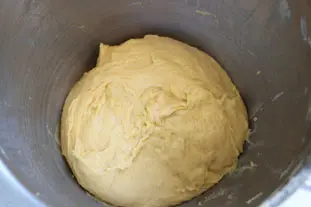

brioche dough

Note that we’ve been using pie dough as an example from the start, but this really applies to any dough containing butterbrioche dough that’s too warm, for example, is also a nightmare to work with.
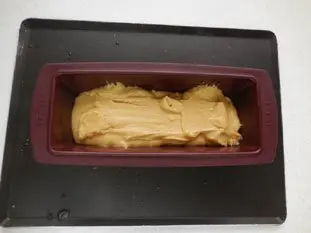


cake batter

In the same vein, cake batters are also affected. We don’t really handle them directly since we usually pour the batter into a pan, but even so, a cold cake batter is always an advantage, both when pouring into the pan and during baking.
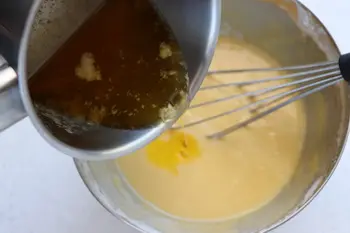


melted-butter batter

Batter recipes that use melted or browned butter—such as madeleines, financiers, etc.—are also included. Although the butter is melted or browned during preparation, once the batter is ready, it’s still best to chill it to make pouring and baking easier.


In summary: To be easily handled or worked with, a dough containing butter must be very cold; if it isn’t, don’t struggle with it—stop what you’re doing and return the dough to the refrigerator for as long as necessary for it to firm up again.
Lasts posts
With vinegar?
With vinegar?
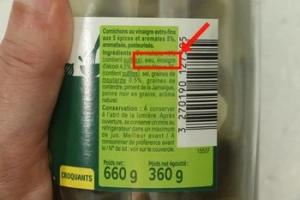
When you buy a jar of pickles labeled “in vinegar,” you’re looking for their tangy, crunchy flavor to go with cold cuts, sandwiches, or salads. You expect to find small gherkins preserved in vinegar, with salt and herbs, but is that really the case?
July 15th 20261,6154.8
Congratulate the chef
You've just finished a meal that you really enjoyed. The server approaches with the usual question: “How was it?” And then, as a natural reflex, you simply reply, “Yes, it was very good.” However, when the meal was truly outstanding, this brief exchange deserves a little more. .
July 7th 20261,052 35
Cut twice as fast
Cut twice as fast
When you need to cut something long into small pieces, for example chopped chives or the stem of a spring onion, there's a simple gesture that doubles your cutting speed. Let's see how.
May 21th 20262,4975
The other use for bowl scraper
Your kitchen or bakery utensils may include a horn (left) or a pastry cutter (right). These practical utensils are normally used to scoop the contents of a bowl or salad bowl - the horn - or to cut dough - the pastry cutter. But they also have another, very practical use - let's see what it is.
May 9th 20262,2043
The strange foam of potatoes in milk
As you may have already noticed, when you cook potatoes in milk, especially in small pieces (slices or cubes) for a gratin for example, a surprisingly abundant white foam forms on the surface. Where does it come from?
April 26th 20262,5605
Other articles you might also like
Cut twice as fast
Cut twice as fast
When you need to cut something long into small pieces, for example chopped chives or the stem of a spring onion, there's a simple gesture that doubles your cutting speed. Let's see how.
May 21th 20262,4975
With vinegar?
With vinegar?
When you buy a jar of pickles labeled “in vinegar,” you’re looking for their tangy, crunchy flavor to go with cold cuts, sandwiches, or salads. You expect to find small gherkins preserved in vinegar, with salt and herbs, but is that really the case?
July 15th 20261,6154.8
The strange foam of potatoes in milk
As you may have already noticed, when you cook potatoes in milk, especially in small pieces (slices or cubes) for a gratin for example, a surprisingly abundant white foam forms on the surface. Where does it come from?
April 26th 20262,5605
The other use for bowl scraper
Your kitchen or bakery utensils may include a horn (left) or a pastry cutter (right). These practical utensils are normally used to scoop the contents of a bowl or salad bowl - the horn - or to cut dough - the pastry cutter. But they also have another, very practical use - let's see what it is.
May 9th 20262,2043
Congratulate the chef
You've just finished a meal that you really enjoyed. The server approaches with the usual question: “How was it?” And then, as a natural reflex, you simply reply, “Yes, it was very good.” However, when the meal was truly outstanding, this brief exchange deserves a little more. .
July 7th 20261,052 35
Post a comment or question
Posted by
I am not a leaving thing
Follow this page

Receive an e-mail as soon as this page is modified or receives a new comment.

I am not a leaving thing
We'll never share your e-mail address with anyone else.
Alternatively: you can subscribe to the mailing list of cooling-ez.com , you will receive a e-mail for each new recipe published on the site.

Back to top of page