Season to the right level


Season to the right level
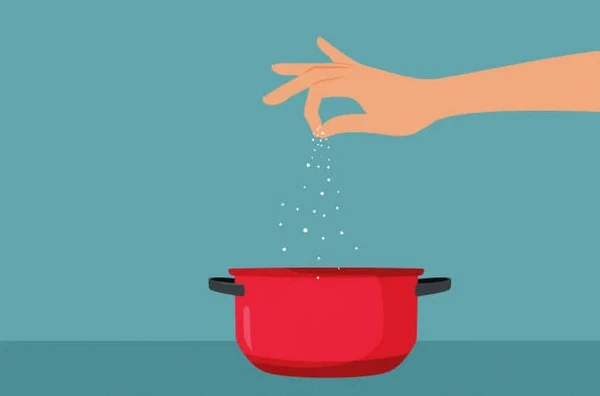
When you need to salt something—for example, fish fillets before cooking them—you’ll naturally sprinkle them with a pinch of salt using your fingers.

There’s nothing particularly remarkable about this very ordinary gesture, which is done all the time in the kitchen, and yet there’s a little trick that changes things a bit—let’s see what it is.
1,507 5/5 (1 reviews)
Grade this page:
Keywords for this post:SeasoningSaltSprinklingHeightTipMethod
Last modified on: October 14th 2026
For this postComments Lasts posts Follow
For this post: Comment Follow Ask me a question Send to a friend
data-ligne="

The Action

We’ve all done it before: you take a pinch of salt between two or three fingers and sprinkle it over your food.
The salt falls like rain onto the food, which is thus, in theory, salted evenly.
In practice, this isn’t always the case, because there’s one important factor: the height of your fingers relative to the food.|/images/blog/hauteur-salage-0.webp|"salting from above"
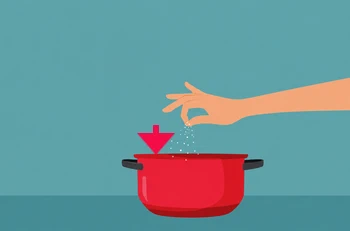
low salting

The risk of salting “low”

If you salt from too low a position—with your fingers right above the food—you’ll create “piles” of salt.
A single bite may then taste overly salty, while the rest of the dish lacks depth.
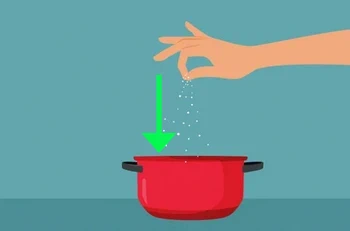
low-salting

Why salt from above?

When you hold your hand about 20 to 30 cm above the food, the salt crystals have time to disperse before falling.

The result: a more even coating, without salty clumps or bland spots. This is exactly the technique many chefs use to season meat, fish, vegetables, or dishes that need a final touch.
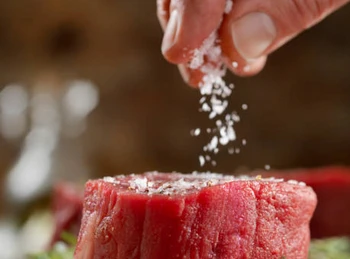
low-salting

When precision is required

Sometimes, for small items—scallops, small pieces of meat, etc.—it may be necessary to salt very precisely and only the food itself. In this case, of course, bring your hand closer and salt gently, in small amounts, directly onto each piece.

In summary: Salt from above to distribute evenly, and from below to target precisely. It’s a simple distinction, but it often makes the difference between a properly seasoned dish and a truly balanced one.
Lasts posts
How to Properly Fill a Jar
When you have a jar in your kitchen that’s almost empty—flour or almond flour, for example—you’ll probably refill it before it’s completely empty. And that’s a great way to go about it—no one wants to run out of an ingredient right in the middle of a recipe. Once you’ve...
October 2nd 20261,0905
Serving Temperature for Wine
When it comes to serving wine, you may (like me) have a fairly simple rule of thumb: red wine at room temperature, and white, rosé, and yellow wines in the fridge until it’s time to serve them. It’s very easy to remember, but it’s a bit simplistic, and you’ll see that there’s a much...
September 23th 20261,1735
Hot Emulsified Sauces
In French cuisine, sauces are a very important part of a recipe—not just a side dish. In fact, they’re so important that, especially since the time of Auguste Escoffier, they’ve been classified into categories. And among these categories are “hot emulsified sauces,” or lukewarm ones. ...
September 9th 20261,5915
Hot Dishes and Cold Dishes
When plating or serving a dish—whether hot or cold—on a plate, it’s very important to make sure they’re both the right temperature; in other words: if the dish is hot, the plate should be hot, and conversely, if the dish is cold, the plate should be cold. Is this really important? Let’s...
September 2nd 20261,3393
In baking, cold is your friend
When you bake at home—especially when making pie crusts—you’ve probably noticed that it’s quite difficult to work with the dough when it’s hot. It gets soft, is hard to roll out, and breaks or crumples very easily. And this doesn’t just happen when it’s hot—even in a comfortable...
August 26th 20261,3015
Other articles you might also like

September 28th 20264452 Sponsored article
How to Properly Fill a Jar
When you have a jar in your kitchen that’s almost empty—flour or almond flour, for example—you’ll probably refill it before it’s completely empty. And that’s a great way to go about it—no one wants to run out of an ingredient right in the middle of a recipe. Once you’ve...
October 2nd 20261,0905
Hot Dishes and Cold Dishes
When plating or serving a dish—whether hot or cold—on a plate, it’s very important to make sure they’re both the right temperature; in other words: if the dish is hot, the plate should be hot, and conversely, if the dish is cold, the plate should be cold. Is this really important? Let’s...
September 2nd 20261,3393
Hot Emulsified Sauces
In French cuisine, sauces are a very important part of a recipe—not just a side dish. In fact, they’re so important that, especially since the time of Auguste Escoffier, they’ve been classified into categories. And among these categories are “hot emulsified sauces,” or lukewarm ones. ...
September 9th 20261,5915

January 19th 20214,0674.9 Sponsored article
Post a comment or question
Posted by
I am not a leaving thing
Follow this page

Receive an e-mail as soon as this page is modified or receives a new comment.

I am not a leaving thing
We'll never share your e-mail address with anyone else.
Alternatively: you can subscribe to the mailing list of cooling-ez.com , you will receive a e-mail for each new recipe published on the site.

Back to top of page