The Principle
For these sauces—which, as it turns out, are aptly named—you always proceed the same way: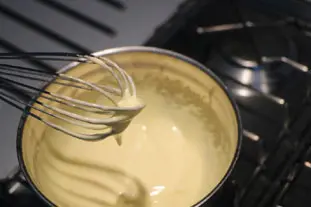
1) Start by making a sabayon with egg yolks and a little liquid (we’ll come back to that) over low heat, ideally in a double boiler.
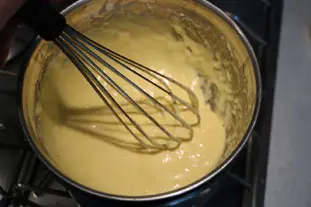
2) Once the sabayon is made, gradually incorporate melted butter until an emulsion forms and the desired texture is achieved.
An emulsion is a stable mixture of two liquids that don’t naturally mix: lemon juice and melted butter, thanks to the egg yolk, which acts as an emulsifier—that is, a binding agent.
An emulsion is a stable mixture of two liquids that don’t naturally mix: lemon juice and melted butter, thanks to the egg yolk, which acts as an emulsifier—that is, a binding agent.
Tips and Tricks
While the concept seems simple—sabayon followed by melted butter—in practice it’s easy to mess up, so here’s a list of tips to help you succeed:- It’s best to make your sabayon in a double boiler—it’s much easier to control the temperature that way
- Add a pinch of flour to your egg yolks before starting the sabayon—it’s a very old trick whose effectiveness I’m not entirely sure of, but it seems to work well
- There’s an easy ratio to remember: 1 egg yolk, 2 or 3 tablespoons of liquid, and 60 grams of butter
- Fold in the butter gradually, taking your time, and whisk constantly
- Preferably use melted clarified butter—it’s easier to incorporate
- If something goes wrong along the way—if the sauce “separates,” with the fat on one side and the rest on the other— don’t panic: remove it from the double boiler and add 2 teaspoons of very cold water, whisk until it returns to normal, then continue incorporating the butter
- Some chefs tend to start with a fairly neutral sabayon, made with water or white wine, and then add the flavored liquid (lemon, etc.) afterward, once the emulsion has formed

These two sauces are very delicate; they cannot be reheated, but they can be kept warm for a short while in their double boiler off the heat—but that’s all.
That’s why store-bought ready-made Hollandaise or Béarnaise sauces are packed with all kinds of additives—just look at the endless list of ingredients on the label—to make them suitable for long-term storage.
That’s why store-bought ready-made Hollandaise or Béarnaise sauces are packed with all kinds of additives—just look at the endless list of ingredients on the label—to make them suitable for long-term storage.
Hollandaise vs. Béarnaise
The difference between the two lies in the liquid added to the egg yolks: lemon juice for Hollandaise, and a shallot-vinegar-tarragon reduction for Béarnaise. You’ll notice that both liquids are very concentrated in flavor and tangy, which pairs well with the buttery richness.It’s amusing to note that their names have nothing to do with their origins: the name “Hollandaise” comes from the French victory in the War of the Dutch Succession under Louis XIV, and “Béarnaise” from the fact that it was invented in a restaurant near Paris, “Le Pavillon Henri IV,” and Henri IV was a king of France nicknamed “the Béarnais” because he was a native of Pau.
Variations
The base sauce is, of course, Hollandaise—made with lemon juice—and Béarnaise is “the” variation of it, featuring a vinegar-tarragon reduction.But we can also mention, among others, Mousseline sauce (Hollandaise + whipped cream), mustard sauce (Hollandaise + mustard), Maltese sauce (Hollandaise with blood orange juice instead of lemon), and Choron sauce (Béarnaise + tomato paste).
In summary: Hot emulsified sauces—such as hollandaise and béarnaise—are all made from a sabayon, egg yolks, and a flavored liquid, into which melted butter is slowly whisked until the desired texture is achieved. They aren’t very easy to get right, but they’re so delicious.