This site uses only a few technical cookies that are necessary for its operation.
By continuing to browse, you agree to their use (learn more...).
By continuing to browse, you agree to their use (learn more...).
Products: Yeast
Yeast
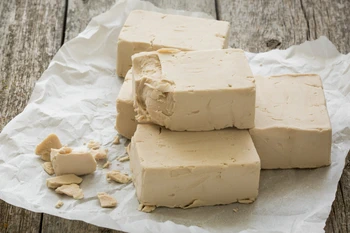
Yeast (also called "brewer's yeast" or "baker's yeast") is a living product, made up of microscopic fungi which grow slowly when they are in a warm place.Baker's yeast is for use in breads and viennoiseries. Gently mix it into the dough, then wait for it to work.
It should not be confused with baking powder, which is used for raising cakes.
If you need to buy it: Yeast is available in two basic kinds: fresh yeast (ask your baker to sell or give you some, it looks like a greyish paste, which should be kept in a sealed container in the fridge and used within a few days), or dried yeast in 5 g sachets (on the left in the photo). Dried yeast will keep for several months without any problem. It can be used like fresh yeast, but only half the quantity is needed (it's a very effective yeast).
I usually use this conversion: 1 dried yeast sachet = 10 g fresh yeast, and vice versa.
Note: For each recipe you can use either fresh or dried yeast. Use whichever you have to hand.If you want to use it: Yeast is a delicate product. It doesn't like cold (which slows its action), direct contact with sugar (which can kill the yeast by "burning" it), and excessive heat, but contrary to a common belief, direct contact with salt doesn't kill it.
44 K 4.3/5 (31 reviews)
Last modified on: September 24th 2026
Recipes which use this product: 58, of which:


Post a comment or question