The ideal restaurant


The ideal restaurant
Like all passionate cooks (I suppose), from time to time I dream of opening my own restaurant.

I imagine loads of things: it will be like this or like that, we'll do this, I'll cook that, the room will have this or that – in short, I dream.
16 K 4.4/5 (18 reviews)
Grade this page:
Last modified on: October 15th 2012
For this post: Comment Follow Ask me a question Send to a friend
The ideal restaurant
But now I have a son who's in the trade (cook-in-exile in Brussels as I write), and another who, even with a Master's in Biology, passed several summers as “chef de commis” in a restaurant on the coast, I've been able to see what a real restaurant kitchen is like and how it functions. This (alas) brought me back down to earth with a bump…

But no matter, I'll carry on as if the two lads I've just mentioned are still little and we're playing games, of the sort that start with “Let's say that…” or “What if…”

So, let's say that:

- It would be a small, even very small restaurant, about twenty covers. One person serving, two at most in the kitchen.

- There will be a bread oven with the door opening in one inside walls of the main room. We'd bake a batch of levain-raised bread for the evening service, which will come out of the oven (the timing is crucial) while customers are arriving. There would be a batch of plain bread rolls and various specials. They'd be served fresh and still hot from the oven, and everyone would be offered one in a paper bag to take away when they pay the bill.

bread


- From time to time, there would be pizza or flammenkueche days, or for any other dish that can be cooked on an open fire, but no fresh bread on those days.

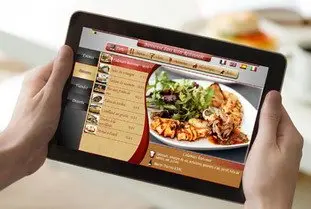
- No menus on paper, just a flat screen (or more than one depending on the room layout) on which photos of the dishes of the day would scroll through. Tablets (iPad style) would be passed around to diners so that they could consult the menu electronically. This would effectively be a mini-website in the language of their choice, diffused by wi-fi through the restaurant. Customers mobile phones and smartphones could log onto it or access the internet while they are waiting for food to be served. Diners could even order themselves, or call the waiter, who would also take the order in electronic form. This would then appear directly on a screen in the kitchen.

- The style of cooking would be simple, not a huge menu, but everything with plenty of flavour, properly cooked, as much fresh local produce as possible, preferably organic. One fixed midday menu, with just 2 choices of main course and dessert. Dishes would always vary according to the season, the market and events.

- Themed meals : Sushi, Spain, Mexico, Slow Food, etc.

- Some "core dishes", easy to prepare in advance and store, would always be available, winter and summer: Pâté de campagne, assiette de cochonnaille (selection of cold pork meats), crème brulée, tiramisu, etc.

- At the end of the meal, a choice of 2 coffees: classic espresso, or a “longer” coffee in a cafetière served at the table with (free, maybe?) top-ups. In both cases, these would be served with a little home-made treat: meringues, financiers, chocolate, etc. which would change every day.

Right, now all I have to do is come up with the name …
Lasts posts
Getting out of the fridge early
Very often when you're cooking, you need to take food or preparations out of the fridge, to use them in the recipe in progress. There's nothing tricky about this: you just take them out of the fridge and use them, usually immediately, in the recipe. But is this really a good method?
November 24th 20256755
Who's making the croissants?
When you look at a bakery from the outside, you naturally think that in the bakery, the bakers make the bread, and in the laboratory, the pastry chefs make the cakes. It's very often like that, with each of these professions having quite different ways of working, but sometimes there's also one...
November 23th 2025704
Oven height
Oven height
When we put a dish or cake in the oven, we naturally tend to put it on the middle shelf, and that's what we usually do. But in some cases, this position and height can be a little tricky, so let's find out why.
October 8th 20252,2235
The importance of sieving
In recipes that use a fine powder (flour, powdered sugar, etc.), you'll often see the advice to sift before using it. To sift is to pass the powder in question through a sieve (a very fine strainer) before incorporating it into your recipe. It's often advice, but is it really useful?
September 3rd 20257,2173
The grease spray
The grease spray
As soon as you have something in a recipe that sticks to the mold, the question always arises as to how difficult it is to remove from the mold. There's nothing more frustrating than breaking your cake when unmolding it, because part of it has stuck in the mold. The classic way to avoid this is...
August 26th 20256,7445

Other pages you may also like
Artichoke stalks
Artichoke stalks
When preparing artichokes for cooking, you may well already know that we often need to remove the first round of leaves, if they are tatty or dirty, as well as the inedible stalk. The operative word here is “remove” , rather than “cut off”.
October 25th 201653 K4.3
A few tips for effective kneading at home
When you have to knead dough for bread or some other recipe, you may well use a food processor or the type of machine known as a stand mixer. The best-known brands are Kenwood and KitchenAid. They are useful tools, but here are a few tips to help you get the best out of them.
June 23th 2021283 K 23.8
Salt and yeast
Salt and yeast
Let's take a look at an old baker's legend: You may have already read that somewhere in a recipe that uses baker's yeast(bread, pastries, leavened doughs in general) it is often specified "Don't put salt in contact with the yeast, you'll kill it (the yeast)"! Well, that's a belief, and there are...
March 15th 201974 K4.3
The baker always gild twice
I've already told you about gilding, the beaten whole egg that is spread with a brush on anything that needs to brown in the oven: puff pastry, pastries, etc. and that professionals use a lot, I'm going to come back to this to clarify a bit how to do it, and give you a professional tip.
June 9th 201935 K4.2
When should you salt?
In the kitchen, we salt very frequently, almost all the time, and we must be careful because this salt can influence the texture of what you are cooking. I'm not going to talk about the amount of salt here, that's for another time, but rather about : When do you salt?
August 13th 201917 K4.5
Post a comment or question
Posted by:
I am not a leaving thing

Follow this page
If you are interested in this page, you can "follow" it, by entering your email address here. You will then receive a notification immediately each time the page is modified or a new comment is added. Please note that you will need to confirm this following.
I am not a leaving thing
Note: We'll never share your e-mail address with anyone else.
Alternatively: you can subscribe to the mailing list of cooling-ez.com , you will receive a e-mail for each new recipe published on the site.

Back to top of page