The peak of the apple season


The peak of the apple season
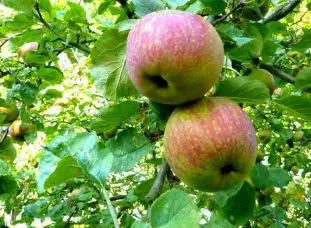
As I write these lines, we are in the middle of the apple season, and it's an apple year, as you may have noticed if you have apple trees around you, they are bursting with fruit!

Excellent news for the people in the west of France in particular, but let's have a little thought for those in the east where it's a completely different story, the late spring frost has done a lot of damage, an almost blank year for apples and other fruits in some regions.
9,176 5/5 (13 reviews)
Grade this page:
Keywords for this post:ApplesSeasonGoldenApple peelerTaste
Last modified on: October 23th 2021
For this post: Comment Follow Ask me a question Send to a friend
The peak of the apple season

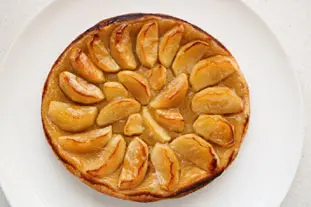
tarte aux pommes

It's the season, as I said, and you have to take advantage of it as much as possible, even if apples keep pretty well over time.
So, let's go for all kinds of recipes: cakes, pies, compotes, baked, etc. It's delicious, and it can be used with all varieties of apples, which are often called in french "knife apples" to differentiate them from "cider apples".

In France, there are probably as many varieties of apples as there are cheeses, some of which are very well known, such as "golden", "reinette", "granny-smith" etc. And others much less well known and often very local, like the "reinettes d'Armorique", "calville", "belle fille normande", etc.
Of course, they are generally not very popular, you will hardly find them in supermarkets, but you can find them on the markets or with local producers, or with enthusiasts, who try to maintain (with difficulty) this greedy heritage.

As far as apples and recipes are concerned, in cooking and pastry-making, there are no rules, you can use any apple in any recipe, in theory... In practice it is a bit more delicate, and here are some points that deserve your attention:

- It's always good to remember, apples are overall quite fragile and susceptible to insect attack, so it's perfectly normal to have fruit that's a bit stained, a bit ugly, and not at all like the apples in the shiny, smooth, perfectly round in commercials. Surface imperfections are a sign of a lack of chemical treatments, and therefore a good sign, whereas a fruit that is "too" beautiful, especially with those stupid individual sticker labels, is always a bit fishy in my eyes. Long live ugly apples!

- Some apples don't do well with baking, granny-smiths for example, but that's almost an exception, and not an absolute rule either.
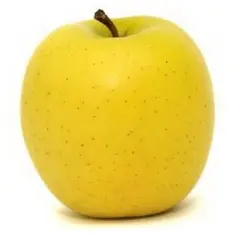
pommes golden

- The golden apple (above) is the archetype of the fruit that has been over-selected, processed and improved, to finally obtain an apple, certainly very pretty on the outside, but with a rather bland taste.
In my opinion, this is the apple to avoid, and to turn to more typical apples, which are much better in taste and health.
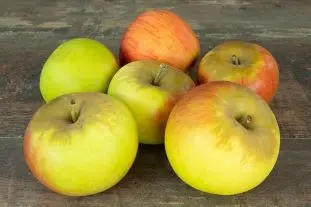

pommes reinettes

- The whole family of reinettes, and in particular the "reine des reinettes" (above) give an excellent and delicious result when cooked, their small natural acidity gives absolutely divine tarts (and in particular the tarte tatin).

- Whatever the recipe you are going to make, compote, tart or other, it is always very interesting to mix several varieties, rather sweet with rather sour for example. The taste will vary as you eat a pie or a cake, you will be pleasantly surprised by the result.

- The taste of apples changes with time, generally more pronounced, a little more acidic after the harvest, and softening with time.
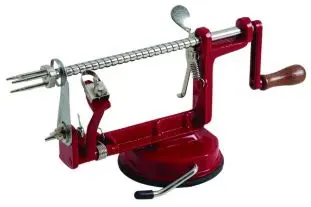

épluche-pommes

- If you like and prepare apples often, I strongly advise you to invest in an apple peeler (pictured above) which peels, cores, and slices, it's not very expensive and makes life incredibly easy. If you decide on a whim to make an apple crumble for example, the simplest of cakes without doubt and adored by children because they can put their hands in the dough, a crumble then, with this tool, in 10 minutes of clock it is in the oven.


In summary: Make the most of the apple season, opt for local varieties if you can find them, avoid golden ones and invest in an apple peeler if possible and... eat apples!


Lasts posts
Butter vs. grease
Butter vs. grease
We often read in a recipe where a pastry is put into a mould that, just before pouring, the mould should be buttered or greased. But what's the difference between these 2 terms?
December 1st 20256905
Getting out of the fridge early
Very often when you're cooking, you need to take food or preparations out of the fridge, to use them in the recipe in progress. There's nothing tricky about this: you just take them out of the fridge and use them, usually immediately, in the recipe. But is this really a good method?
November 24th 20259725
Who's making the croissants?
When you look at a bakery from the outside, you naturally think that in the bakery, the bakers make the bread, and in the laboratory, the pastry chefs make the cakes. It's very often like that, with each of these professions having quite different ways of working, but sometimes there's also one...
November 23th 2025872
Oven height
Oven height
When we put a dish or cake in the oven, we naturally tend to put it on the middle shelf, and that's what we usually do. But in some cases, this position and height can be a little tricky, so let's find out why.
October 8th 20252,4795
The importance of sieving
In recipes that use a fine powder (flour, powdered sugar, etc.), you'll often see the advice to sift before using it. To sift is to pass the powder in question through a sieve (a very fine strainer) before incorporating it into your recipe. It's often advice, but is it really useful?
September 3rd 20257,3533

Other pages you may also like
Drawing a pattern in pastry
Often in the kitchen, in pastry-making, or in baking, we need to trace a pattern on a pastry. It's just a question of aesthetics but it has its effect after baking on a galette, pithiviers, pâté en croute (terrine in a pie crust), etc.
May 23th 201935 K4.1
The 3 kinds of meringue
Meringue – what could be simpler? Just beaten egg whites with sugar added. This makes a fairly stiff mixture which can then be cooked in a cool oven to create those lovely, light confections. But in the world of professional patisserie, meringue comes in three different kinds. Even if the...
June 14th 201364 K4.5
The return of the "Norman hole"
You maybe know the "trou normand", this old gastronomic custom typically French which consists in taking a (small) glass of calvados, generally between the last course and the dessert? It's something that seems a bit anachronistic nowadays, having a glass of an alcohol of more than 60° in the...
December 18th 202115 K4.8
Too much sweet and savoury
There is a food trend which is creeping in everywhere in France right now: mixing sweet with savoury. In some restaurants, it is becoming difficult to order a classic dish, like “roast veal” for instance, without being served fruits in the garnish or honey/conserves/syrup in the sauce or cooked...
November 3rd 201127 K4.5
Different kinds of pastry and dough
When cooking in general, and particularly in baking, we can make and use many different kinds of pastry and dough. All built on the same "base": flour - a powder to which we add fat, liquid or both to produce the dough which is then cooked. .
November 6th 2012111 K 14.0
Post a comment or question
Posted by:
I am not a leaving thing

Follow this page
If you are interested in this page, you can "follow" it, by entering your email address here. You will then receive a notification immediately each time the page is modified or a new comment is added. Please note that you will need to confirm this following.
I am not a leaving thing
Note: We'll never share your e-mail address with anyone else.
Alternatively: you can subscribe to the mailing list of cooling-ez.com , you will receive a e-mail for each new recipe published on the site.

Back to top of page