Vegetable soups


Vegetable soups
As I write this post, we are slowly slipping into winter, and this late autumn is the perfect time for soups, especially vegetable ones. Soups, that somewhat "soft" dish, often associated with our childhood, infallible remedy against a cold evening or an ugly weather, or both.
12 K 5/5 (18 reviews)
Grade this page:
Last modified on: December 5th 2017
For this post: Comment Follow Ask me a question Send to a friend
Vegetable soups
What exactly is a vegetable soup? Let's just say: Water, in which vegetables are cooked long enough to mix with the water. That's the principle of course, after that it can be made in an infinite number of ways by changing the liquid (water, milk, broth, juice,...) and all the vegetables you can put in it, it's a recipe that's almost as old as humanity, and fire, and yes, pottery too.

It's very easy to make: a pan, you pour water, you add peeled vegetables, you salt a little and you cook for a long time. A small modern concession, a little shot of mixer at the end of cooking to obtain a smooth soup and hey presto, it's ready.
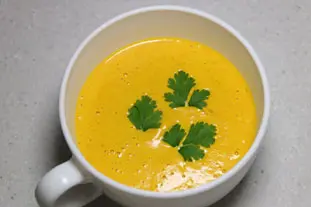
vegetable soup


Let's put this into practice with the leek and potato soup, one of the pillars of French home cooking:
- Leeks are washed, peeled and sliced
- Potatoes are peeled, washed and cut into small pieces
- Put everything in a large saucepan, cover with water and salt
- Cook, mix if necessary, and it's ready

Is that all? No, not quite, because it is possible to improve this method considerably by working the vegetables a little before adding the water. Let's start again:
- Wash, peel and slice leeks
- Peel, wash and chop potatoes
This is where it changes
- In the pot where the soup will be cooked, heat a little olive oil (or butter) over high heat
- Add a chopped onion and fry for 1 minute
- Add leek and potatoes to the pan, salt, pepper, and stir well, and cook for 3 or 4 minutes
- Then add the water and cook.
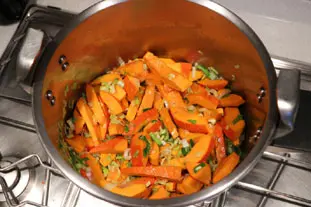
vegetable soup


This little change is the trick that does it all: Frying the vegetables together, with the onion and a little oil/butter, before putting in the water, will give them a taste and depth that will be much better than vegetables simply added to the future soup water. This goes for all soups, to all vegetables.

To sum up: Always fry the vegetables in a future soup for a few minutes with each other, the taste will be much better.
Lasts posts
Butter vs. grease
Butter vs. grease
We often read in a recipe where a pastry is put into a mould that, just before pouring, the mould should be buttered or greased. But what's the difference between these 2 terms?
December 1st 20259565
Getting out of the fridge early
Very often when you're cooking, you need to take food or preparations out of the fridge, to use them in the recipe in progress. There's nothing tricky about this: you just take them out of the fridge and use them, usually immediately, in the recipe. But is this really a good method?
November 24th 20251,0875
Who's making the croissants?
When you look at a bakery from the outside, you naturally think that in the bakery, the bakers make the bread, and in the laboratory, the pastry chefs make the cakes. It's very often like that, with each of these professions having quite different ways of working, but sometimes there's also one...
November 23th 2025984
Oven height
Oven height
When we put a dish or cake in the oven, we naturally tend to put it on the middle shelf, and that's what we usually do. But in some cases, this position and height can be a little tricky, so let's find out why.
October 8th 20252,6845
The importance of sieving
In recipes that use a fine powder (flour, powdered sugar, etc.), you'll often see the advice to sift before using it. To sift is to pass the powder in question through a sieve (a very fine strainer) before incorporating it into your recipe. It's often advice, but is it really useful?
September 3rd 20257,5083

Other pages you may also like
Maillard reactions
Maillard reactions
This subject cropped up recently in a discussion with my three charming nieces; do you know what Maillard reactions are? With a name like that, they could well be some principle in mechanics, but in fact the term applies to something much closer to all of us: it's what gives food more flavour...
January 28th 201538 K4
Should a sausage be pricked before cooking?
If you are using sausages in a recipe, you may have already asked yourself the question: Should you prick it before cooking it, or not? You will certainly find as many opinions "you should prick" as "you should not". Let's try to untangle all this.
September 29th 201848 K4.1
Circles vs. moulds tins
If you like to bake or make quiches, pies etc. you must surely have one or more pie pans at home, in different diameters and perhaps materials. They are indispensable, without them there is no way to make beautiful pies, and they work very well, but you have another option, instead of moulds,...
October 2nd 202016 K5
 Pastry and bakery dough families
Pastry and bakery dough families
There are many kinds, or families, of pastry and bakery doughs, depending on whether you want to make a tart, a cake, a pie, a brioche, croissants and so on. I'll try to give you a quick overview of all these doughs, how they're classified, and what they're used for.
November 16th 202013 K4.9
The skin side of the fish first?
When it comes to cooking fresh fish, if it's filleted with its skin on and you're planning to pan-fry it in a little olive oil, for example, you might ask yourself the following question: Which side, skin or flesh, should come into contact with the pan first?
February 13th 202126 K4.4
Post a comment or question
Posted by:
I am not a leaving thing

Follow this page
If you are interested in this page, you can "follow" it, by entering your email address here. You will then receive a notification immediately each time the page is modified or a new comment is added. Please note that you will need to confirm this following.
I am not a leaving thing
Note: We'll never share your e-mail address with anyone else.
Alternatively: you can subscribe to the mailing list of cooling-ez.com , you will receive a e-mail for each new recipe published on the site.

Back to top of page