Cleaning endives


Cleaning endives
If you buy your endives elsewhere than in supermarkets, and in this case the best is of course from a market gardener, he or she is the one who planted and harvested them, in this case you will have endives full of earth or sand, depending on where they were grown, which is normal and reassuring, we know where they come from.

How to wash/clean them efficiently? That's what we'll see in this post.
27 K 4.6/5 (18 reviews)
Grade this page:
Keywords for this post:EndivesCleaningSoilSandAdvice
Last modified on: March 24th 2020
For this post: Comment Follow Ask me a question Send to a friend
Cleaning endives
When it comes to cleaning, the classic way is to cut the base, then remove the leaves from around the endive, until you have a very clean vegetable. Classic, but not great, the loss is important, especially if the endive comes from the sand, you have to remove a lot of leaves (too many), to have one ready to be used in a recipe.

Can we do better?

Yes, it is better to wash it in fact, before trimming it, but this washing should not be done like for another vegetable, by soaking them in water for example. On the contrary, on the one hand they get waterlogged if you do that, but on the other hand a small part of the sand that was on the turn will end up in the endive, and when tasted it will crunch under the tooth very unpleasantly.

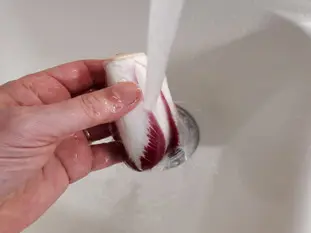
No, here's the thing, in fact it's better to proceed like this: Run a trickle of warm water from the tap, and put the endive underneath one by one, with the head down, like this:
nettoyage endives


This way, the sand goes into the sink, the endive does not get waterlogged, and the peeling after drying with a cloth, will consist in removing 1 or 2 leaves from the turn, not more, or even none.

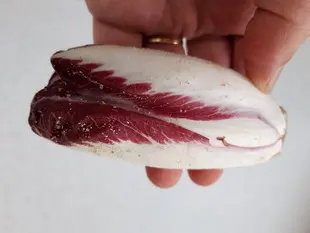
You will note that on the photographs they are red endives, with the season alas even shorter, but which are less bitter than the yellow ones, and of a superb esthetics which make it possible, inter alia, to make a little of decoration in your receipts/plates at little expenses.

One last point about the plastic endive from the supermarket, you have probably noticed that they are absolutely clean, not a grain of sand or dirt. Is it normal knowing that it comes from the earth or sand? To look like this on the shelves, you have to imagine that they must have received a shock treatment, probably not neutral, which have scoured them, or even more. In short, trust your local grower who plants locally.


To sum up: Wash your endives under a trickle of warm water, upside down, before drying them and trimming them.
Lasts posts
A tablet holder
A tablet holder
Perhaps you too cook by consulting your recipe on a tablet or phone, and putting it down on your worktop? It's practical, but not the best solution. Here's a look at how you can make an inexpensive, almost universal stand.
March 14th 20266645
Pre-calibrated pastry dough
When making pie dough (shortbread, shortcrust, sweet...), it's always a good idea to make a lot at once, and then divide it into pieces, which you can freeze. I've already pointed out the mistake not to make, which is to form a ball before freezing. It's difficult to roll out afterwards because...
March 9th 20269205
Butter vs. grease
Butter vs. grease
We often read in a recipe where a pastry is put into a mould that, just before pouring, the mould should be buttered or greased. But what's the difference between these 2 terms?
December 1st 20252,9875
Getting out of the fridge early
Very often when you're cooking, you need to take food or preparations out of the fridge, to use them in the recipe in progress. There's nothing tricky about this: you just take them out of the fridge and use them, usually immediately, in the recipe. But is this really a good method?
November 24th 20251,9445
Who's making the croissants?
When you look at a bakery from the outside, you naturally think that in the bakery, the bakers make the bread, and in the laboratory, the pastry chefs make the cakes. It's very often like that, with each of these professions having quite different ways of working, but sometimes there's also one...
November 23th 20251,761

Other pages you may also like
Drawing a pattern in pastry
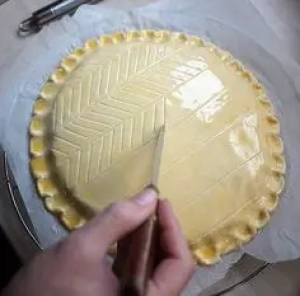
Often in the kitchen, in pastry-making, or in baking, we need to trace a pattern on a pastry. It's just a question of aesthetics but it has its effect after baking on a galette, pithiviers, pâté en croute (terrine in a pie crust), etc.
May 23th 201937 K4.1
The return of the "Norman hole"
You maybe know the "trou normand", this old gastronomic custom typically French which consists in taking a (small) glass of calvados, generally between the last course and the dessert? It's something that seems a bit anachronistic nowadays, having a glass of an alcohol of more than 60° in the...
December 18th 202116 K4.8
Tranché, dissociated, failed, in short... missed!
When preparing a sauce or a cream, there's always a (small) risk that the creamy preparation you're working on will suddenly separate into two parts of different textures: a liquid part, for example, and a more or less solid part, or even become lumpy. It's terribly frustrating, but we'll see...
June 19th 202314 K5
The so-called "nervous" meats
You've probably heard this before, we're talking about "nervous" meat, or meat with nerves, to describe what is indicated by the blue arrow on the left. This is a piece of beef, and what we call a nerve is not a nerve, it is in fact collagen (chemists sometimes call it a "collagen sink"), a...
April 16th 202138 K4.5
Sugar syrups
Sugar syrups
In cooking, and especially in pastry, we often use sugar syrups, a simple mixture of water and sugar in varying proportions. Here is a presentation of their differences. .
January 17th 202313 K4.8
Post a comment or question
Posted by:
I am not a leaving thing

Follow this page
If you are interested in this page, you can "follow" it, by entering your email address here. You will then receive a notification immediately each time the page is modified or a new comment is added. Please note that you will need to confirm this following.
I am not a leaving thing
Note: We'll never share your e-mail address with anyone else.
Alternatively: you can subscribe to the mailing list of cooling-ez.com , you will receive a e-mail for each new recipe published on the site.

Back to top of page