Oven height


Oven height
When we put a dish or cake in the oven, we naturally tend to put it on the middle shelf, and that's what we usually do.

But in some cases, this position and height can be a little tricky, so let's find out why.
4,474 5/5 (3 reviews)
Grade this page:
Keywords for this post:OvenBakingDosageHeightRackHearthLevels
Last modified on: October 8th 2025
For this post: Comment Follow Ask me a question Send to a friend
Oven height
four et niveaux

First of all, it's worth noting that kitchen ovens all have the same square shape, with the roof and grill at the top, and the hearth at the bottom.
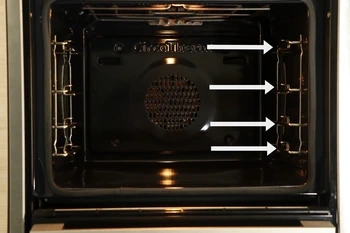
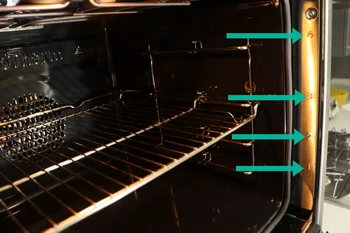
Between the two, there are a number of positions, or levels, usually 3 or 4, into which a grid can be inserted, allowing you to choose whether you want to bake in the middle, or towards the top or bottom.

level-numbering

These positions are often numbered, from 1 (lowest) to 4 (highest) on the side of the oven entrance.

bas dans le four

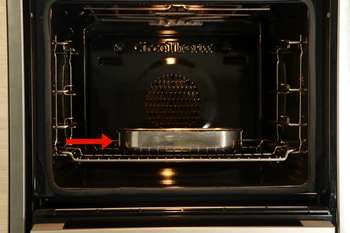
Bottom in oven (1)


This is the lowest position in the oven, bringing the underside of your dish closer to the heat coming from the oven hearth.
You want the heat to come from the underside of your dish, because it needs to cook more from below.
This is the case, for example, with tarts/dishes with puff pastry in the bottom, which need a lot of heat to cook properly.
You may also need to move the top of the dish away from the heat of the vault, to prevent it from coloring too much or even burning, and here too you position it low in the oven.

au milieu dans le four

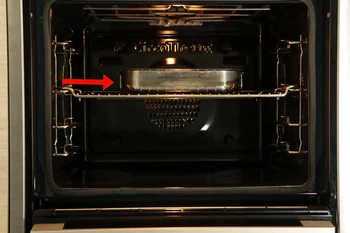
In the middle (3)


This is the standard baking position, where your dish or mold is placed at roughly equal distance from the hearth and vault, and baking is not accentuated either above or below.

haut dans le four

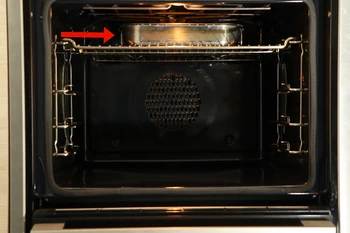
Top of the kiln (4)


This is the highest position in the oven, bringing the top of your dish closer to the heat coming from the oven's vault, or perhaps even the grill.
You do this when you want to get the best heat from the top of the dish, for au gratin for example.


You may have noticed that I didn't mention position 2, as it's an intermediary between 1 and 3 (of course), and allows you to dose things down a little and do "not so low".

Some remarkable points

If we had to sum it all up, we could say that :
  • It's always interesting to play around a little with where the heat is going to come from to cook your dish, simply by positioning it in your oven.
  • If you don't know where to position your dish, simply place it in the middle.
  • If you're baking puff pastry, a thick cake, or anything else that needs to be cooked well on the bottom, put it on the bottom.
  • If you need to brown a dish, put it in the top oven.
  • There's nothing to stop you changing levels as you cook, finishing by raising a dish to bring it closer to the grill, for example.

To sum up: It's always a good idea to control the cooking time in your oven, by putting a dish in the oven at a higher or lower setting, depending on the type of dish.
Lasts posts
XO Cognac Explained: Meaning, Aging, and Flavor Profile
XO Cognac always goes beyond the labels on the bottle: it is often associated with tradition and quality. You get to appreciate the artistry, character and ageing process when you understand what defines this smooth Cognac. The section below tackles everything about XO Cognac, from complex flavour...
January 28th 2026293 Sponsored article
Butter vs. grease
Butter vs. grease
We often read in a recipe where a pastry is put into a mould that, just before pouring, the mould should be buttered or greased. But what's the difference between these 2 terms?
December 1st 20252,3675
Getting out of the fridge early
Very often when you're cooking, you need to take food or preparations out of the fridge, to use them in the recipe in progress. There's nothing tricky about this: you just take them out of the fridge and use them, usually immediately, in the recipe. But is this really a good method?
November 24th 20251,5565
Who's making the croissants?
When you look at a bakery from the outside, you naturally think that in the bakery, the bakers make the bread, and in the laboratory, the pastry chefs make the cakes. It's very often like that, with each of these professions having quite different ways of working, but sometimes there's also one...
November 23th 20251,406
The importance of sieving
In recipes that use a fine powder (flour, powdered sugar, etc.), you'll often see the advice to sift before using it. To sift is to pass the powder in question through a sieve (a very fine strainer) before incorporating it into your recipe. It's often advice, but is it really useful?
September 3rd 20258,7443

Other pages you may also like
Parsley stems
Parsley stems
Parsley, whether curly or flat, is a delicious ingredient in many recipes, where it is used both raw and cooked. When used raw, in a salad for example, where it always provides, alone or with other herbs, a remarkable freshness, only the leaves are kept. And when used cooked?
July 28th 20257,072 13
Tranché, dissociated, failed, in short... missed!
When preparing a sauce or a cream, there's always a (small) risk that the creamy preparation you're working on will suddenly separate into two parts of different textures: a liquid part, for example, and a more or less solid part, or even become lumpy. It's terribly frustrating, but we'll see...
June 19th 202313 K5
Drawing a pattern in pastry
Often in the kitchen, in pastry-making, or in baking, we need to trace a pattern on a pastry. It's just a question of aesthetics but it has its effect after baking on a galette, pithiviers, pâté en croute (terrine in a pie crust), etc.
May 23th 201936 K4.1
The so-called "nervous" meats
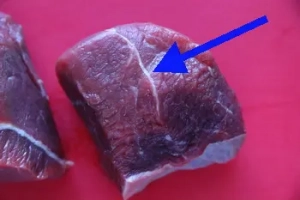
You've probably heard this before, we're talking about "nervous" meat, or meat with nerves, to describe what is indicated by the blue arrow on the left. This is a piece of beef, and what we call a nerve is not a nerve, it is in fact collagen (chemists sometimes call it a "collagen sink"), a...
April 16th 202137 K4.5
Your oven in "proofer" mode
In the bakery, proofing is a crucial stage in the process of making light, plump breads and pastries. During proofing, the yeast ferments the sugars present in the dough, releasing carbon dioxide which forms bubbles. This process allows the dough to swell and aerate, guaranteeing a soft, light...
September 27th 202411 K5
Post a comment or question
Posted by:
I am not a leaving thing

Follow this page
If you are interested in this page, you can "follow" it, by entering your email address here. You will then receive a notification immediately each time the page is modified or a new comment is added. Please note that you will need to confirm this following.
I am not a leaving thing
Note: We'll never share your e-mail address with anyone else.
Alternatively: you can subscribe to the mailing list of cooling-ez.com , you will receive a e-mail for each new recipe published on the site.

Back to top of page