The strange foam of potatoes in milk


The strange foam of potatoes in milk
As you may have already noticed, when you cook potatoes in milk, especially in small pieces (slices or cubes) for a gratin for example, a surprisingly abundant white foam forms on the surface.

Where does it come from?
2,854 5/5 (1 reviews)
Grade this page:
Keywords for this post:PotatoesMousseStarchMilkCookingFoam
Last modified on: April 26th 2026
For this postComments Lasts posts Follow
For this post: Comment Follow Ask me a question Send to a friend
sliced-potatoes
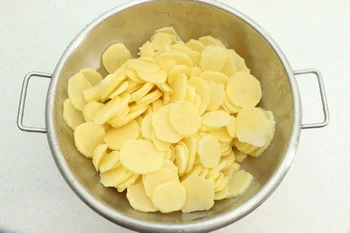
You have peeled, sliced and washed potatoes.
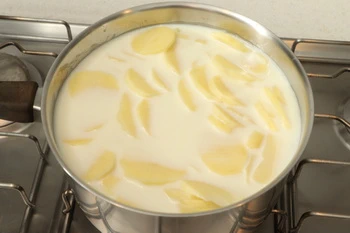
sliced potatoes in milk
You put them to cook in milk, at first everything is normal.
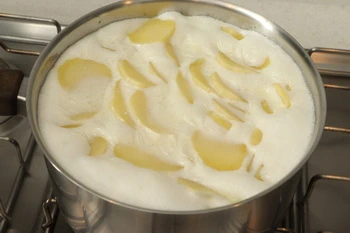
foam on potatoes
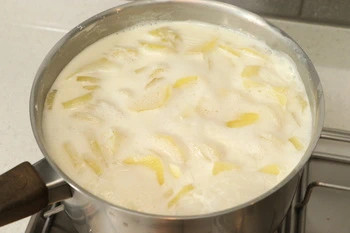
Then, when the milk starts to boil, a fairly abundant white foam forms on the surface, which can easily boil over if you don't do anything.
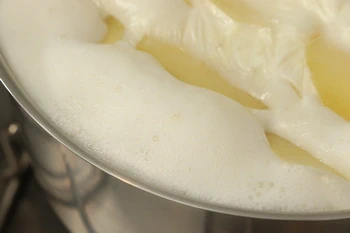
mousse sur les pommes de terre : gros plan
This white foam comes mainly from the starch that escapes from the potatoes during cooking.

This starch is released into the hot milk, gelatinizes and forms a sort of "cloud" or foam on the surface as steam bubbles rise to the surface.

As this happens in milk, the phenomenon is reinforced by its proteins and fats, which stabilize the bubbles, making the foam finer and more persistent.
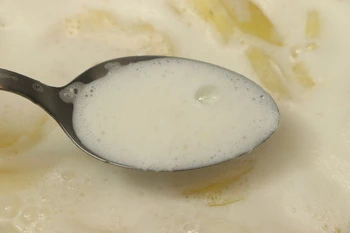
foam on potatoes: close-up
This foam is not dangerous, and has virtually no taste: it's essentially starch, with a little milk protein, and can be left or skimmed (with a skimmer or a simple tablespoon) to avoid spillage, which can happen very quickly.
return to normal potato cooking
Once most of the foam has been removed, the potatoes continue to cook normally.
.

Note that 2 things can increase the amount of foam:
  1. The variety and age of the potatoes: flourier varieties and older tubers yield more starch, and therefore more foam.
  2. the intensity of the boiling and the size of the pan: a high boil with little free surface produces more bubbles and therefore more surface foam.

To sum up: the foam produced when cooking potatoes in milk is simply a reaction between the starch in the potatoes and the milk. It's not at all a problem for the cooking process or your recipe, but you do need to be careful, or even skim it off, to avoid overflowing, which can happen very quickly.
Lasts posts
How to Properly Fill a Jar
When you have a jar in your kitchen that’s almost empty—flour or almond flour, for example—you’ll probably refill it before it’s completely empty. And that’s a great way to go about it—no one wants to run out of an ingredient right in the middle of a recipe. Once you’ve...
October 2nd 20264245
Serving Temperature for Wine
When it comes to serving wine, you may (like me) have a fairly simple rule of thumb: red wine at room temperature, and white, rosé, and yellow wines in the fridge until it’s time to serve them. It’s very easy to remember, but it’s a bit simplistic, and you’ll see that there’s a much...
September 23th 20268255
Hot Emulsified Sauces
In French cuisine, sauces are a very important part of a recipe—not just a side dish. In fact, they’re so important that, especially since the time of Auguste Escoffier, they’ve been classified into categories. And among these categories are “hot emulsified sauces,” or lukewarm ones. ...
September 9th 20261,2565
Hot Dishes and Cold Dishes
When plating or serving a dish—whether hot or cold—on a plate, it’s very important to make sure they’re both the right temperature; in other words: if the dish is hot, the plate should be hot, and conversely, if the dish is cold, the plate should be cold. Is this really important? Let’s...
September 2nd 20269833
In baking, cold is your friend
When you bake at home—especially when making pie crusts—you’ve probably noticed that it’s quite difficult to work with the dough when it’s hot. It gets soft, is hard to roll out, and breaks or crumples very easily. And this doesn’t just happen when it’s hot—even in a comfortable...
August 26th 20261,0165
Other articles you might also like
Parsley stems
Parsley, whether curly or flat, is a delicious ingredient in many recipes, where it is used both raw and cooked. When used raw, in a salad for example, where it always provides, alone or with other herbs, a remarkable freshness, only the leaves are kept. And when used cooked?
July 28th 202511 K 13
Kitchen ovens
You certainly have one in your kitchen, an oven, the essential tool for all kinds of cooking, whether in the kitchen of course, but also in pastry, bakery, pizza, and many others. Here is some information on its structure and operation.
May 16th 202036 K4.4
Who's making the croissants?
When you look at a bakery from the outside, you naturally think that in the bakery, the bakers make the bread, and in the laboratory, the pastry chefs make the cakes. It's very often like that, with each of these professions having quite different ways of working, but sometimes there's also one...
November 23th 20253,180
A tablet holder
Perhaps you too cook by consulting your recipe on a tablet or phone, and putting it down on your worktop? It's practical, but not the best solution. Here's a look at how you can make an inexpensive, almost universal stand.
March 14th 20263,5975
A little leftover butter
Very often when you're making a cake, your recipe will tell you to melt some butter and mix it into the batter - a classic for cookies, cakes, moelleux and the like. And every time you do this, you'll have to butter the baking tin to prevent the dough from sticking during baking. Naturally,...
April 16th 20263,0675
Post a comment or question
Posted by
I am not a leaving thing
Follow this page

Receive an e-mail as soon as this page is modified or receives a new comment.

I am not a leaving thing
We'll never share your e-mail address with anyone else.
Alternatively: you can subscribe to the mailing list of cooling-ez.com , you will receive a e-mail for each new recipe published on the site.

Back to top of page