Drawing a pattern in pastry


Drawing a pattern in pastry
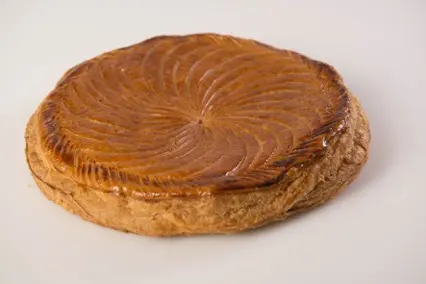
Often in the kitchen, in pastry-making, or in baking, we need to trace a pattern on a pastry.

It's just a question of aesthetics but it has its effect after baking on a galette, pithiviers, pâté en croute (terrine in a pie crust), etc.
34 K 4.1/5 (26 reviews)
Grade this page:
Keywords for this post:PastryPatternsDrawingAestheticTracingGildingKnife
Last modified on: May 23th 2019
For this post: Comment Follow Ask me a question Send to a friend
Drawing a pattern in pastry
It is not very complicated in principle, in general the dough is gilded with a brush and dorure, and then with the tip of a knife you trace the chosen pattern, before either putting it in the oven directly (puff pastry, shortcrust pastry or sweetcrust pastry (pâte sablée)), or putting it in a warm place (milk rolls or croissants, ...).

galette


It's simple in principle, but it deserves some precisions and 1 or 2 tricks, because it's easy to get it wrong.

How to do it?
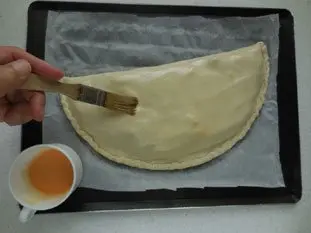
dorure


First of all, we agree, you have to "gild", that is to say to pass some gilding with a brush in a fine and regular layer on the top of the dough. This is important for the colouring when baking of course, but also because by doing this you will create a colour contrast between the dough, golden, and the incisions you will make afterwards, which will show the light, non golden dough. It is this contrast that will give a beautiful pattern when baking.

Then you have to draw the pattern, usually you use a small sharp knife, and that's the trick: you mustn't use the blade of the knife normally (as if you were cutting something), but upside down, that is to say you must use the back of the blade, the one that is thicker and does not cut. And that's because you don't want to split the dough, and in the process risk going through it, but just groove it with the thick side of the knife blade.
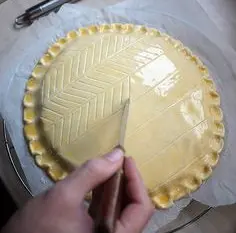
incrustation en pâtisserie


And if possible, don't hold the knife by the handle (as on this picture), because you have too much strength and you risk to crush the dough when you should be "airy", but rather hold it by the blade, between thumb and forefinger, handle up, almost like a pen.

Once you have learned this gesture, give free rein to your creativity in terms of decoration and draw the pattern of your choice: grid, spiral, flowers, grid,...

To sum up: To trace a pattern on a pastry before baking, the best way is to use the thick side of the blade of a small knife, holding it upside down, by the blade, pinched between the thumb and the index finger.

Lasts posts
Getting out of the fridge early
Very often when you're cooking, you need to take food or preparations out of the fridge, to use them in the recipe in progress. There's nothing tricky about this: you just take them out of the fridge and use them, usually immediately, in the recipe. But is this really a good method?
November 24th 20256985
Who's making the croissants?
When you look at a bakery from the outside, you naturally think that in the bakery, the bakers make the bread, and in the laboratory, the pastry chefs make the cakes. It's very often like that, with each of these professions having quite different ways of working, but sometimes there's also one...
November 23th 2025711
Oven height
Oven height
When we put a dish or cake in the oven, we naturally tend to put it on the middle shelf, and that's what we usually do. But in some cases, this position and height can be a little tricky, so let's find out why.
October 8th 20252,2325
The importance of sieving
In recipes that use a fine powder (flour, powdered sugar, etc.), you'll often see the advice to sift before using it. To sift is to pass the powder in question through a sieve (a very fine strainer) before incorporating it into your recipe. It's often advice, but is it really useful?
September 3rd 20257,2233
The grease spray
The grease spray
As soon as you have something in a recipe that sticks to the mold, the question always arises as to how difficult it is to remove from the mold. There's nothing more frustrating than breaking your cake when unmolding it, because part of it has stuck in the mold. The classic way to avoid this is...
August 26th 20256,7525

Other pages you may also like
The so-called "nervous" meats
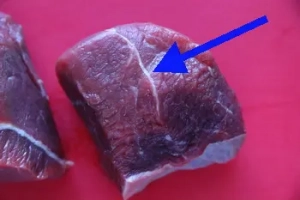
You've probably heard this before, we're talking about "nervous" meat, or meat with nerves, to describe what is indicated by the blue arrow on the left. This is a piece of beef, and what we call a nerve is not a nerve, it is in fact collagen (chemists sometimes call it a "collagen sink"), a...
April 16th 202136 K4.5
Candied fruits: don't get ripped off
Do you like candied fruit? You might like to nibble a handful or add it to a recipe, like a classic fruit cake or delicious Italian specialities like panettone or sicilian epiphany pie.
June 21th 201767 K 24.2
A few tips for effective kneading at home
When you have to knead dough for bread or some other recipe, you may well use a food processor or the type of machine known as a stand mixer. The best-known brands are Kenwood and KitchenAid. They are useful tools, but here are a few tips to help you get the best out of them.
June 23th 2021283 K 23.8
What is the difference between bakery and patisserie?
This is a question that you may well have asked yourself and which I will attempt to answer. In France the two trades of "boulangerie" (bakery) and "pâtisserie" (patisserie and confectionery) have always been quite distinct, but where exactly do the boundaries lie? .
February 7th 2017134 K 14.1
Egg yolks and caster sugar
We often come across recipes where we need to mix egg yolks with caster sugar. This would appear to be a very ordinary and simple thing to do but, be warned, these two ingredients can behave oddly together.
February 15th 201882 K 24.3
Post a comment or question
Posted by:
I am not a leaving thing

Follow this page
If you are interested in this page, you can "follow" it, by entering your email address here. You will then receive a notification immediately each time the page is modified or a new comment is added. Please note that you will need to confirm this following.
I am not a leaving thing
Note: We'll never share your e-mail address with anyone else.
Alternatively: you can subscribe to the mailing list of cooling-ez.com , you will receive a e-mail for each new recipe published on the site.

Back to top of page