Should I believe my oven?


Should I believe my oven?
Can you really trust your oven? This is an important question as we are always tempted to take the temperature indicated as gospel truth and, unfortunately, this is rarely very precise.
32 K 4.6/5 (20 reviews)
Grade this page:
Keywords for this post:OvenCookingTemperatureChecking
Last modified on: July 4th 2011
For this post: Comment Follow Ask me a question Send to a friend
Should I believe my oven?
When I set my oven to 200°C, is it really at that temperature? The actual temperature can be measured easily if you have an accurate thermometer.

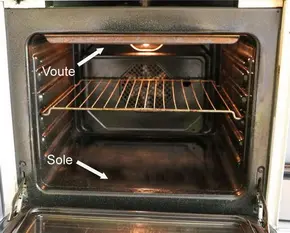
To check my own oven (a “De Dietrich” model UMP501), I placed the probe of the thermometer in the oven, closed the door, set it to 200°C and noted the temperature at 30 second intervals over 20 minutes.

Ideally, of course, the oven should heat up rapidly to exactly 200°C, then stay at this temperature until I open the door to put the food in, or until I turn it off. Unfortunately, the reality is dramatically different. Here is the temperature curve recorded:
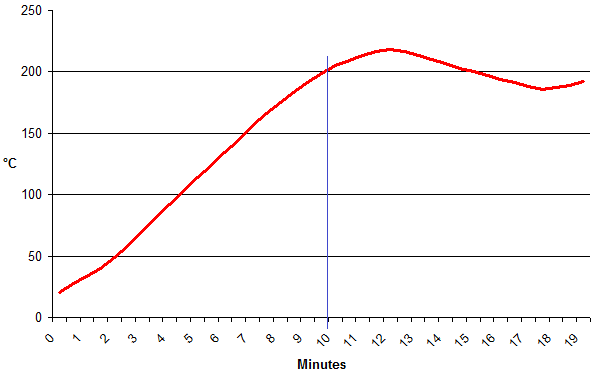
oven temperature


From this graph we can note that:

1) The oven takes 10 minutes to reach 200°. So far, so good.
2) It beeps to tell me that it has reached 200° when, in fact, it is only at 191°, which is not so good.
3) Although it is supposed to stop heating at 200°C, it goes up to 217° before coming back down to 186°, and from then on it varies 10 or 20° around the set temperature, which is far from ideal.

These variations are significant but, fortunately, not the end of the world for most recipes. A little hotter or cooler doesn't make that much difference, and can be compensated by a slightly shorter or longer cooking time.

But take care, even so, with recipes that require a precise temperature, such as macarons or foie gras. For these, it is a good idea to measure the oven temperature when it indicates that it is at the right temperature, then adapt the recipe accordingly.

This is somewhat disappointing, as my oven was quite expensive at the time, and the salesman promised me an oven that had “precise temperature control” . But then, when it comes to selling, they always promise the moon.

So, in the end, in answer to the question “Should I trust my oven?” the reply is definitely: no, you should not trust your oven. Instead, you should measure and calibrate it beforehand to know how it really performs.

And then, we're talking here about an electric oven. Just imagine what's involved with a gas oven…

Lasts posts
Who's making the croissants?
When you look at a bakery from the outside, you naturally think that in the bakery, the bakers make the bread, and in the laboratory, the pastry chefs make the cakes. It's very often like that, with each of these professions having quite different ways of working, but sometimes there's also one...
November 23th 2025631
Oven height
Oven height
When we put a dish or cake in the oven, we naturally tend to put it on the middle shelf, and that's what we usually do. But in some cases, this position and height can be a little tricky, so let's find out why.
October 8th 20252,1375
The importance of sieving
In recipes that use a fine powder (flour, powdered sugar, etc.), you'll often see the advice to sift before using it. To sift is to pass the powder in question through a sieve (a very fine strainer) before incorporating it into your recipe. It's often advice, but is it really useful?
September 3rd 20257,1793
The grease spray
The grease spray
As soon as you have something in a recipe that sticks to the mold, the question always arises as to how difficult it is to remove from the mold. There's nothing more frustrating than breaking your cake when unmolding it, because part of it has stuck in the mold. The classic way to avoid this is...
August 26th 20256,6975
Cake moulds
Cake moulds
When we make a cake, or a cake of the same rectangular shape, we usually take out our usual mould and tell ourselves that the recipe is anyway "for a cake", but is it really that simple?
August 25th 20256,7315

Other pages you may also like
Fruits which can ruin your jelly
There are many ways of making a fruit mousse, but one of the simplest is to prepare a fruit jelly (basically a fresh fruit coulis with gelatine) and then mix this jelly before it sets completely with whipped cream. The result is perfect for filling a charlotte, for example. But do beware;...
March 6th 201378 K4.0
The window-pane test in bread-making
The home bread-makers often ask themselves “Have I kneaded my dough long enough?” . A good question, as dough that is insufficiently kneaded will not rise properly or will fall flat when the top is slashed, which is very frustrating. To know when the dough is ready, one can rely on the length...
June 16th 202196 K 23.9
What is the difference between bakery and patisserie?
This is a question that you may well have asked yourself and which I will attempt to answer. In France the two trades of "boulangerie" (bakery) and "pâtisserie" (patisserie and confectionery) have always been quite distinct, but where exactly do the boundaries lie? .
February 7th 2017134 K 14.1
A few tips for effective kneading at home
When you have to knead dough for bread or some other recipe, you may well use a food processor or the type of machine known as a stand mixer. The best-known brands are Kenwood and KitchenAid. They are useful tools, but here are a few tips to help you get the best out of them.
June 23th 2021283 K 23.8
The beautiful story of the croissants
As you may have already noticed, cooking, baking and pastry-making are full of stories or legends, usually very romantic, about this or that product or recipe. This is often the case for named recipes, for example tarte tatin, peach melba, paris-brest and many others, but it also applies to very...
October 10th 201819 K5
Post a comment or question
Posted by:
I am not a leaving thing

Follow this page
If you are interested in this page, you can "follow" it, by entering your email address here. You will then receive a notification immediately each time the page is modified or a new comment is added. Please note that you will need to confirm this following.
I am not a leaving thing
Note: We'll never share your e-mail address with anyone else.
Alternatively: you can subscribe to the mailing list of cooling-ez.com , you will receive a e-mail for each new recipe published on the site.

Back to top of page